Map of France showing where the Mella arms are recorded
The Mella arms were recorded in Picardie, c. 1663.
Picardie lay on the northern road into France and saw armies pass through it repeatedly. Its landowners were soldiers as often as farmers, and a soldier needed a shield he could be recognised by.
This is where the arms were entered in the register. Families often moved to other parts of the country, so the same name can turn up in more than one region.
The body that granted and recorded arms in France in this period.
Louis XIV of France
Sovereign of the period
Louis XIV of France
1643–1715
Reigning in France when the Mella arms are first recorded.
How Arms Worked in France
In France, a coat of arms was a mark of honor that passed down through the male line to all legitimate descendants. Families often used the same shield without changes to show their shared heritage. If a branch wanted to stand out, they could add a small mark to their shield to show their specific place in the family tree.
Granting authority
The Juge d'armes de France acted as the official authority that regulated and verified coats of arms across the country.
How they got arms
Families typically inherited their arms from ancestors, though they could also receive them through royal grants or by proving their noble status.
Where arms were recorded
Coats of arms were officially recorded in the Armorial Général de France, which began its main collection in the year 1696.
The family's standing
Recorded among the armigerous families of Picardie.
Origin & History of the Mella Family in France
The history of the Mella family in France is deeply rooted in the northern region of Picardie, where records confirm their presence as early as 1663. During the seventeenth century, this area was a vital landscape of agricultural development and local trade, placing the family within a society defined by rural craftsmanship and parish life. Families in Picardie at this time were often closely tied to the land and the local church, which served as the primary center for recording births, marriages, and deaths. As the Mella name became established in this region, the family likely participated in the traditional economic activities of the time, such as farming or textile production, which were the backbones of the Picardie economy. By maintaining a consistent presence in the local community, the early members of the Mella family helped shape the social fabric of their village, leaving behind a legacy that reflects the resilience and stability of families living in northern France during the reign of King Louis XIV.
Meaning of the Mella family crest colors & symbols
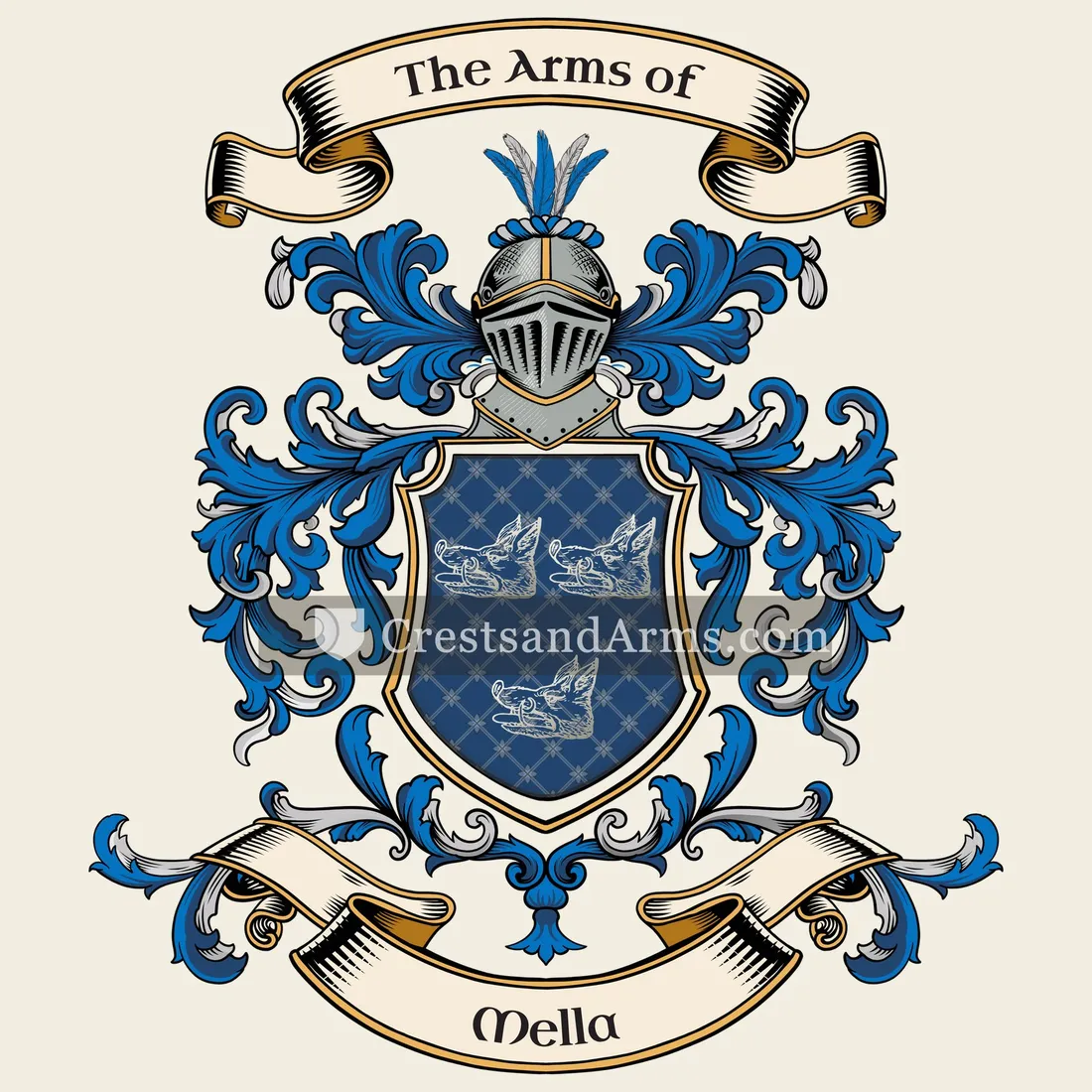
Symbols on this shield
boars headA fierce fighter who battles to the end
Colours
Blue (Azure)Means: Loyalty and truth
Silver (Argent)Means: Peace and sincerity
Historical info
Source
Sir Bernard Burke, The General Armory of England, Scotland, Ireland and Wales, London: Harrison & Sons, 1884
Blazon (the actual original written record)
“Az. three boars' heads erased in bend ar”
Englandc. 1620
Digital archive packCoat of arms PNG, gold border print PDF, vector SVG and the certificate of authenticity. Sent to your email in minutes.
Map of England showing where the Mella arms are recorded
The Mella arms were recorded in England, c. 1620.
Arms such as these were typically recorded in York.
Yorkshire is the largest of the English counties, and it held more gentry families than any other. Land there was split among a great many households rather than a few, so a great many of them carried arms.
This is where the arms were entered in the register. Families often moved to other parts of the country, so the same name can turn up in more than one region.
The body that granted and recorded arms in England in this period.
James VI and I
Sovereign of the period
James VI and I
1603–1625
Reigning in France when the Mella arms are first recorded.
How Arms Worked in England
English heraldry allowed arms to be shared by all legitimate descendants of the original owner. These symbols were treated as personal property that moved through the generations to all children. While the eldest son kept the original design, other family members could use the same shield without needing to change it or register their own unique versions.
Granting authority
The College of Arms in London has regulated the use of coats of arms throughout England and Wales since 1484.
How they got arms
Families typically obtained their coats of arms through a formal grant from the Crown or by proving their ancient right to them.
Where arms were recorded
All official coats of arms are recorded in the registers kept at the College of Arms, which date back to the fifteenth century.
The family's standing
Recorded among the armigerous families of England.
Origin & History of the Mella Family in England
The history of the Mella name in England finds a firm anchor in the city of York during the early seventeenth century. By 1620, records confirm that individuals bearing this surname were established members of the local community, living within a region defined by its deep medieval roots and its significance as a northern hub for trade and administration. During this period, families like the Mellas often lived in close-knit urban parishes where their daily lives were shaped by the local church and the evolving economic landscape of the city. While the name may have roots that stretch across broader European borders, its presence in York suggests that these early family members were integrated into the social fabric of northern England during a time of significant transition. Their documented residence in 1620 provides a clear starting point for understanding how the family contributed to the local history of the region long before the modern era.
Mella Meaning & Related Branches
Root word
Mel
Derived from the Latin word for honey.
This name
MellaA topographic name for someone living near a honey-producing area or a sweet-natured person.
also spelled
Melo
Mellow
Mellou
Documented Sources
J. B. Rietstap, Armorial Général, Gouda: G. B. van Goor Zonen, 1884–87
Archives départementales de la Somme, Registres paroissiaux et d'état civil
Boulanger, Jean-François, Histoire de la Picardie, 2005
Goubert, Pierre, Beauvais et le Beauvaisis de 1600 à 1730, 1960
Digital archive packCoat of arms PNG, gold border print PDF, vector SVG and the certificate of authenticity. Sent to your email in minutes.


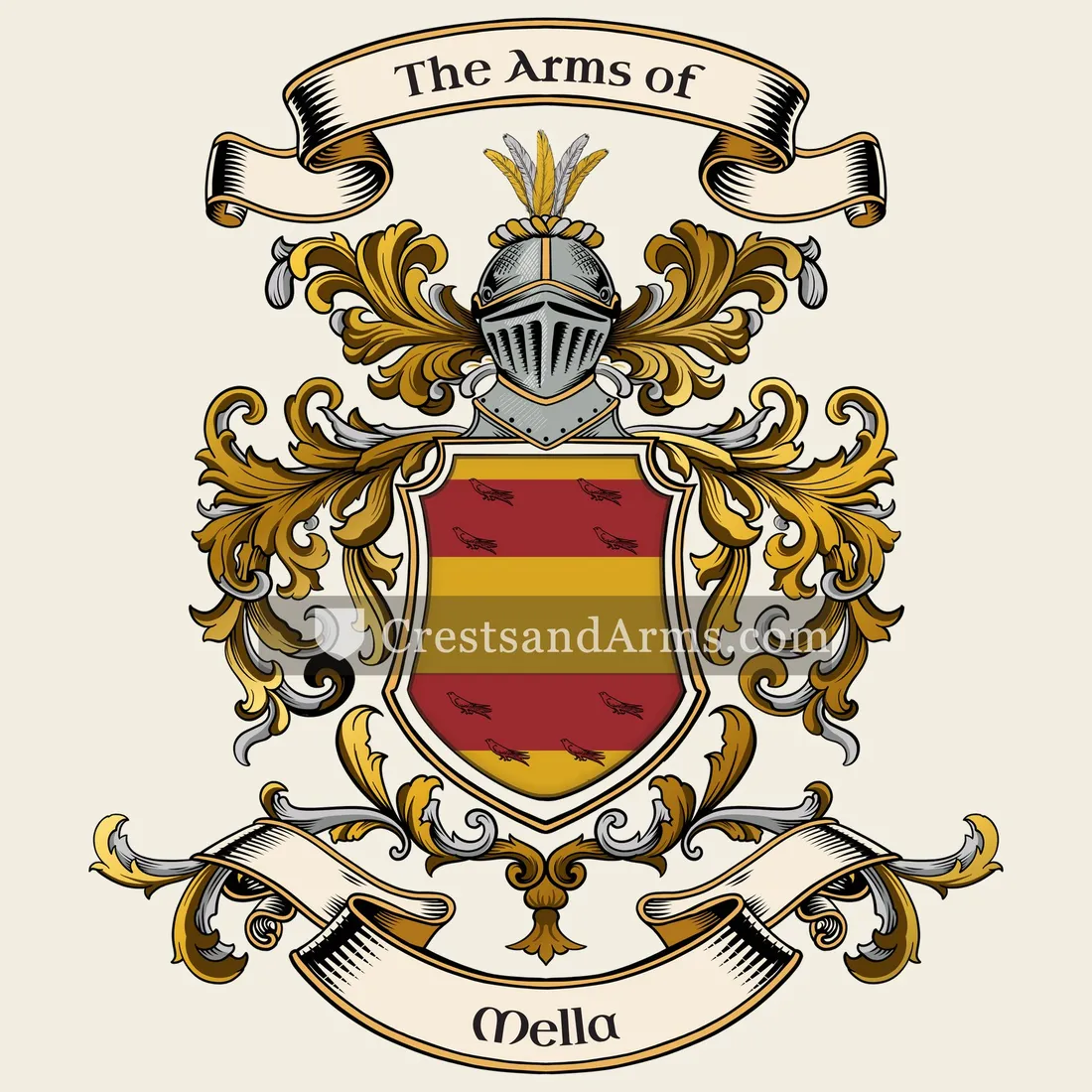
 fessThe military belt, and readiness to serve
 martletA younger son, who must win his own land
 fessThe military belt, and readiness to serve
 martletA younger son, who must win his own land


 boars headA fierce fighter who battles to the end