Map of Spain showing where the Mercer arms are recorded
The Mercer arms were recorded in Aragon, c. 1722.
Aragon was mountain and river country in north-eastern Spain, with a strong tradition of small independent landholders. A great many families counted as gentry there, and each one needed a shield to be told apart.
This is where the arms were entered in the register. Families often moved to other parts of the country, so the same name can turn up in more than one region.
The body that granted and recorded arms in Spain in this period.
Philip V of Spain
Sovereign of the period
Philip V of Spain
1714–1724
Reigning in Spain when the Mercer arms are first recorded.
How Arms Worked in Spain
In Spain, a coat of arms was considered a form of property that belonged to the entire family line. These arms were passed down from a father to all his children equally. Younger branches of the family usually kept the original design without needing to add any special marks to distinguish their specific line.
Granting authority
The Cronista Rey de Armas was the official body that regulated and granted coats of arms throughout Spain.
How they got arms
Families often obtained their arms through royal grants or by proving their noble status to the official heraldic authority.
Where arms were recorded
Coats of arms were officially recorded in the registers of the Cronista Rey de Armas starting in 1496.
The family's standing
Recorded among the armigerous families of Aragon.
Origin & History of the Mercer Family in Spain
The history of the Mercer family in Spain is deeply tied to the social and economic structure of the Kingdom of Aragon during the early eighteenth century. By 1722, records indicate that members of the family were already established within this region, likely serving in roles related to trade, administration, or land management. The name itself derives from the Latin word *mercator*, which refers to a merchant or a trader. This suggests that the earliest ancestors of the family were likely part of the growing professional class that facilitated commerce across the Mediterranean. As the family settled into the local Aragonese society, they integrated into the daily life of the community, contributing to the regional economy and maintaining a presence in the local census and parish registers. Their transition into Spanish life reflects the broader movement of families across Europe who sought new opportunities in trade and civil service during this period.
Coat of Arms & Family Crest Details
Symbols on this shield
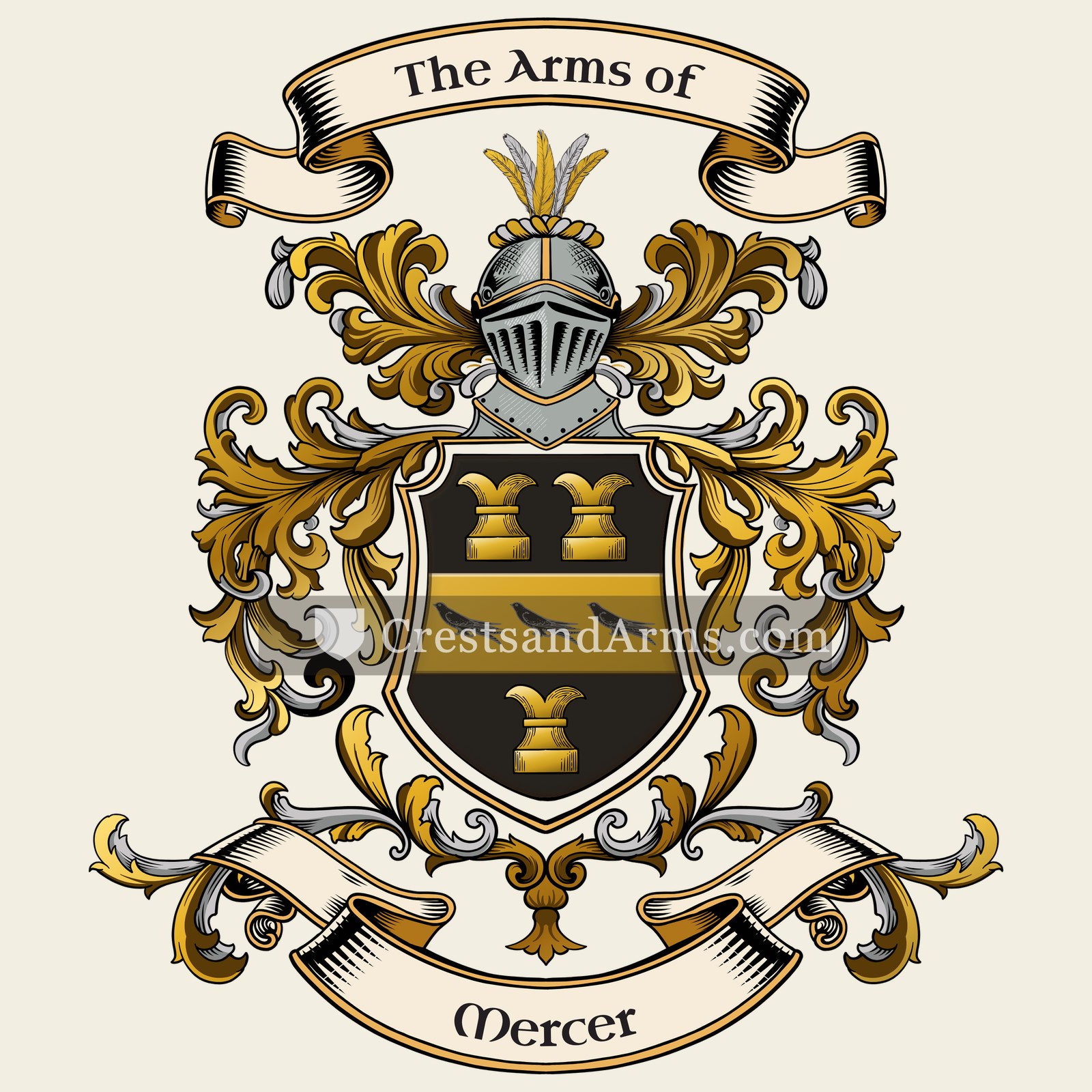
fessThe military belt, and readiness to serve
chess rookStrategy, and the defence of a position
martletA younger son, who must win his own land
Colours
Black (Sable)Means: Constancy
Gold (Or)Means: Generosity
Historical info
Source
Sir Bernard Burke, The General Armory of England, Scotland, Ireland and Wales, London: Harrison & Sons, 1884
Blazon (the actual original written record)
“Sa. on a fesse betw. three chessrooks or, as many martlets of the first”
BerksFifield · Berks, c. 1620
Digital archive packCoat of arms PNG, gold border print PDF, vector SVG and the certificate of authenticity. Sent to your email in minutes.
Map of England showing where the Mercer arms are recorded
The Mercer arms were recorded in Berks, c. 1620.
Berkshire sat on the road west from London with the royal castle at Windsor in the middle of it. Court families bought estates within reach, and an estate near the court almost always came with a coat of arms.
This is where the arms were entered in the register. Families often moved to other parts of the country, so the same name can turn up in more than one region.
The body that granted and recorded arms in England in this period.
James VI and I
Sovereign of the period
James VI and I
1603–1625
Reigning in Spain when the Mercer arms are first recorded.
How Arms Worked in England
English heraldry allowed arms to be shared by all legitimate descendants of the original owner. These symbols were treated as personal property that moved through the generations to all children. While the eldest son kept the original design, other family members could use the same shield without needing to change it or register their own unique versions.
Granting authority
The College of Arms in London has regulated the use of coats of arms throughout England and Wales since 1484.
How they got arms
Families typically obtained their coats of arms through a formal grant from the Crown or by proving their ancient right to them.
Where arms were recorded
All official coats of arms are recorded in the registers kept at the College of Arms, which date back to the fifteenth century.
The family's standing
Recorded among the armigerous families of Berks.
Origin & History of the Mercer Family in England
The surname Mercer originated as an occupational name derived from the Old French word *mercier*, which referred to a merchant or a dealer in textiles. In medieval England, this title was commonly given to individuals who traded in fine fabrics like silk and linen, often serving as prominent members of the merchant guilds in growing urban centers. By the early 17th century, the family had established a notable presence in the county of Berkshire. Records from 1620 confirm that members of the Mercer family were living in this region, where they likely participated in the local agricultural or trade-based economy that defined rural English life during the Stuart period. As the family settled into these communities, the name became a permanent fixture of the local landscape, reflecting a long history of trade and social integration within the English countryside.
Coat of Arms & Family Crest Details
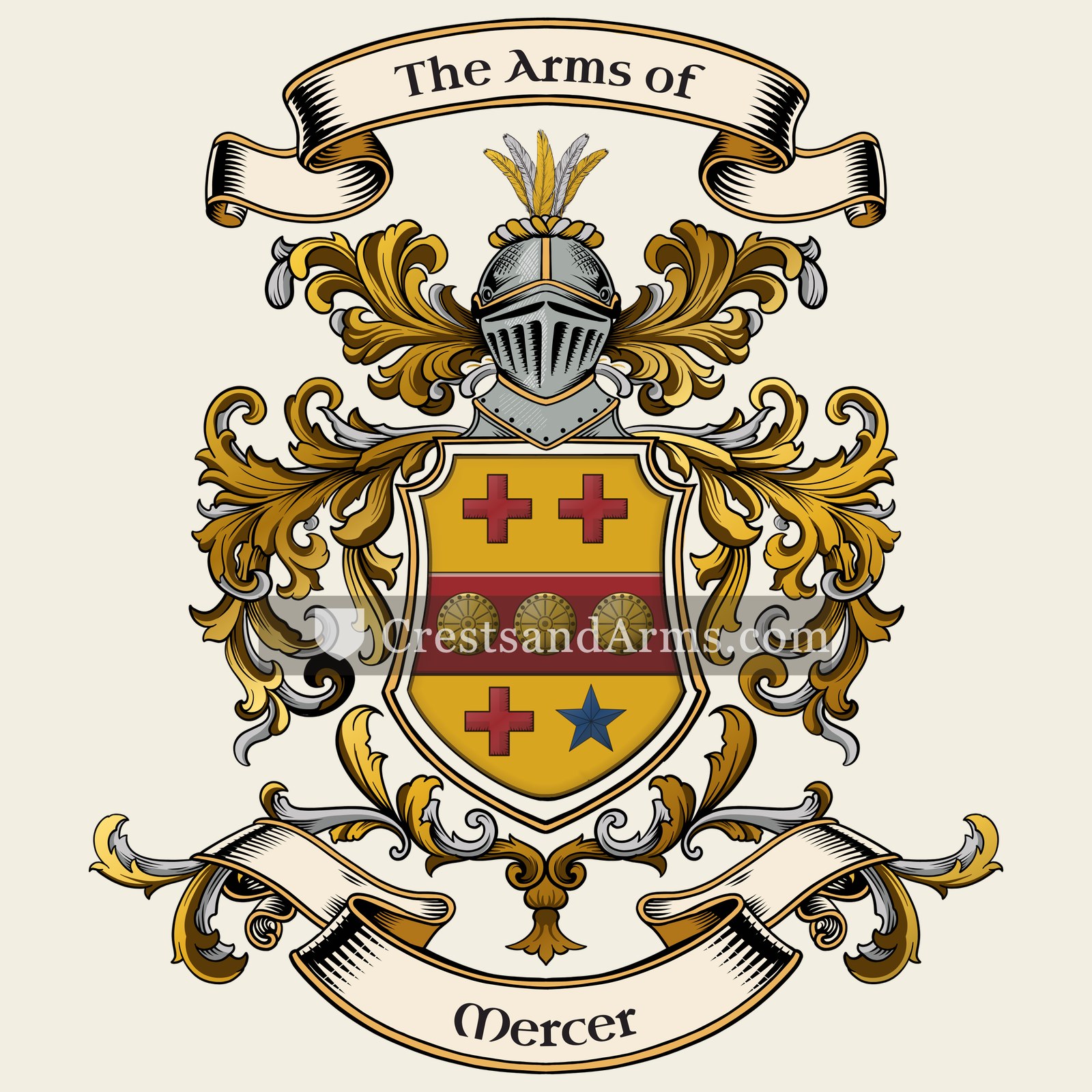
Symbols on this shield
fessThe military belt, and readiness to serve
cross symbolChristian faith and service
mulletThe third son, and a divine quality from above
roundelA coin, and one who has been to the crusades
Colours
Gold (Or)Means: Generosity
Red (Gules)Means: Military strength
Blue (Azure)Means: Loyalty and truth
Historical info
Source
Sir Bernard Burke, The General Armory of England, Scotland, Ireland and Wales, London: Harrison & Sons, 1884
Blazon (the actual original written record)
“Or, on a fess betw. three crosses pattée gu. in chief and a mullet az. in base as many bezants”
KinrossAldie · Kinross, c. 1748
Digital archive packCoat of arms PNG, gold border print PDF, vector SVG and the certificate of authenticity. Sent to your email in minutes.
Map of Scotland showing where the Mercer arms are recorded
The Mercer arms were recorded in Kinross, c. 1748.
Kinross was the second smallest Scottish county, farming country around a loch. Its few landed families held their ground for centuries, and long holding is what fills a register.
This is where the arms were entered in the register. Families often moved to other parts of the country, so the same name can turn up in more than one region.
The body that granted and recorded arms in Scotland in this period.
George II of Great Britain
Sovereign of the period
George II of Great Britain
1727–1760
Reigning in Spain when the Mercer arms are first recorded.
How Arms Worked in Scotland
Scottish heraldry is unique because it treats a coat of arms as a piece of personal property protected by law. Only one person can own a specific design at any given time. When a family grows, the head keeps the original shield while other relatives must apply for their own distinct version with slight changes to prove their specific identity.
Granting authority
The Court of the Lord Lyon acts as the official body that regulates and controls all heraldic matters throughout Scotland.
How they got arms
Individuals obtain a legal right to their arms through a formal petition process that confirms their identity and family connection.
Where arms were recorded
All valid coats of arms are officially entered into the Public Register of All Arms and Bearings starting from 1672.
The family's standing
Recorded among the armigerous families of Kinross.
Origin & History of the Mercer Family in Scotland
The surname Mercer is an occupational name that originated from the Old French word *mercier*, meaning a merchant or a dealer in textiles. While the name has roots across the British Isles, the family established a notable presence in Scotland by the Middle Ages, particularly within the regions of Perthshire and Kinross. By the mid-18th century, records confirm that members of the Mercer family were well-integrated into the local community of Kinross. These early ancestors likely played an active role in the local economy, as the name itself suggests a historical connection to trade and commerce. Over the generations, the family became deeply rooted in the social fabric of the area, contributing to the agricultural and civic life of the Scottish Lowlands. Their long-standing presence in Kinross by 1748 reflects a history of stability and steady integration into the evolving landscape of rural Scotland.
Mercer Meaning & Related Branches
Root word
merx
Latin term referring to merchandise or goods for trade.
This name
MercerAn occupational surname for a merchant or a trader of goods.
also spelled
Mercere
Mercerer
Mercier
Merser
Related arms
Merciervariant spelling
Merservariant spelling
Beauchamprecorded with Mercer, same area
Isaacksonrecorded with Mercer, same area
Documented Sources
J. B. Rietstap, Armorial Général, Gouda: G. B. van Goor Zonen, 1884–87
Archivo de la Corona de Aragón, Registro General del Sello
Archivo Histórico Provincial de Zaragoza, Protocolos Notariales
Ladero Quesada, Miguel Ángel, La España de los Reyes Católicos, 2005
Digital archive packCoat of arms PNG, gold border print PDF, vector SVG and the certificate of authenticity. Sent to your email in minutes.


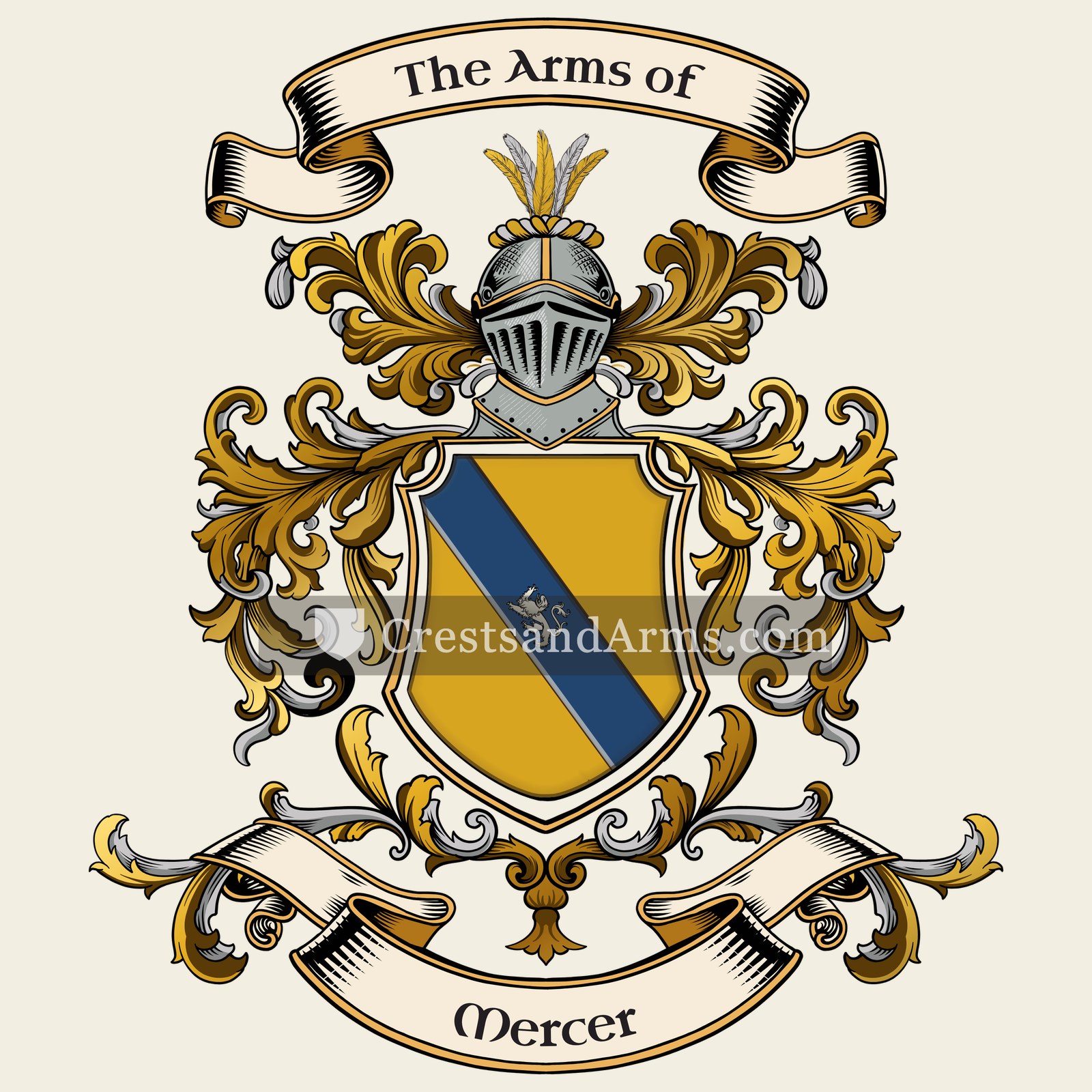
 bendDefence, and the scarf of a commander
 lionCourage, strength and royalty
 bendDefence, and the scarf of a commander
 lionCourage, strength and royalty


 fessThe military belt, and readiness to serve
 chess rookStrategy, and the defence of a position
 martletA younger son, who must win his own land


 cross symbolChristian faith and service
 mulletThe third son, and a divine quality from above
 roundelA coin, and one who has been to the crusades