Map of France showing where the Mercier arms are recorded
The Mercier arms were recorded in Franche-Comte, c. 1497.
Franche-Comte sat between France and the Empire and changed hands more than once. Border families held their land under arms and expected to defend it, so a shield was a practical thing rather than an ornament.
This is where the arms were entered in the register. Families often moved to other parts of the country, so the same name can turn up in more than one region.
The body that granted and recorded arms in France in this period.
Charles VIII of France
Sovereign of the period
Charles VIII of France
1483–1498
Reigning in France when the Mercier arms are first recorded.
How Arms Worked in France
In France, a coat of arms was a mark of honor that passed down through the male line to all legitimate descendants. Families often used the same shield without changes to show their shared heritage. If a branch wanted to stand out, they could add a small mark to their shield to show their specific place in the family tree.
Granting authority
The Juge d'armes de France acted as the official authority that regulated and verified coats of arms across the country.
How they got arms
Families typically inherited their arms from ancestors, though they could also receive them through royal grants or by proving their noble status.
Where arms were recorded
Coats of arms were officially recorded in the Armorial Général de France, which began its main collection in the year 1696.
The family's standing
Recorded among the armigerous families of Franche-Comte.
Origin & History of the Mercier Family in France
The surname Mercier is a classic example of an occupational name that emerged during the Middle Ages in France. It comes from the Old French word *mercier*, which referred to a merchant or a dealer in textiles and small wares. Because trade was essential to the growth of medieval towns, families who held this name were often found in bustling market centers across the country. By the late 15th century, the family had established a notable presence in the region of Franche-Comté. Records from 1497 confirm that members of the Mercier line were active in this area, which was then a strategic territory located between the French kingdom and the Holy Roman Empire. These early ancestors likely played a vital role in the regional economy by managing the flow of goods and supplies through the mountainous landscape. Over time, the name spread from these local trade hubs to become one of the most common and recognizable surnames throughout all of France.
Coat of Arms & Family Crest Details
Symbols on this shield
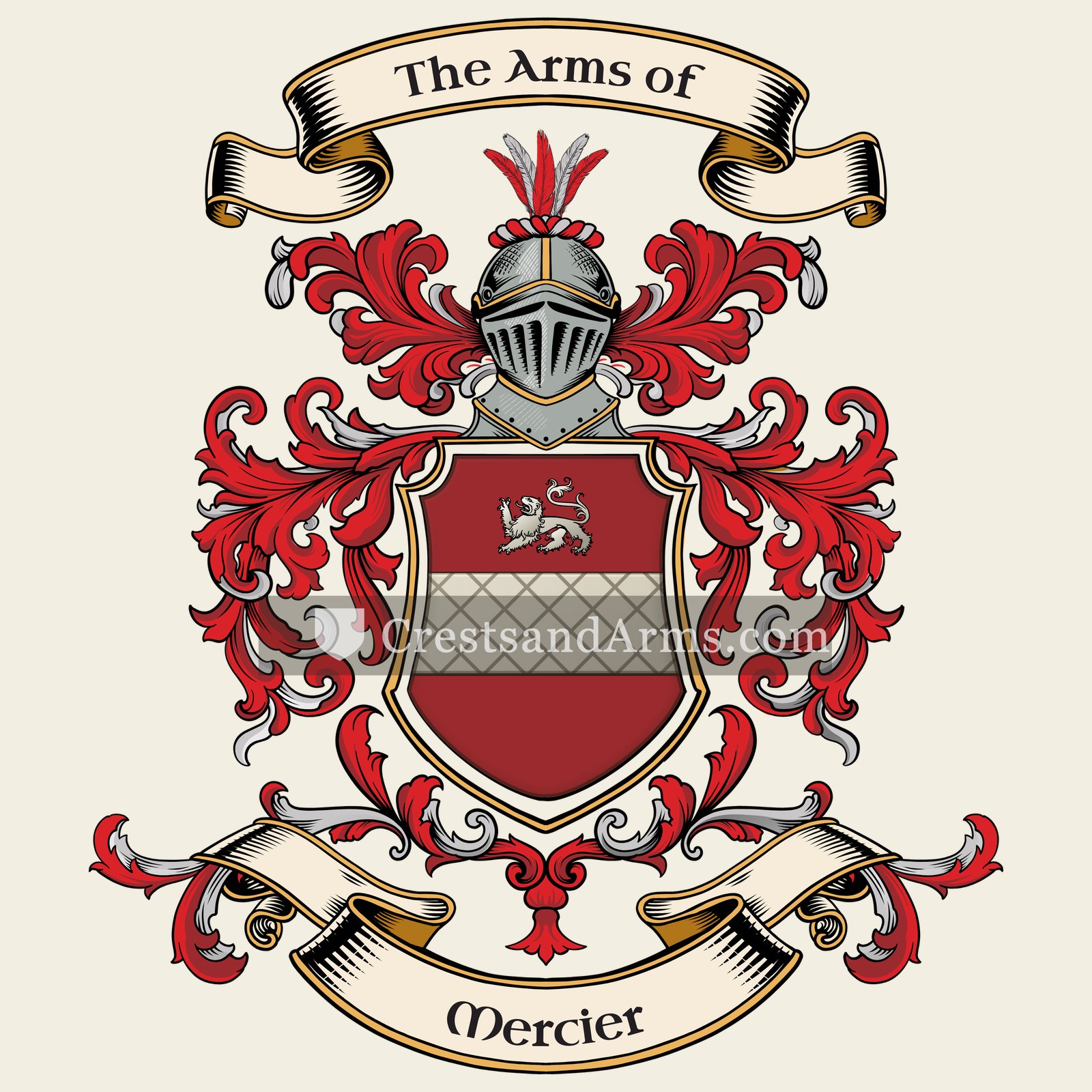
fessThe military belt, and readiness to serve
lionCourage, strength and royalty
Colours
Red (Gules)Means: Military strength
Silver (Argent)Means: Peace and sincerity
Historical info
Source
J. B. Rietstap, Armorial Général, Gouda: G. B. van Goor Zonen, 1884–87
Blazon (the actual original written record)
“De gu. au lion d'arg.; à la fasce du même, br. sur le tout.”
SwitzerlandGenève, c. 1745
Digital archive packCoat of arms PNG, gold border print PDF, vector SVG and the certificate of authenticity. Sent to your email in minutes.
Map of Switzerland showing where the Mercier arms are recorded
The Mercier arms were recorded in Genève, c. 1745.
This is where the arms were entered in the register. Families often moved to other parts of the country, so the same name can turn up in more than one region.
The body that granted and recorded arms in Switzerland in this period.
How Arms Worked in Switzerland
In Switzerland, coats of arms were not restricted to the nobility and were often adopted by common citizens and families. These symbols were passed down through generations to show family identity. When branches of a family grew, they often changed small details of the design to distinguish their own line from the original group.
Granting authority
Cantonal and civic authorities managed the use of coats of arms within their specific regions and local jurisdictions.
How they got arms
Families typically assumed their own coats of arms based on local custom rather than receiving them from a central monarch.
Where arms were recorded
Arms were recorded in various cantonal and civic registers starting from the fourteenth century throughout the Swiss region.
The family's standing
Recorded among the armigerous families of Switzerland.
Origin & History of the Mercier Family in Switzerland
The surname Mercier originates from the French word for a merchant or a dealer in textiles, reflecting the professional roots of the family during the Middle Ages. By the time the name became firmly established in Geneva in 1745, it was already associated with families who played active roles in the city's growing commercial and civic life. During the eighteenth century, Geneva was a major hub for international trade and banking, and individuals bearing this name were often integrated into the city's influential merchant class. These early family members were part of a society that valued education, craftsmanship, and trade connections across the borders of France and Switzerland. As residents of Geneva, they lived in a city defined by its unique status as a center for intellectual exchange and economic prosperity. Their presence in the city records from this period highlights their transition from local tradespeople into established citizens who contributed to the stability and development of the region.
Coat of Arms & Family Crest Details
Symbols on this shield
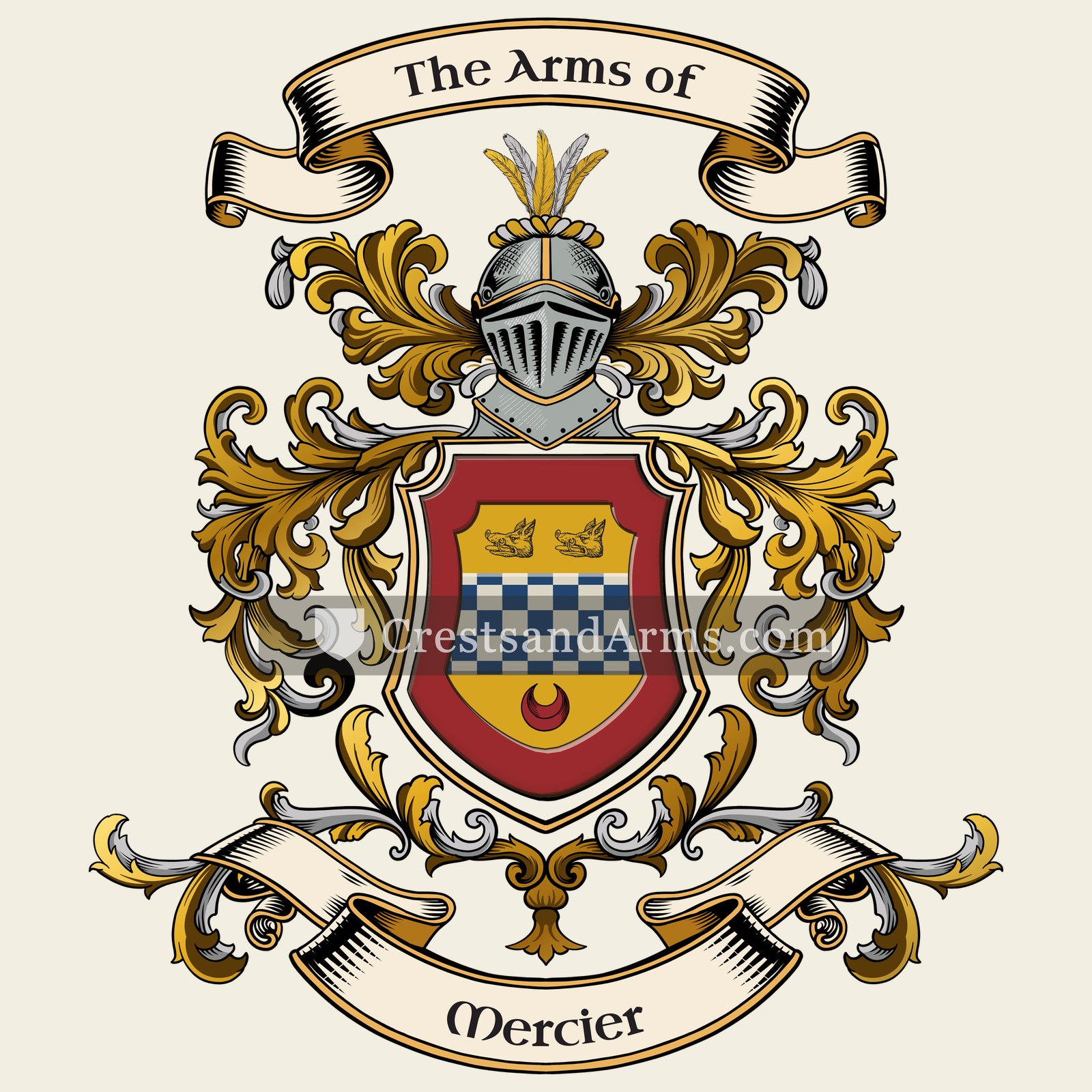
fessThe military belt, and readiness to serve
chequyConstancy, and the counting-board
bordureA difference between branches of one family
boars headA fierce fighter who battles to the end
crescentHonour by the sovereign, and the second son
Colours
Gold (Or)Means: Generosity
Silver (Argent)Means: Peace and sincerity
Red (Gules)Means: Military strength
Black (Sable)Means: Constancy
Historical info
Source
Sir Bernard Burke, The General Armory of England, Scotland, Ireland and Wales, London: Harrison & Sons, 1884
Blazon (the actual original written record)
“Or, a fesse chequy az. and ar. betw. two boars' heads in chief sa. and a crescent in base gu. a bordure engr. of the last”
NorthumberlandNorthumberland, c. 1620
Digital archive packCoat of arms PNG, gold border print PDF, vector SVG and the certificate of authenticity. Sent to your email in minutes.
Map of England showing where the Mercier arms are recorded
The Mercier arms were recorded in Northumberland, c. 1620.
Northumberland was border country facing Scotland, raided and fought over for three hundred years. Families held their land in return for defending it, and a defending household carried a shield.
This is where the arms were entered in the register. Families often moved to other parts of the country, so the same name can turn up in more than one region.
The body that granted and recorded arms in England in this period.
James VI and I
Sovereign of the period
James VI and I
1603–1625
Reigning in France when the Mercier arms are first recorded.
How Arms Worked in England
English heraldry allowed arms to be shared by all legitimate descendants of the original owner. These symbols were treated as personal property that moved through the generations to all children. While the eldest son kept the original design, other family members could use the same shield without needing to change it or register their own unique versions.
Granting authority
The College of Arms in London has regulated the use of coats of arms throughout England and Wales since 1484.
How they got arms
Families typically obtained their coats of arms through a formal grant from the Crown or by proving their ancient right to them.
Where arms were recorded
All official coats of arms are recorded in the registers kept at the College of Arms, which date back to the fifteenth century.
The family's standing
Recorded among the armigerous families of Northumberland.
Origin & History of the Mercier Family in England
The family name Mercier originates from the Old French word for a merchant, specifically one who dealt in fine fabrics and luxury goods. While the name is deeply rooted in French history, members of the family established a presence in Northern England by the early seventeenth century. Records confirm that individuals bearing the name were living in Northumberland by 1620. During this period, the northern border regions were undergoing significant social and economic changes following the union of the English and Scottish crowns. Settlers with continental European backgrounds often moved into these areas to participate in the growing trade networks or to seek new opportunities in land management. As the Mercier family integrated into the local community, they transitioned from their traditional roles as continental traders to become part of the evolving social fabric of rural Northumberland. Their presence in this region highlights the movement of families across borders during a time of increased migration and regional development.
Mercier Meaning & Related Branches
Root word
merx
Latin term meaning merchandise, goods, or wares.
This name
MercierAn occupational surname for a merchant or a trader of goods.
also spelled
Mercyer
Mershay
Mercer
Merser
Related arms
Guinetsame arms
Poupart de Neuflizesimilar arms
Mercervariant spelling
Merciavariant spelling
Documented Sources
J. B. Rietstap, Armorial Général, Gouda: G. B. van Goor Zonen, 1884–87
Dauzat, Albert. Dictionnaire étymologique des noms et prénoms de France. 1951
Morlet, Marie-Thérèse. Dictionnaire étymologique des noms de famille. 1991
Archives départementales du Doubs. Série B: Cours et juridictions. 1497
Digital archive packCoat of arms PNG, gold border print PDF, vector SVG and the certificate of authenticity. Sent to your email in minutes.


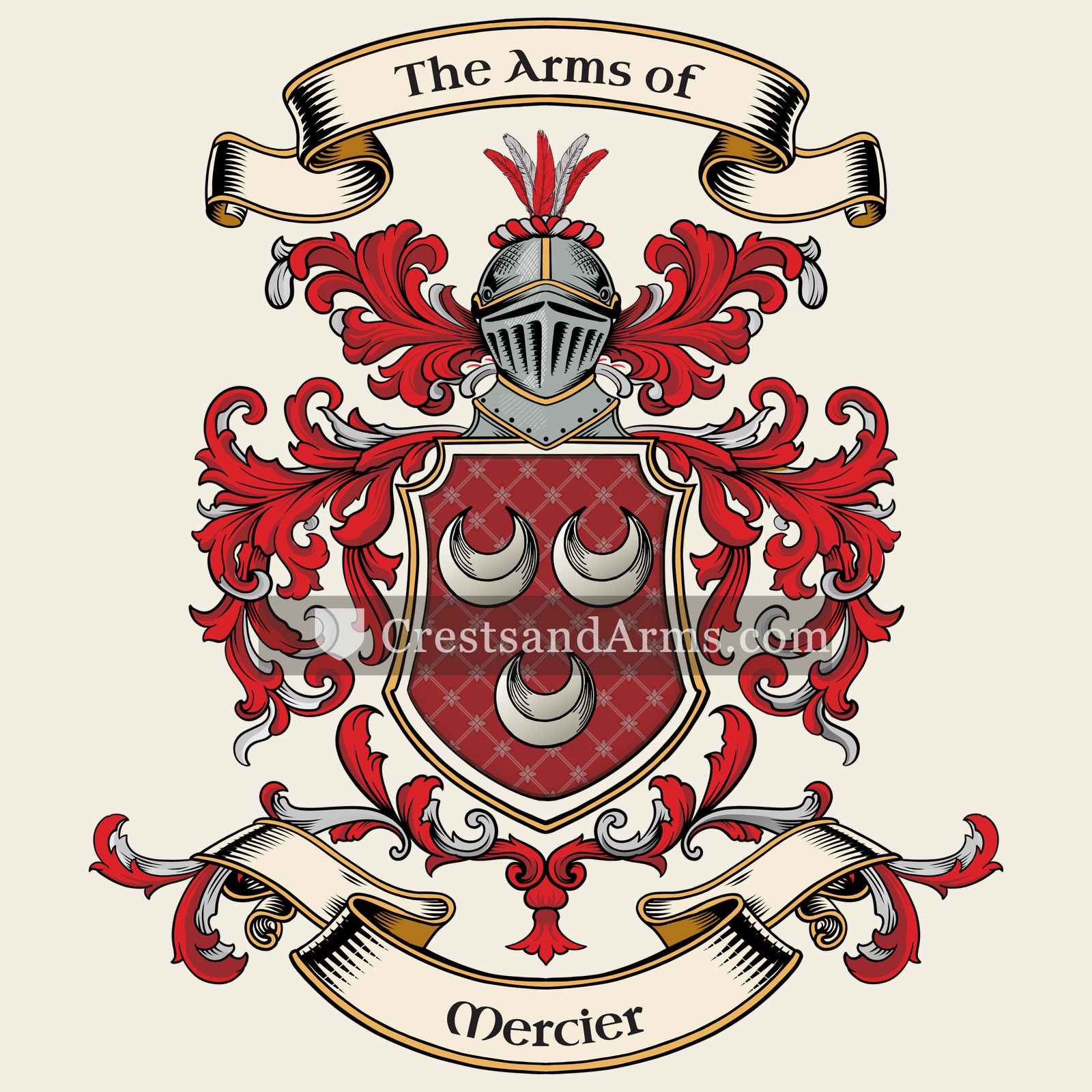
 crescentHonour by the sovereign, and the second son
 crescentHonour by the sovereign, and the second son


 fessThe military belt, and readiness to serve
 lionCourage, strength and royalty

 chequyConstancy, and the counting-board
 bordureA difference between branches of one family
 boars headA fierce fighter who battles to the end