Map of England showing where the Meredith arms are recorded
The Meredith arms were recorded in Chester, c. 1620.
Cheshire was governed apart from the rest of England for much of its history, with its own courts and its own gentry. That separateness bred a strong local landed class, and landed families carried arms.
This is where the arms were entered in the register. Families often moved to other parts of the country, so the same name can turn up in more than one region.
The body that granted and recorded arms in England in this period.
James VI and I
Sovereign of the period
James VI and I
1603–1625
Reigning in England when the Meredith arms are first recorded.
How Arms Worked in England
English heraldry allowed arms to be shared by all legitimate descendants of the original owner. These symbols were treated as personal property that moved through the generations to all children. While the eldest son kept the original design, other family members could use the same shield without needing to change it or register their own unique versions.
Granting authority
The College of Arms in London has regulated the use of coats of arms throughout England and Wales since 1484.
How they got arms
Families typically obtained their coats of arms through a formal grant from the Crown or by proving their ancient right to them.
Where arms were recorded
All official coats of arms are recorded in the registers kept at the College of Arms, which date back to the fifteenth century.
The family's standing
Recorded among the armigerous families of Chester.
Origin & History of the Meredith Family in England
The surname Meredith originates from the Welsh name Maredudd, which translates to "great lord" or "sea lord." While the name is deeply rooted in Welsh history, it began to spread across the border into England as families migrated for trade and opportunity. By the early 17th century, the name was well-established in the city of Chester, a vital hub for commerce and travel between Wales and the English Midlands. Families living in Chester during this time were often part of the growing merchant class, benefiting from the city’s status as a gateway to Ireland and the Welsh interior. These early inhabitants helped transition the name from its traditional Welsh origins into the broader English social landscape, embedding it into the local records of the region by 1620.
Coat of Arms & Family Crest Details
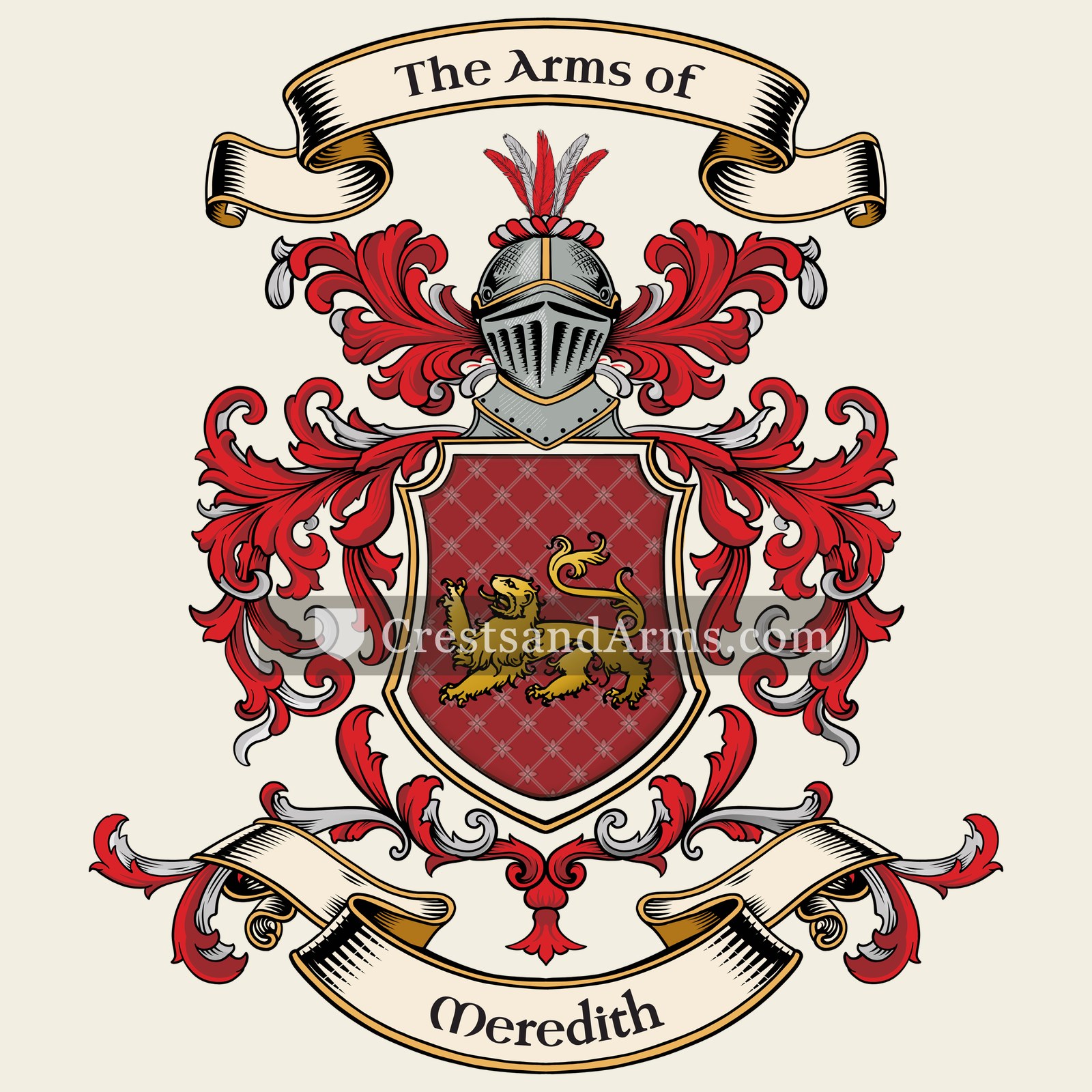
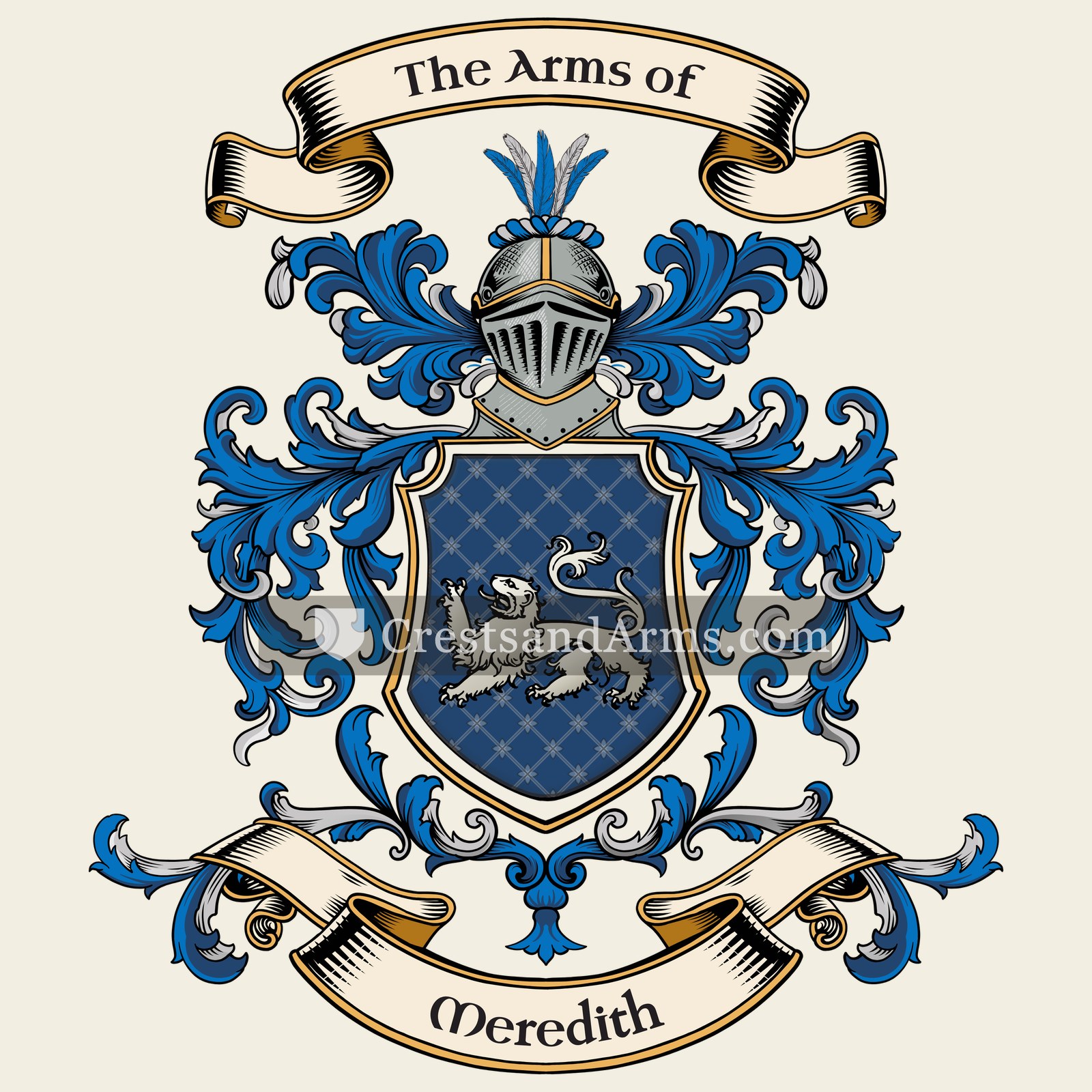
Symbols on this shield
lionCourage, strength and royalty
Colours
Blue (Azure)Means: Loyalty and truth
Silver (Argent)Means: Peace and sincerity
Historical info
Source
Sir Bernard Burke, The General Armory of England, Scotland, Ireland and Wales, London: Harrison & Sons, 1884
Blazon (the actual original written record)
“Az. a lion ramp. ar”
SligoCloonamahon · Sligo, c. 1645
Digital archive packCoat of arms PNG, gold border print PDF, vector SVG and the certificate of authenticity. Sent to your email in minutes.
Map of Ireland showing where the Meredith arms are recorded
The Meredith arms were recorded in Sligo, c. 1645.
Sligo was north-western Irish country with a harbour and poor land behind it. Its families were few and held their ground for a very long time, which is what put them in the records.
This is where the arms were entered in the register. Families often moved to other parts of the country, so the same name can turn up in more than one region.
The body that granted and recorded arms in Ireland in this period.
Charles I of England
Sovereign of the period
Charles I of England
1625–1649
Reigning in England when the Meredith arms are first recorded.
How Arms Worked in Ireland
The Ulster King of Arms granted coats of arms to individuals who proved their social standing and good character. These symbols were typically inherited by all legitimate descendants of the original holder. If a family branch wanted a unique look, they could apply for a specific change to their design through the office to ensure their identity remained distinct.
Granting authority
The Ulster King of Arms acted as the official body that regulated and issued all coats of arms throughout Ireland.
How they got arms
Families obtained their arms through formal grants issued by the office after proving their eligibility and paying the required fees.
Where arms were recorded
All official grants were recorded in the registers held by the Ulster King of Arms starting from the year 1552.
The family's standing
Recorded among the armigerous families of Sligo.
Origin & History of the Meredith Family in Ireland
The name Meredith has deep roots in the Welsh language, originating from the personal name Maredudd, which translates to great lord or sea lord. While the name is famously Welsh, members of the family established a significant presence in Ireland by the mid-seventeenth century. By 1645, records confirm that the Meredith family was well-settled in County Sligo. During this period, the family often held positions of influence within the local administration and the Church of Ireland. Their migration to the region was part of a larger movement of settlers who moved across the Irish Sea to manage land and serve in government roles. Over time, these families became deeply integrated into the social and political fabric of the west of Ireland, transitioning from newcomers to established members of the local community.
Coat of Arms & Family Crest Details
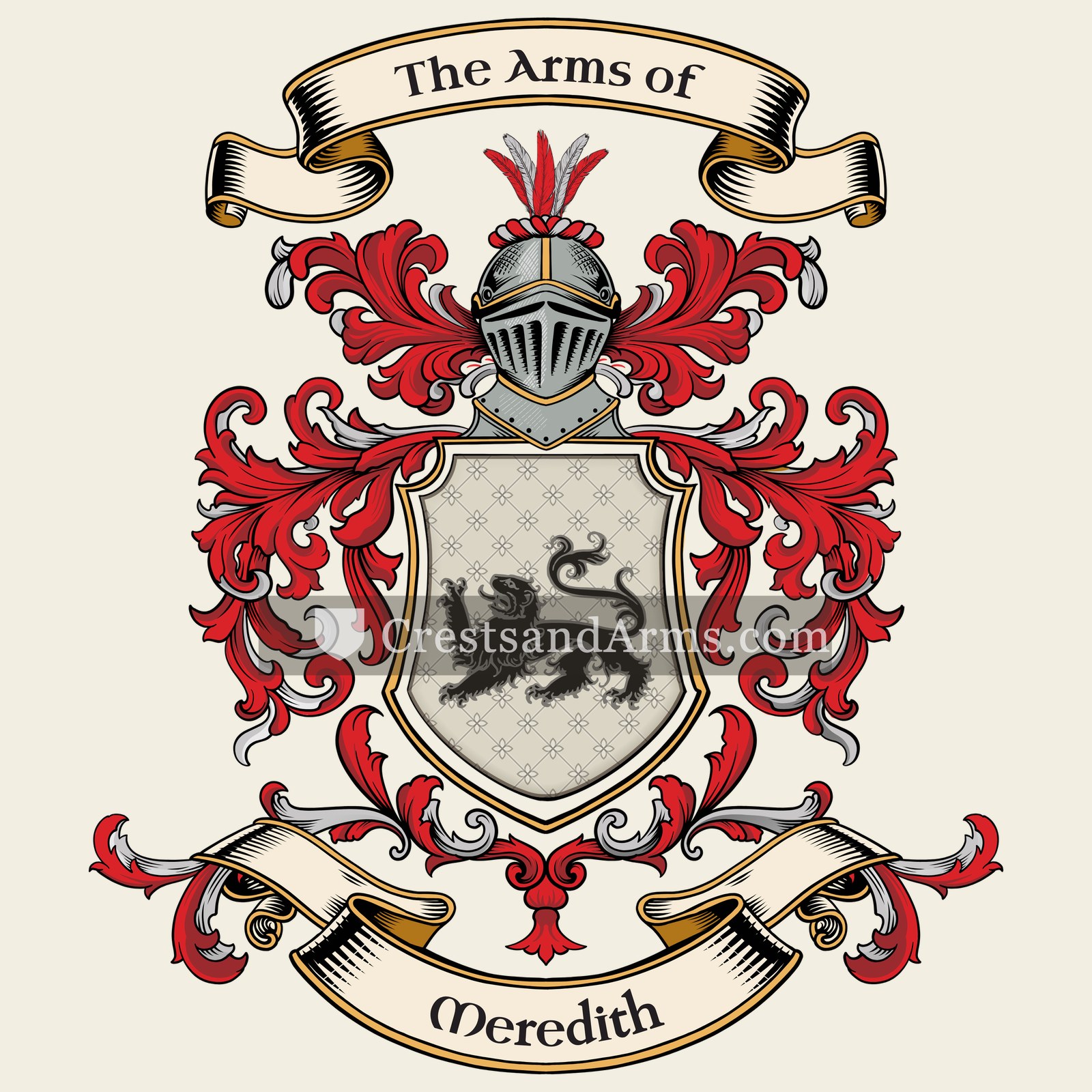
Symbols on this shield
lionCourage, strength and royalty
Colours
Silver (Argent)Means: Peace and sincerity
Black (Sable)Means: Constancy
Historical info
Source
Sir Bernard Burke, The General Armory of England, Scotland, Ireland and Wales, London: Harrison & Sons, 1884
Blazon (the actual original written record)
“Ar. a lion ramp. sa. gorged with a collar and chain affixed thereto, reflexed over the back or”
RadnorRadnor, c. 1574
Digital archive packCoat of arms PNG, gold border print PDF, vector SVG and the certificate of authenticity. Sent to your email in minutes.
Map of Wales showing where the Meredith arms are recorded
The Meredith arms were recorded in Radnor, c. 1574.
Radnorshire was empty mid-Welsh hill country, the least populated county in Wales. Its few landed families held their ground for centuries, and long holding brought arms.
This is where the arms were entered in the register. Families often moved to other parts of the country, so the same name can turn up in more than one region.
The body that granted and recorded arms in Wales in this period.
Elizabeth I of England
Sovereign of the period
Elizabeth I of England
1558–1603
Reigning in England when the Meredith arms are first recorded.
How Arms Worked in Wales
English heraldry allowed arms to be shared by all legitimate descendants of the original owner. These symbols were treated as personal property that moved through the generations to all children. While the eldest son kept the original design, other family members could use the same shield without needing to change it or register their own unique versions.
Granting authority
The College of Arms in London has regulated the use of coats of arms throughout England and Wales since 1484.
How they got arms
Families typically obtained their coats of arms through a formal grant from the Crown or by proving their ancient right to them.
Where arms were recorded
All official coats of arms are recorded in the registers kept at the College of Arms, which date back to the fifteenth century.
The family's standing
Recorded among the armigerous families of Radnor.
Origin & History of the Meredith Family in Wales
The surname Meredith originates from the ancient Welsh personal name Maredudd, which translates to "great lord" or "sea lord." In the early centuries of Welsh history, names were not passed down as fixed surnames but were instead patronymic, meaning a person was identified by their father’s name. Over time, as English administrative practices spread into Wales, these patronymic names became permanent family surnames. By the late sixteenth century, the Meredith name was firmly established in the historic county of Radnorshire. Records indicate that members of the family were active in this region by 1574, where they were often involved in local landholding and community leadership. This transition from a descriptive title used to identify an individual to a stable family name reflects the broader cultural shifts that occurred as Wales became more integrated into the legal and social systems of the British Isles.
Meredith Meaning & Related Branches
Root word
Maredudd
Derived from the Welsh elements for sea and lord.
This name
MeredithA traditional Welsh name signifying a lord of the sea or great ruler.
also spelled
Meredyth
Meredid
Related arms
Meredythvariant spelling
Bishoprecorded with Meredith, same area
Davyerecorded with Meredith, same area
Leachrecorded with Meredith, same area
Documented Sources
Sir Bernard Burke, The General Armory of England, Scotland, Ireland and Wales, London: Harrison & Sons, 1884
Bardsley, Charles Wareing, A Dictionary of English and Welsh Surnames, 1901
Cheshire Archives and Local Studies, Chester City Parish Records, 1620
Reaney, P.H., A Dictionary of British Surnames, 1958
Digital archive packCoat of arms PNG, gold border print PDF, vector SVG and the certificate of authenticity. Sent to your email in minutes.


 lionCourage, strength and royalty
 lionCourage, strength and royalty