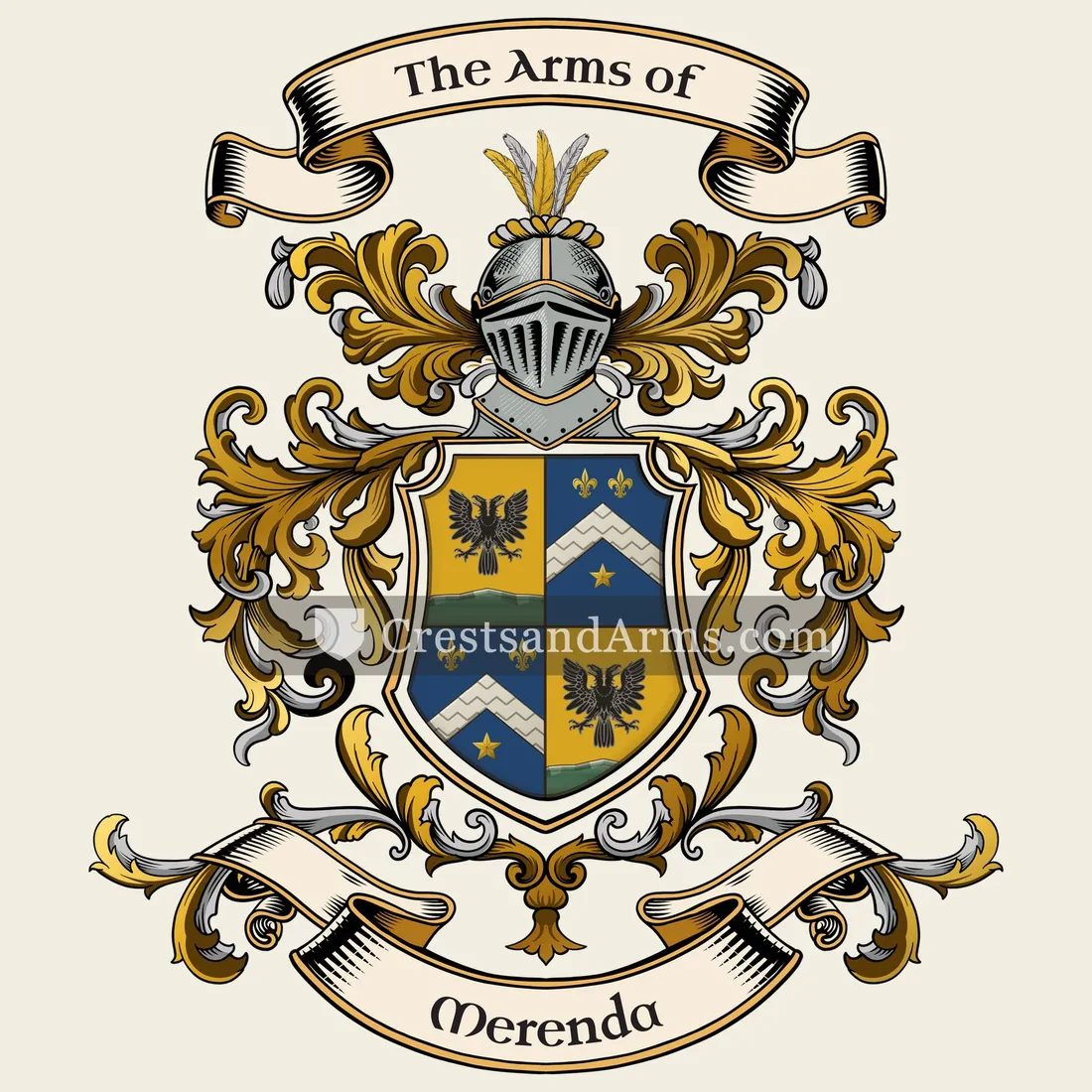
A record of documented arms, meaning and origin, researched for the Merenda family of Italy.
Reg. 2759 · Italian, M–O
Meaning of the Merenda family crest colors & symbols
Symbols on this shield
mountThe ground held, and steadfastness upon it
chevronProtection, and faithful service completed
eagleNobility, strength and a keen mind
fleur de lisPurity, light, and the sixth son
mulletThe third son, and a divine quality from above
Colours
Gold (Or)Means: Generosity
Blue (Azure)Means: Loyalty and truth
Green (Vert)Means: Hope
Silver (Argent)Means: Peace and sincerity
Black (Sable)Means: Constancy
Historical info
Source
J. B. Rietstap, Armorial Général, Gouda: G. B. van Goor Zonen, 1884–87
Blazon (the actual original written record)
“Ec.: aux 1 et 4 d'or à l'aigle de sa., soutenue d'un tertre de trois coupeaux de sin.; aux 2 et 3 d'azur au chev. d'arg., acc. en chef de deux fleurs-de-lis d'or et en p. d'une étoile du même. Deux cq. cour. C.: 1° l'aigle, entre deux prob. coupées alt. d'or et de sa.; 1. d'or et de sa.; 2° un vol à l'antique aux armes du 2; 1. d'arg. et d'azur.”
BavariaBologne · Bavaria, c. 1775
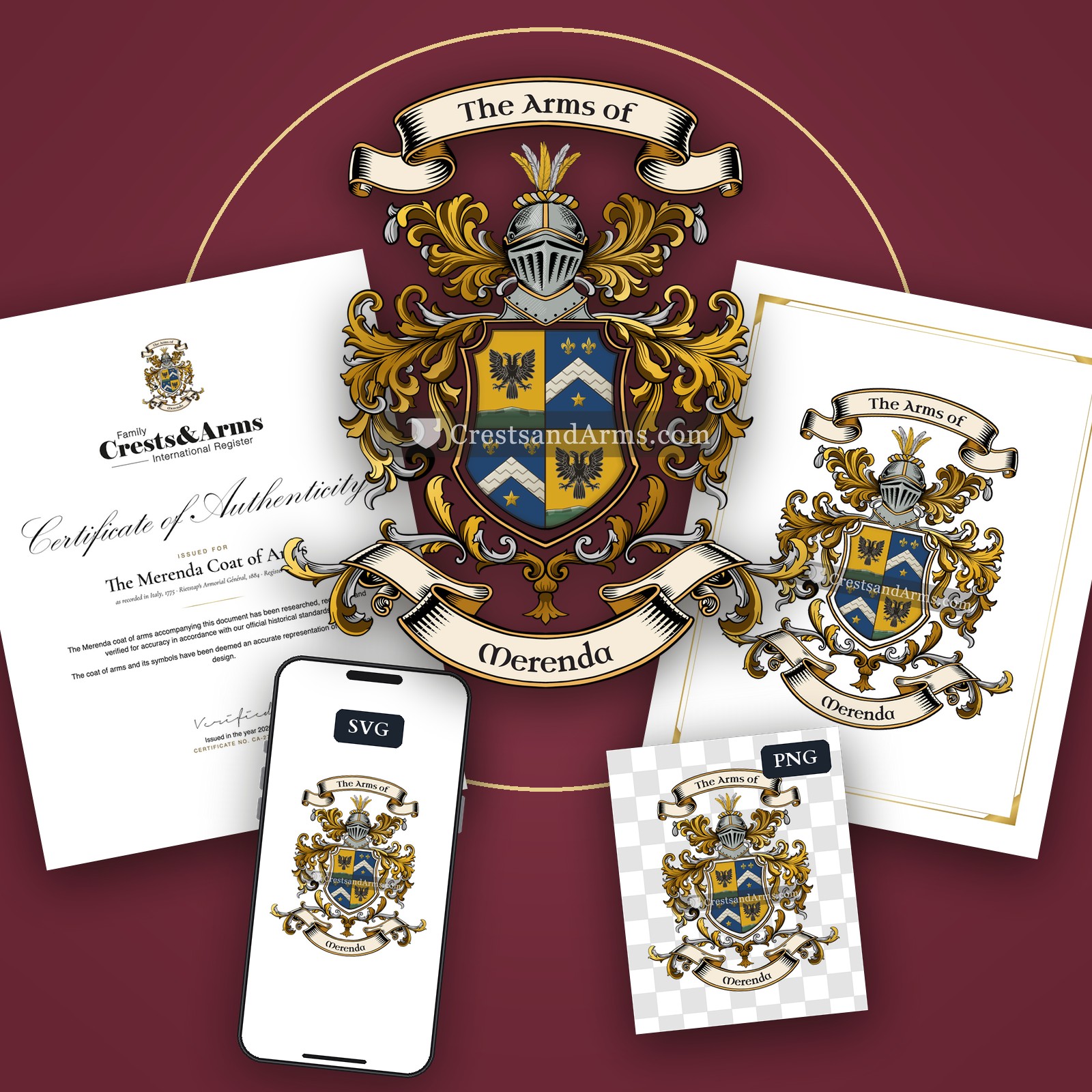
Digital archive packCoat of arms PNG, gold border print PDF, vector SVG and the certificate of authenticity. Sent to your email in minutes.
Map of Italy showing where the Merenda arms are recorded
The Merenda arms were recorded in Bavaria, c. 1775.
Bavaria was a country of old landed families and walled market towns. Estates passed down the same line for centuries, and both the landowners and the leading townsmen kept arms, which is why so many Bavarian names sit in the registers.
This is where the arms were entered in the register. Families often moved to other parts of the country, so the same name can turn up in more than one region.
The body that granted and recorded arms in Italy in this period.
Alvise Giovanni Mocenigo
Sovereign of the period
Alvise Giovanni Mocenigo
1763–1778
Reigning in Italy when the Merenda arms are first recorded.
How Arms Worked in Italy
In the Italian states, coats of arms were often used by noble families to show their status and history. These symbols were passed down through the generations to all legitimate male descendants. Younger branches of a family usually kept the original design but sometimes added small changes to distinguish their specific line from the main branch.
Granting authority
Various local rulers and city governments controlled the use of coats of arms across the different Italian states.
How they got arms
Families often assumed their own arms or received them as official grants from local lords, popes, or city councils.
Where arms were recorded
Arms were recorded in local city archives or private family books rather than in one single national register.
The family's standing
Recorded among the armigerous families of Bavaria.
Origin & History of the Merenda Family in Italy
The family name Merenda carries a long history rooted in the cultural landscapes of Central Europe. By the year 1775, records confirm that members of the family were well-established in the region of Bavaria. During this era, Bavaria was a center of significant social and political change under the rule of the Wittelsbach dynasty. Families living in this territory often held roles tied to local agriculture, trade, or the administrative needs of the growing state. As the eighteenth century progressed, the Merenda family would have navigated the transition from traditional feudal structures toward the more modern bureaucratic systems that defined German society. Their presence in the region reflects the broader movement of families who contributed to the stability and development of Bavarian towns and rural communities during the late Enlightenment period.
Merenda Meaning & Related Branches
Root word
merenda
Latin term for a light afternoon snack or meal.
This name
MerendaAn occupational nickname for someone who provided snacks or a midday meal to workers.
also spelled
Merendorie
Merendorry
Merendoris
Documented Sources
J. B. Rietstap, Armorial Général, Gouda: G. B. van Goor Zonen, 1884–87


 mountThe ground held, and steadfastness upon it
 chevronProtection, and faithful service completed
 eagleNobility, strength and a keen mind
 fleur de lisPurity, light, and the sixth son
 mulletThe third son, and a divine quality from above
 mountThe ground held, and steadfastness upon it
 chevronProtection, and faithful service completed
 eagleNobility, strength and a keen mind
 fleur de lisPurity, light, and the sixth son
 mulletThe third son, and a divine quality from above