Map of Belgium showing where the Mersch arms are recorded
The Mersch arms were recorded in Luxemb, c. 1737.
This is where the arms were entered in the register. Families often moved to other parts of the country, so the same name can turn up in more than one region.
The body that granted and recorded arms in Belgium in this period.
Charles VI, Holy Roman Emperor
Sovereign of the period
Charles VI, Holy Roman Emperor
1711–1740
Reigning in Belgium when the Mersch arms are first recorded.
How Arms Worked in Belgium
In Belgium, a coat of arms is considered personal property that is passed down through the male line to legitimate descendants. Families often use the same shield design across generations to show their shared heritage. If a branch of the family wants to change the design, they must apply for an official update to their specific version of the arms.
Granting authority
The Conseil héraldique is the official body that regulates and approves all coats of arms in Belgium.
How they got arms
Families obtain their coats of arms through formal royal grants or by confirming their historical right to use existing designs.
Where arms were recorded
All approved coats of arms are officially recorded in the public registers of the Conseil héraldique since 1844.
The family's standing
Recorded among the armigerous families of Belgium.
Origin & History of the Mersch Family in Belgium
The family name Mersch originates from the town of Mersch, which is located in the heart of modern-day Luxembourg. During the early eighteenth century, the family was well-established in this region, as evidenced by records confirming their presence there by 1737. The name itself is a topographical surname, meaning it was likely adopted by individuals who lived near the confluence of the Alzette, Mamer, and Eisch rivers. In the local Luxembourgish language, the name is closely tied to the geography of the valley where these waterways meet. Throughout the 1700s, families bearing this name were often involved in the agricultural and administrative life of the rural districts. As the family grew, they remained deeply connected to the identity of their ancestral town, which served as a central hub for trade and local governance in the Grand Duchy.
Related Branches & Arms
Root word
Mariscus
Latin term for a marsh or a swampy area.
This name
MerschA topographic name for someone who lived near a marsh or wetland.
also spelled
Mersh
Related arms
Meersch (van der) - Brabvariant spelling
Meersch (van der) - Brugesvariant spelling
Meersch (van der) de Heulevariant spelling
Meersch (van der) de Roosendaelevariant spelling
Documented Sources
J. B. Rietstap, Armorial Général, Gouda: G. B. van Goor Zonen, 1884–87
National Archives of Luxembourg, État civil et registres paroissiaux
National Archives of Luxembourg, Fonds de la Cour de Justice
Mersch, Jules, Biographie nationale du pays de Luxembourg depuis ses origines jusqu'à nos jours, 1947
Trausch, Gilbert, Histoire du Luxembourg : le destin européen d'un petit pays, 2003
Digital archive packCoat of arms PNG, gold border print PDF, vector SVG and the certificate of authenticity. Sent to your email in minutes.


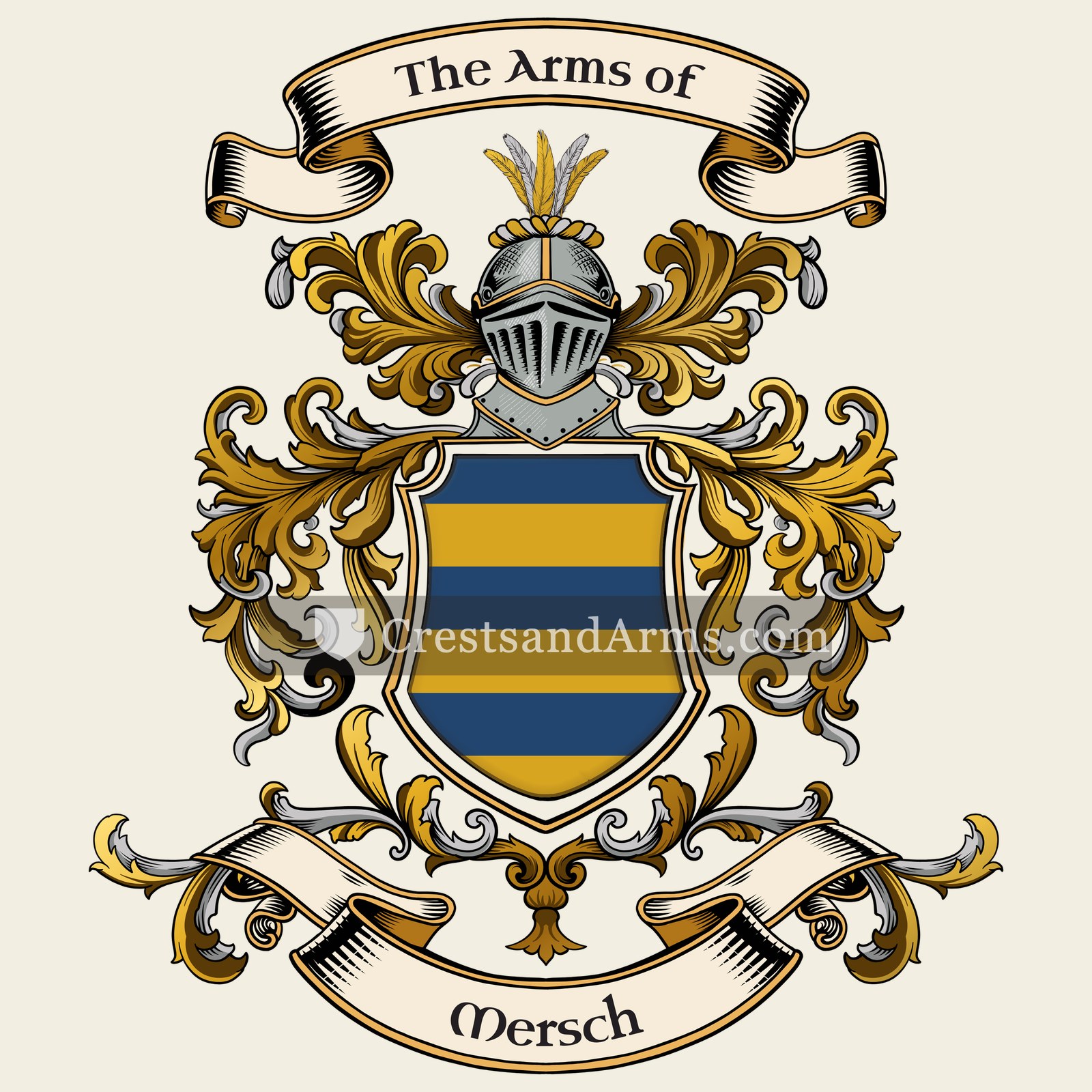
 fessThe military belt, and readiness to serve
 fessThe military belt, and readiness to serve