Map of France showing where the Messier arms are recorded
The Messier arms were recorded in Paris, c. 1663.
This is where the arms were entered in the register. Families often moved to other parts of the country, so the same name can turn up in more than one region.
The body that granted and recorded arms in France in this period.
Louis XIV of France
Sovereign of the period
Louis XIV of France
1643–1715
Reigning in France when the Messier arms are first recorded.
How Arms Worked in France
In France, a coat of arms was a mark of honor that passed down through the male line to all legitimate descendants. Families often used the same shield without changes to show their shared heritage. If a branch wanted to stand out, they could add a small mark to their shield to show their specific place in the family tree.
Granting authority
The Juge d'armes de France acted as the official authority that regulated and verified coats of arms across the country.
How they got arms
Families typically inherited their arms from ancestors, though they could also receive them through royal grants or by proving their noble status.
Where arms were recorded
Coats of arms were officially recorded in the Armorial Général de France, which began its main collection in the year 1696.
The family's standing
Recorded among the armigerous families of France.
Origin & History of the Messier Family in France
The surname Messier originates from the French word *messier*, which historically referred to a rural official or a guardian of the harvest. In the feudal system of medieval France, these individuals were responsible for protecting crops from animals and thieves, ensuring that the local food supply remained secure. By the time the family appears in the official records of Paris in 1663, the name had transitioned from a specific job title into a hereditary family identifier. During this period, the Messier family was part of the urban growth of the French capital, living in a city that was rapidly expanding under the influence of King Louis XIV. As the family settled into life in Paris, they became part of the complex social fabric of the seventeenth century, moving away from their agricultural roots to participate in the commerce and administration of a rising European power.
Coat of Arms & Family Crest Details
Symbols on this shield
lozengeHonour and nobility, and the arms of a woman
Colours
Blue (Azure)Means: Loyalty and truth
Gold (Or)Means: Generosity
Historical info
Source
J. B. Rietstap, Armorial Général, Gouda: G. B. van Goor Zonen, 1884–87
Blazon (the actual original written record)
“D'azur à trois los. d'or.”
SwitzerlandGenève, c. 1745
Digital archive packCoat of arms PNG, gold border print PDF, vector SVG and the certificate of authenticity. Sent to your email in minutes.
Map of Switzerland showing where the Messier arms are recorded
The Messier arms were recorded in Genève, c. 1745.
This is where the arms were entered in the register. Families often moved to other parts of the country, so the same name can turn up in more than one region.
The body that granted and recorded arms in Switzerland in this period.
How Arms Worked in Switzerland
In Switzerland, coats of arms were not restricted to the nobility and were often adopted by common citizens and families. These symbols were passed down through generations to show family identity. When branches of a family grew, they often changed small details of the design to distinguish their own line from the original group.
Granting authority
Cantonal and civic authorities managed the use of coats of arms within their specific regions and local jurisdictions.
How they got arms
Families typically assumed their own coats of arms based on local custom rather than receiving them from a central monarch.
Where arms were recorded
Arms were recorded in various cantonal and civic registers starting from the fourteenth century throughout the Swiss region.
The family's standing
Recorded among the armigerous families of Switzerland.
Origin & History of the Messier Family in Switzerland
The history of the Messier family in Switzerland is deeply rooted in the social and professional landscape of Geneva during the eighteenth century. By 1745, records confirm that members of the family were already established residents within the city walls. The name itself is derived from the Old French word *messier*, which historically referred to a person responsible for guarding crops or managing agricultural land. In the context of Geneva, this suggests that early ancestors likely held roles related to the oversight of rural estates or the administration of local harvests. As the city grew into a center for trade and intellectual exchange, the family integrated into the local community, transitioning from their agrarian roots into the urban life of a bustling Swiss republic. Their presence in the city archives during this period highlights a transition from rural stewardship to becoming part of the permanent citizenry of Geneva.
Messier Meaning & Related Branches
Root word
messis
Latin term referring to the harvest or the act of reaping.
This name
MessierAn occupational surname for a harvester or someone who worked during the harvest season.
also spelled
Messyay
Documented Sources
J. B. Rietstap, Armorial Général, Gouda: G. B. van Goor Zonen, 1884–87
Dauzat, Albert. Dictionnaire étymologique des noms et prénoms de France. 1951
Morlet, Marie-Thérèse. Dictionnaire étymologique des noms de famille. 1991
Archives Nationales de France, Minutier central des notaires de Paris
Digital archive packCoat of arms PNG, gold border print PDF, vector SVG and the certificate of authenticity. Sent to your email in minutes.


 armA person of action, industrious and laborious
 armA person of action, industrious and laborious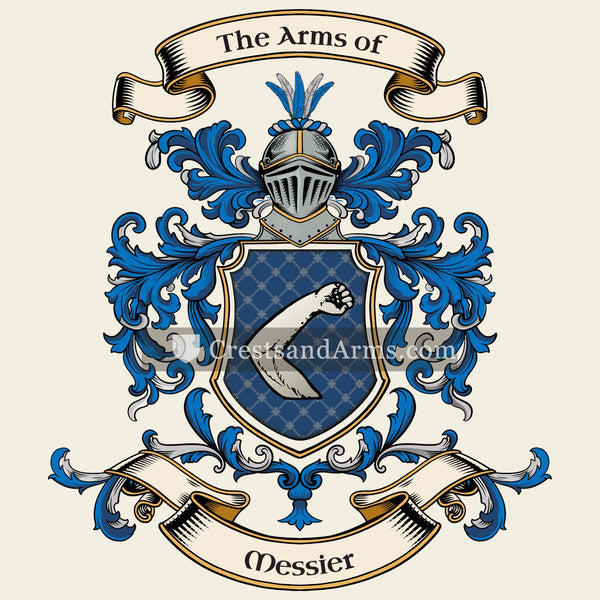


 lozengeHonour and nobility, and the arms of a woman