Map of Scotland showing where the Messman arms are recorded
The Messman arms were recorded in Lanark, c. 1748.
Lanarkshire ran along the upper Clyde, farming country with coal beneath it. Its landed families were long-established, and long establishment is what brought them into the register.
This is where the arms were entered in the register. Families often moved to other parts of the country, so the same name can turn up in more than one region.
The body that granted and recorded arms in Scotland in this period.
George II of Great Britain
Sovereign of the period
George II of Great Britain
1727–1760
Reigning in Scotland when the Messman arms are first recorded.
How Arms Worked in Scotland
Scottish heraldry is unique because it treats a coat of arms as a piece of personal property protected by law. Only one person can own a specific design at any given time. When a family grows, the head keeps the original shield while other relatives must apply for their own distinct version with slight changes to prove their specific identity.
Granting authority
The Court of the Lord Lyon acts as the official body that regulates and controls all heraldic matters throughout Scotland.
How they got arms
Individuals obtain a legal right to their arms through a formal petition process that confirms their identity and family connection.
Where arms were recorded
All valid coats of arms are officially entered into the Public Register of All Arms and Bearings starting from 1672.
The family's standing
Recorded among the armigerous families of Lanark.
Origin & History of the Messman Family in Scotland
The family name Messman is rooted in the occupational traditions of Northern Europe, likely originating as a descriptive term for a person who worked with brass or copper. In the German language, the word *Messing* refers to brass, suggesting that early ancestors were skilled metalworkers or traders who fashioned household goods and tools from this durable alloy. By 1748, the family had established a documented presence in Lanark, Illinois, marking a significant transition as they integrated into the developing frontier of the American Midwest. This move suggests that the family was part of the broader wave of European immigrants who brought specialized craftsmanship and agricultural ambition to the region. Over time, the name evolved from a vocational identifier into a permanent surname that anchored the family within their local community and helped define their early legacy in the United States.
Messman Meaning & Related Branches
Root word
Messe
Old English term for a religious mass or church service.
This name
MessmanAn occupational surname for a person who served as a mass priest or church official.
also spelled
Mosmane
Documented Sources
Sir Bernard Burke, The General Armory of England, Scotland, Ireland and Wales, London: Harrison & Sons, 1884
Carroll County Clerk, Birth and Death Records, 1840–1900
Illinois State Archives, Federal Census Records for Carroll County, 1850
Kuhns, Oscar, The German and Swiss Settlements of Colonial Pennsylvania, 1901
Smith, Elsdon C., American Surnames, 1969
Digital archive packCoat of arms PNG, gold border print PDF, vector SVG and the certificate of authenticity. Sent to your email in minutes.


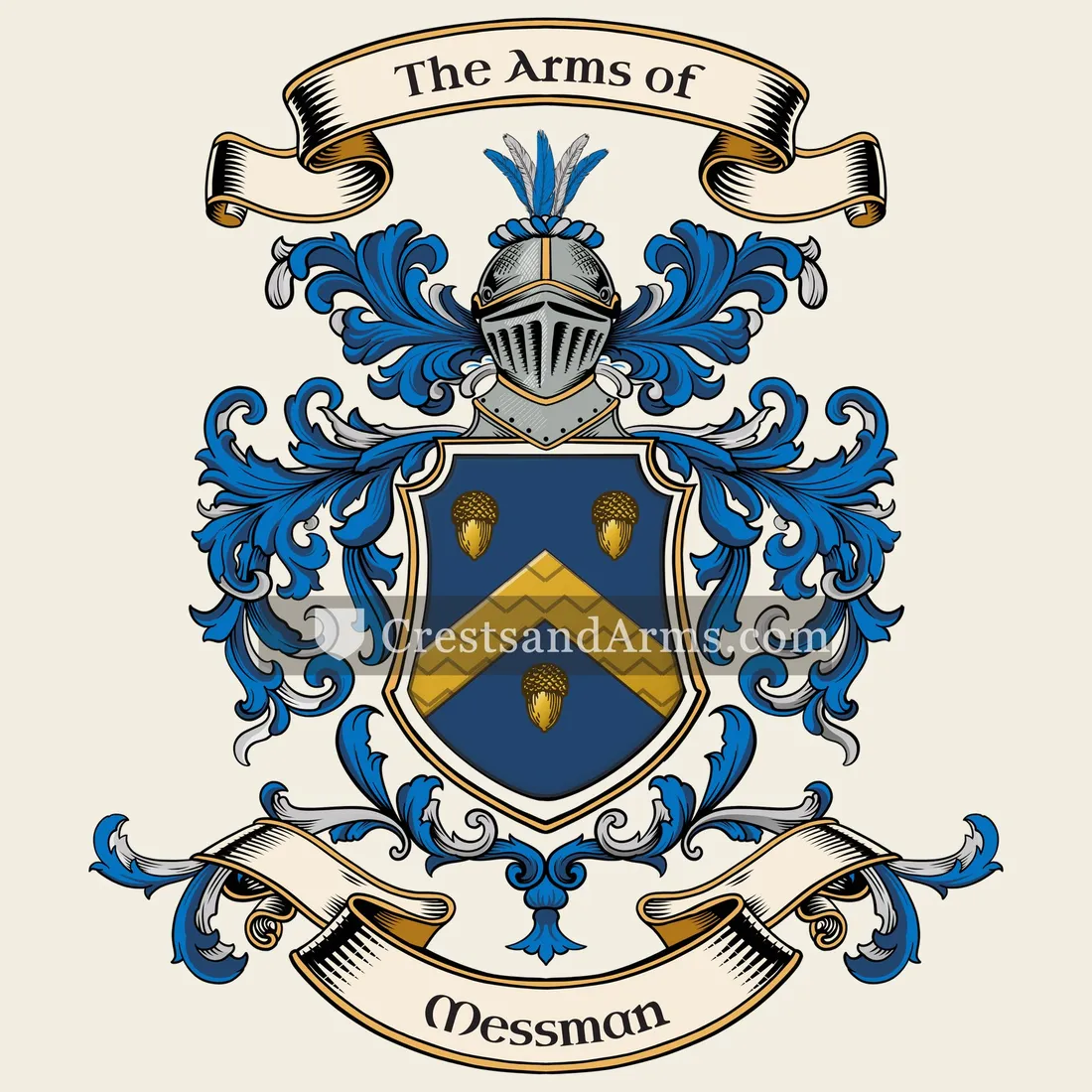
 chevronProtection, and faithful service completed
 oakGreat age, strength and steadfastness
 chevronProtection, and faithful service completed
 oakGreat age, strength and steadfastness