Map of Poland showing where the Mestemacher arms are recorded
The Mestemacher arms were recorded in Courland, c. 1782.
Courland was Baltic coast country held in large estates by a small number of families. They kept their land for generations and served as officers abroad, and both landholding and service brought arms with them.
This is where the arms were entered in the register. Families often moved to other parts of the country, so the same name can turn up in more than one region.
Region
Courland
First recorded
1782
Granting Authority for the Mestemacher Arms
Ennoblement by the Sejm
Author: Olek Remesz · CC BY-SA 3.0
The body that granted and recorded arms in Poland in this period.
Stanisław August Poniatowski
Sovereign of the period
Stanisław August Poniatowski
1764–1795
Reigning in Poland when the Mestemacher arms are first recorded.
How Arms Worked in Poland
Polish noble families shared a single coat of arms across many different surnames, creating large clans rather than individual designs. These symbols were held collectively by all members of the clan regardless of their specific family name. When a new family joined the nobility, they were adopted into an existing clan and began using that group's established shield.
Granting authority
The Sejm, which was the Polish parliament, held the power to grant noble status and the right to bear arms.
How they got arms
Families typically received their coat of arms through a formal act of ennoblement granted by the Sejm for distinguished service.
Where arms were recorded
These grants were officially recorded in the Crown Metrica, which served as the central archive for state documents starting in the sixteenth century.
The family's standing
Recorded among the armigerous families of Courland.
Origin & History of the Mestemacher Family in Poland
The Mestemacher family name originates from the Low German region, where it functioned as a descriptive occupational surname. The name is composed of the words "meste," meaning knife, and "maker," meaning maker, identifying the earliest ancestors as skilled bladesmiths or cutlers. By the late 18th century, members of the family had migrated eastward into the Baltic region. Historical records confirm their presence in Courland by 1782, a territory then under the influence of the Russian Empire. This migration was common for German-speaking artisans and professionals who sought new opportunities in the Baltic provinces. Over time, the family integrated into the local social structure of Courland, transitioning from their origins as craftsmen into roles within the regional administration and professional classes.
Mestemacher Meaning & Related Branches
Root word
Mestmacher
A maker of measuring instruments or a master craftsman.
This name
MestemacherAn occupational surname denoting a person who produced measuring tools or served as a master artisan.
also spelled
Mestmaker
Mestmachar
Documented Sources
J. B. Rietstap, Armorial Général, Gouda: G. B. van Goor Zonen, 1884–87
Bahlow, Hans, Deutsches Namenlexikon: Familien- und Vornamen nach Ursprung und Sinn erklärt, 1967
Latvian State Historical Archives (Latvijas Valsts vēstures arhīvs), Fond 235: Evangelical Lutheran Church Records of Courland, 1782


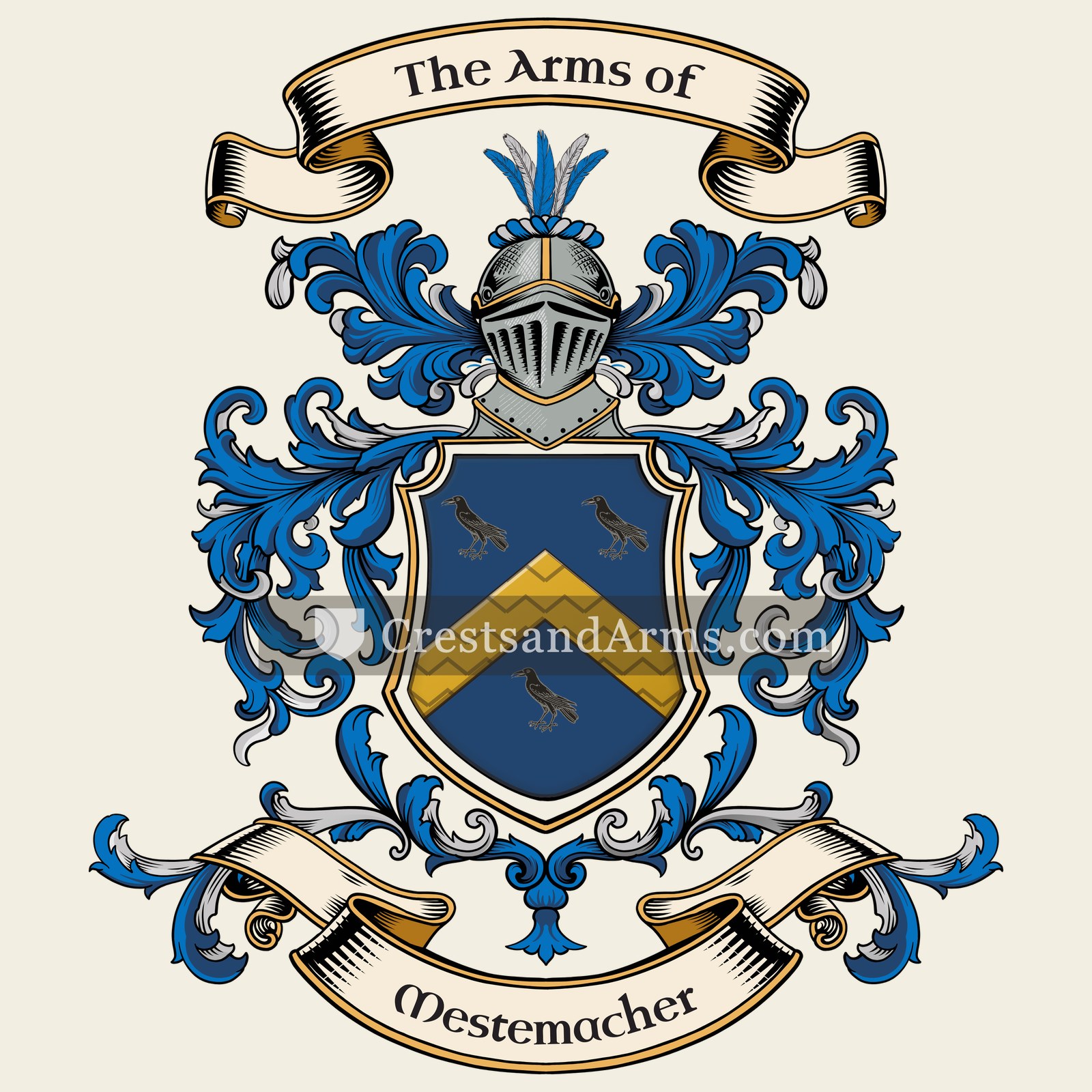
 chevronProtection, and faithful service completed
 ravenConstancy and divine providence
 chevronProtection, and faithful service completed
 ravenConstancy and divine providence