Map of France showing where the Metevier arms are recorded
The Metevier arms were recorded in Languedoc, c. 1663.
Languedoc stretched across the south of France, a country of small towns, vineyards and old local families. Its gentry were numerous rather than grand, and a great many of them held arms even where their estates were modest.
This is where the arms were entered in the register. Families often moved to other parts of the country, so the same name can turn up in more than one region.
The body that granted and recorded arms in France in this period.
Louis XIV of France
Sovereign of the period
Louis XIV of France
1643–1715
Reigning in France when the Metevier arms are first recorded.
How Arms Worked in France
In France, a coat of arms was a mark of honor that passed down through the male line to all legitimate descendants. Families often used the same shield without changes to show their shared heritage. If a branch wanted to stand out, they could add a small mark to their shield to show their specific place in the family tree.
Granting authority
The Juge d'armes de France acted as the official authority that regulated and verified coats of arms across the country.
How they got arms
Families typically inherited their arms from ancestors, though they could also receive them through royal grants or by proving their noble status.
Where arms were recorded
Coats of arms were officially recorded in the Armorial Général de France, which began its main collection in the year 1696.
The family's standing
Recorded among the armigerous families of Languedoc.
Origin & History of the Metevier Family in France
The family name Metevier traces its roots to the southern regions of France, with documented evidence placing members of the family in the Languedoc province as early as 1663. The name itself is derived from the Old French term "metevier," which historically referred to a harvester or a reaper of grain. This suggests that the earliest ancestors were likely agricultural workers or tenant farmers who played a vital role in the rural economy of the seventeenth century. During this period, families in Languedoc were often deeply connected to the land and the seasonal cycles of wheat production. As the family grew, they became part of the local social fabric, navigating the complex religious and political shifts that defined life in southern France before the turn of the eighteenth century. By remaining rooted in these provincial communities, the early Meteviers helped establish a legacy tied to the traditional labor and landscape of the French countryside.
Meaning of the Metevier family crest colors & symbols
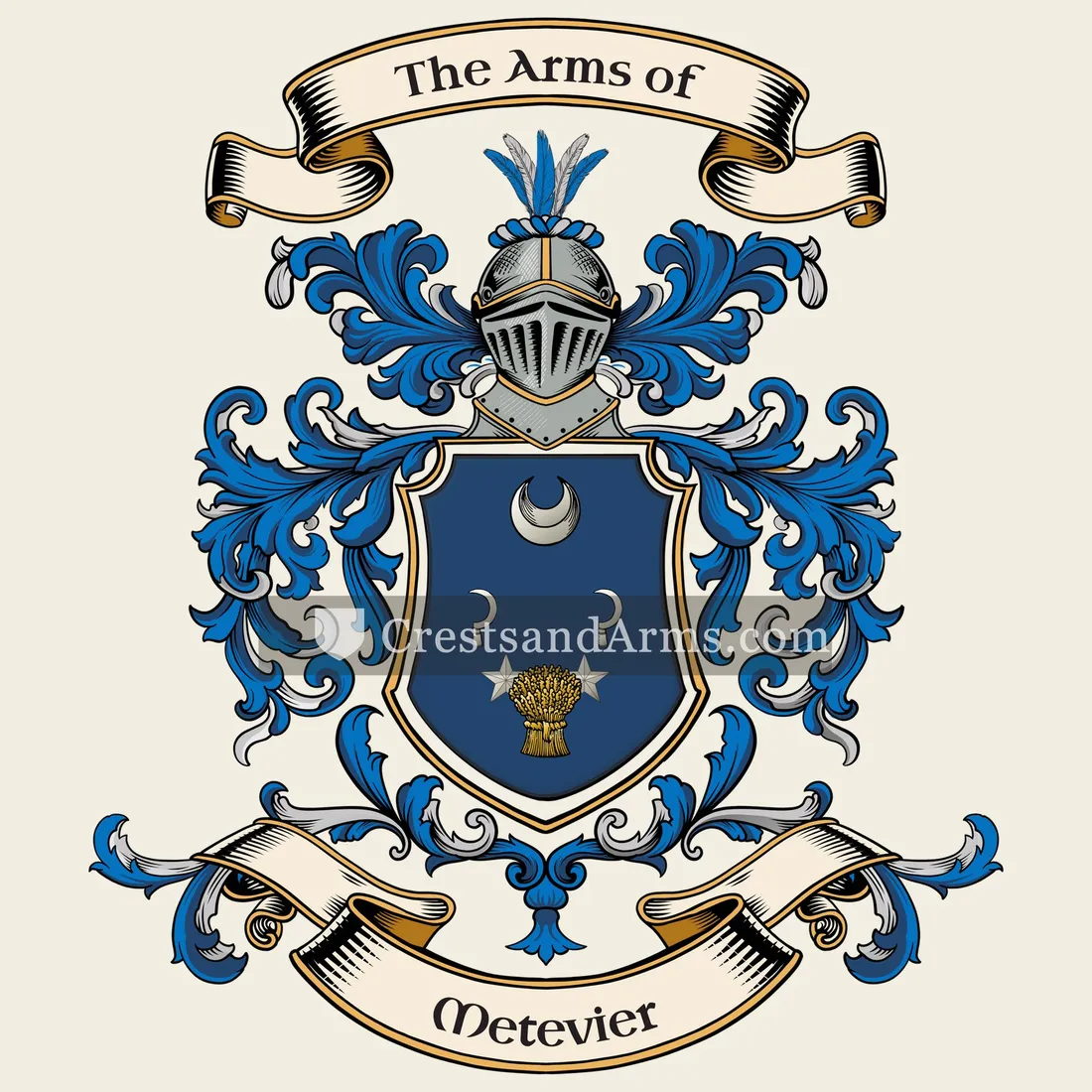
Symbols on this shield
sickleThe harvest, and the reaping of what was sown
mulletThe third son, and a divine quality from above
crescentHonour by the sovereign, and the second son
wheatsheafPlenty, and the harvest of one's own labour
Colours
Blue (Azure)Means: Loyalty and truth
Silver (Argent)Means: Peace and sincerity
Gold (Or)Means: Generosity
Historical info
Source
Sir Bernard Burke, The General Armory of England, Scotland, Ireland and Wales, London: Harrison & Sons, 1884
Blazon (the actual original written record)
“Az. two scythes in saltire betw. as many mullets ar. in chief a crescent of the last and in base a garb or”
GuernseyGuernsey, c. 1688
Digital archive packCoat of arms PNG, gold border print PDF, vector SVG and the certificate of authenticity. Sent to your email in minutes.
The body that granted and recorded arms in Guernsey in this period.
James II of England
Sovereign of the period
James II of England
1685–1688
Reigning in France when the Metevier arms are first recorded.
How Arms Worked in Guernsey
Arms in the Channel Islands were granted and recorded by the College of Arms in London, under the same law of arms as England. They could be used by all legitimate descendants of the original owner: the eldest son kept the original design, and other family members used the same shield without registering a version of their own.
Granting authority
The College of Arms in London has regulated the use of coats of arms for Guernsey and the other Channel Islands since 1484.
How they got arms
Families typically obtained their coats of arms through a formal grant from the Crown or by proving their ancient right to them.
Where arms were recorded
All official coats of arms are recorded in the registers kept at the College of Arms, which date back to the fifteenth century.
The family's standing
Recorded among the armigerous families of Guernsey.
Origin & History of the Metevier Family in Guernsey
The Metevier family established a significant presence in Guernsey by 1688, marking the beginning of a long history on the island. The name itself is of French origin and likely describes a person who worked as a grain measurer or a tax collector for agricultural goods. When these early family members arrived in Guernsey, they integrated into a society that blended Norman traditions with a unique island identity. Over the following generations, the family became deeply rooted in the local community, often participating in the maritime and agricultural life that defined the Channel Islands. Their survival and growth on the island reflect the broader movement of families who sought stability in Guernsey during a period of shifting political and religious landscapes in Europe. By settling into the local parish systems, the Meteviers helped shape the social fabric of the island while maintaining the distinct linguistic and cultural heritage brought over from the continent.
Metevier Meaning & Related Branches
Root word
metivier
derived from the old french word for a harvester or reaper
This name
Metevieran occupational surname for someone who worked as a harvester of crops
also spelled
Metivyer
Metivie
Meteevyay
Documented Sources
J. B. Rietstap, Armorial Général, Gouda: G. B. van Goor Zonen, 1884–87
Archives Départementales de l'Hérault, Registres paroissiaux et d'état civil de la commune de Montpellier, 1663
Dauzat, Albert, Dictionnaire étymologique des noms de famille et prénoms de France, 1951
Morlet, Marie-Thérèse, Dictionnaire étymologique des noms de famille, 1991
Digital archive packCoat of arms PNG, gold border print PDF, vector SVG and the certificate of authenticity. Sent to your email in minutes.


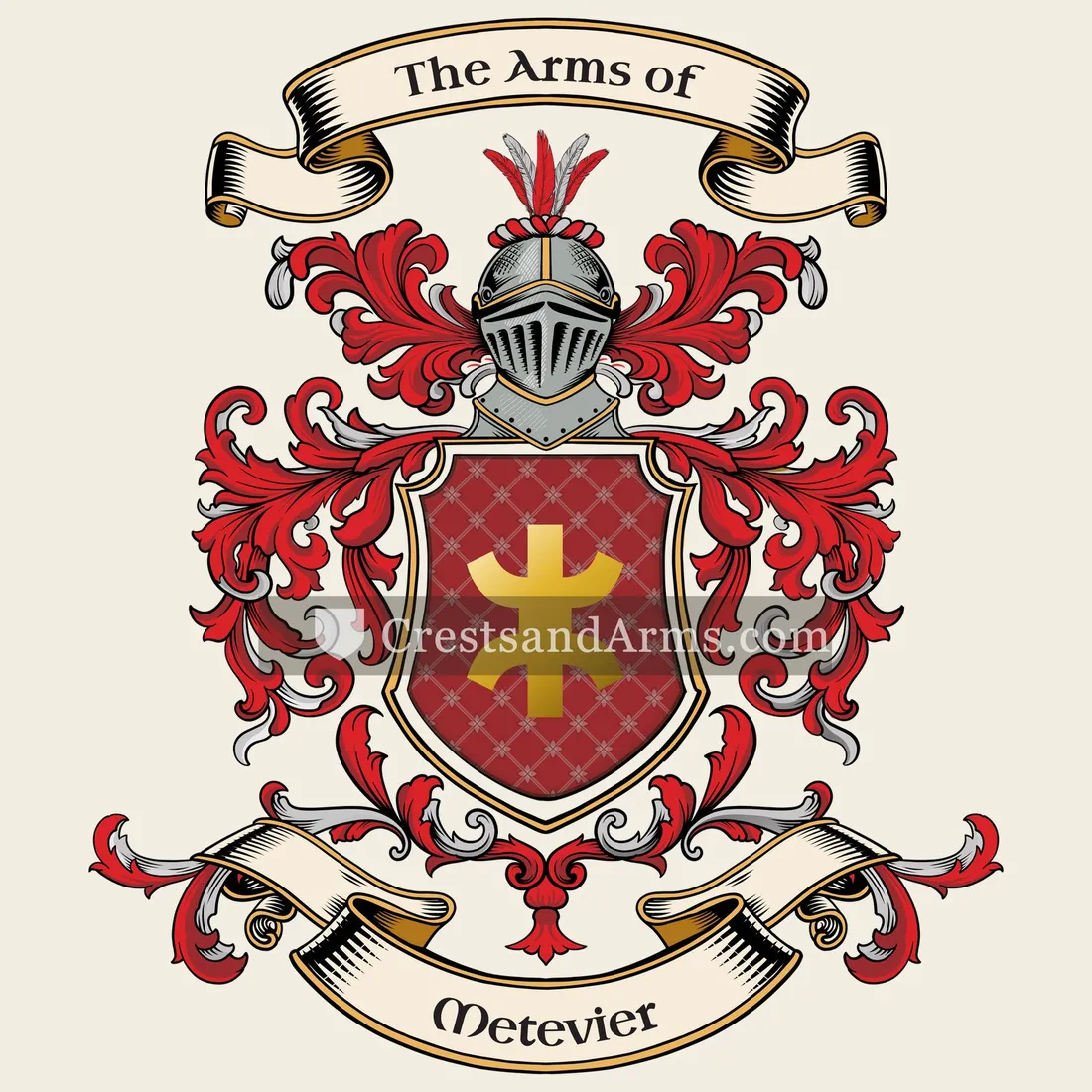
 millrind / fer de molineThe mill's iron, and the grinding of grain
 millrind / fer de molineThe mill's iron, and the grinding of grain


 sickleThe harvest, and the reaping of what was sown
 mulletThe third son, and a divine quality from above
 crescentHonour by the sovereign, and the second son
 wheatsheafPlenty, and the harvest of one's own labour