Map of Belgium showing where the Metz arms are recorded
The Metz arms were recorded in Belgium, c. 1737.
Arms such as these were typically recorded in Brabant.
Brabant lay at the heart of the Low Countries, where the trade routes met. Its towns were wealthy and its landowners many, and both kinds of family kept arms, which is why the region is so heavily represented.
This is where the arms were entered in the register. Families often moved to other parts of the country, so the same name can turn up in more than one region.
The body that granted and recorded arms in Belgium in this period.
Charles VI, Holy Roman Emperor
Sovereign of the period
Charles VI, Holy Roman Emperor
1711–1740
Reigning in Belgium when the Metz arms are first recorded.
How Arms Worked in Belgium
In Belgium, a coat of arms is considered personal property that is passed down through the male line to legitimate descendants. Families often use the same shield design across generations to show their shared heritage. If a branch of the family wants to change the design, they must apply for an official update to their specific version of the arms.
Granting authority
The Conseil héraldique is the official body that regulates and approves all coats of arms in Belgium.
How they got arms
Families obtain their coats of arms through formal royal grants or by confirming their historical right to use existing designs.
Where arms were recorded
All approved coats of arms are officially recorded in the public registers of the Conseil héraldique since 1844.
The family's standing
Recorded among the armigerous families of Belgium.
Origin & History of the Metz Family in Belgium
The family name Metz has deep roots in the historical region of Brabant, where records confirm members of the family were established by 1737. During this era, the name was closely tied to the shifting borders and cultural exchanges between the Low Countries and the surrounding Germanic territories. Families with this name often lived as skilled laborers or tradespeople who moved along the busy river networks and trade routes connecting Brabant to major commercial hubs. Because the region was a crossroads for many different cultures, the name Metz likely served as a marker of identity for those who traveled or settled in these growing urban centers. Over time, these early ancestors became part of the local social fabric, helping to shape the agricultural and mercantile life that defined the province during the eighteenth century.
Coat of Arms & Family Crest Details
Symbols on this shield
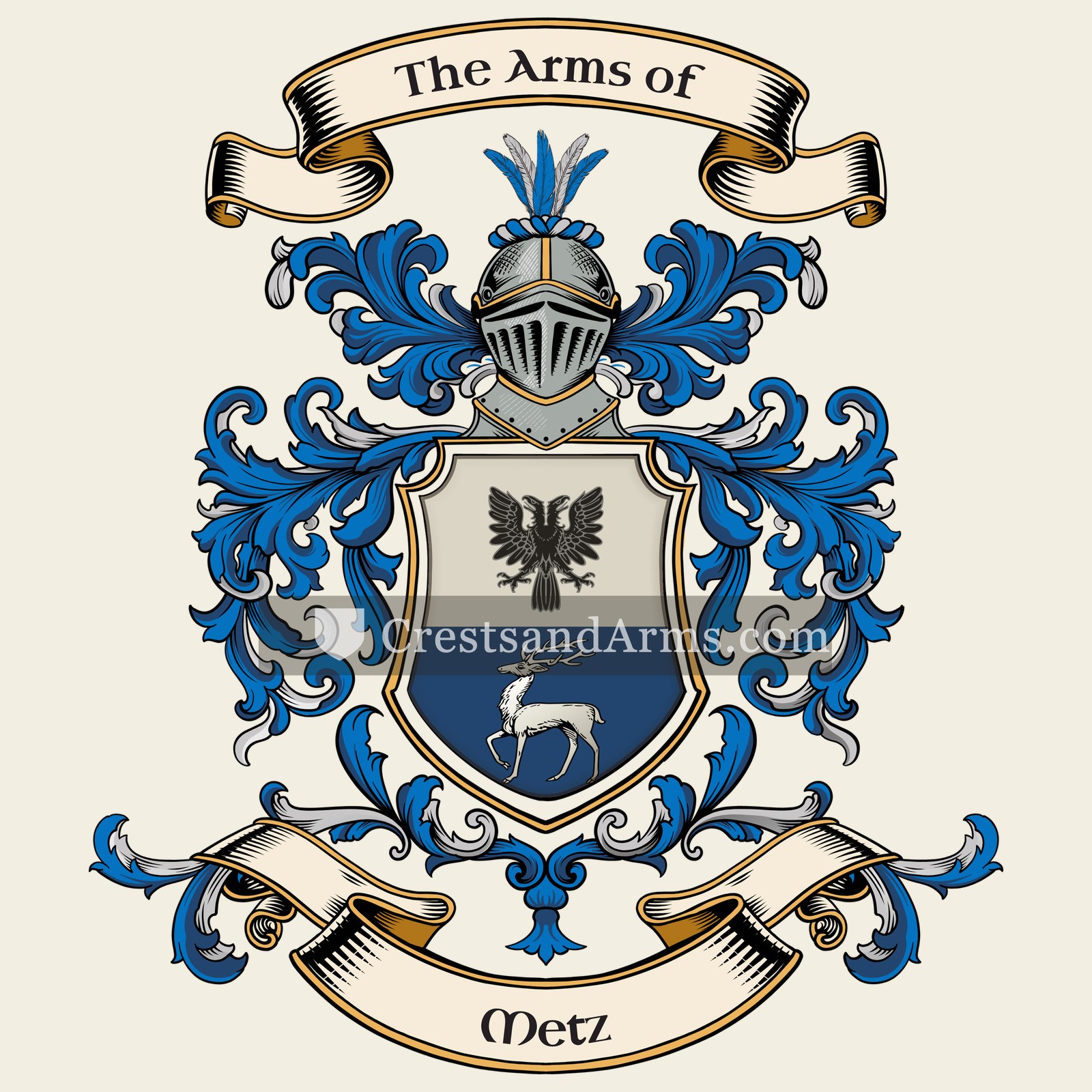
dovePeace, love and the Holy Spirit
Colours
Blue (Azure)Means: Loyalty and truth
Silver (Argent)Means: Peace and sincerity
Historical info
Source
J. B. Rietstap, Armorial Général, Gouda: G. B. van Goor Zonen, 1884–87
Blazon (the actual original written record)
“D'azur à trois colombes d'arg.”
MaineMaine, c. 1663
Digital archive packCoat of arms PNG, gold border print PDF, vector SVG and the certificate of authenticity. Sent to your email in minutes.
Map of France showing where the Metz arms are recorded
The Metz arms were recorded in Maine, c. 1663.
Maine was quiet farming country in western France, held in small manors by families who stayed for generations. Nothing about it was grand, but steady landholding is exactly what puts a name in the registers.
This is where the arms were entered in the register. Families often moved to other parts of the country, so the same name can turn up in more than one region.
The body that granted and recorded arms in France in this period.
Louis XIV of France
Sovereign of the period
Louis XIV of France
1643–1715
Reigning in Belgium when the Metz arms are first recorded.
How Arms Worked in France
In France, a coat of arms was a mark of honor that passed down through the male line to all legitimate descendants. Families often used the same shield without changes to show their shared heritage. If a branch wanted to stand out, they could add a small mark to their shield to show their specific place in the family tree.
Granting authority
The Juge d'armes de France acted as the official authority that regulated and verified coats of arms across the country.
How they got arms
Families typically inherited their arms from ancestors, though they could also receive them through royal grants or by proving their noble status.
Where arms were recorded
Coats of arms were officially recorded in the Armorial Général de France, which began its main collection in the year 1696.
The family's standing
Recorded among the armigerous families of Maine.
Origin & History of the Metz Family in France
The surname Metz originates from the ancient city of Metz in the Lorraine region of France, which served as a significant crossroads for trade and culture. Families who took this name often identified themselves by their ancestral ties to this historic site, which was known for its strategic location near the Moselle River. By the mid-seventeenth century, individuals bearing this name were part of the wave of French settlers who traveled across the Atlantic to establish new lives in North America. Historical records confirm that members of the Metz family were present in the Maine region as early as 1663, marking them among the early pioneers in that territory. These settlers brought with them the traditions and linguistic heritage of their French homeland, helping to shape the early social landscape of the frontier. Their presence in the region during this period highlights the movement of French families who sought to build communities in the wilderness while maintaining a connection to their European roots.
Coat of Arms & Family Crest Details
Symbols on this shield
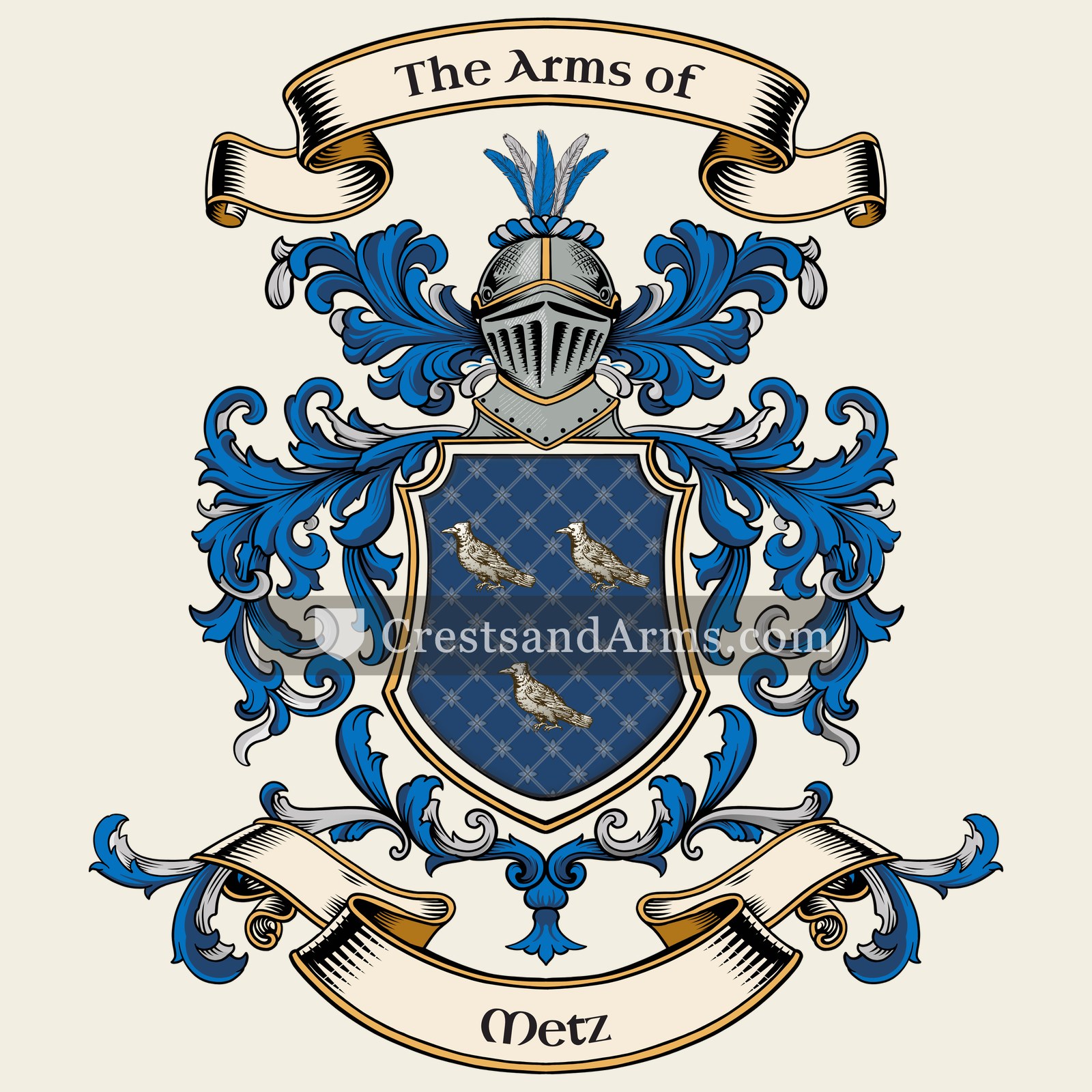
eagleNobility, strength and a keen mind
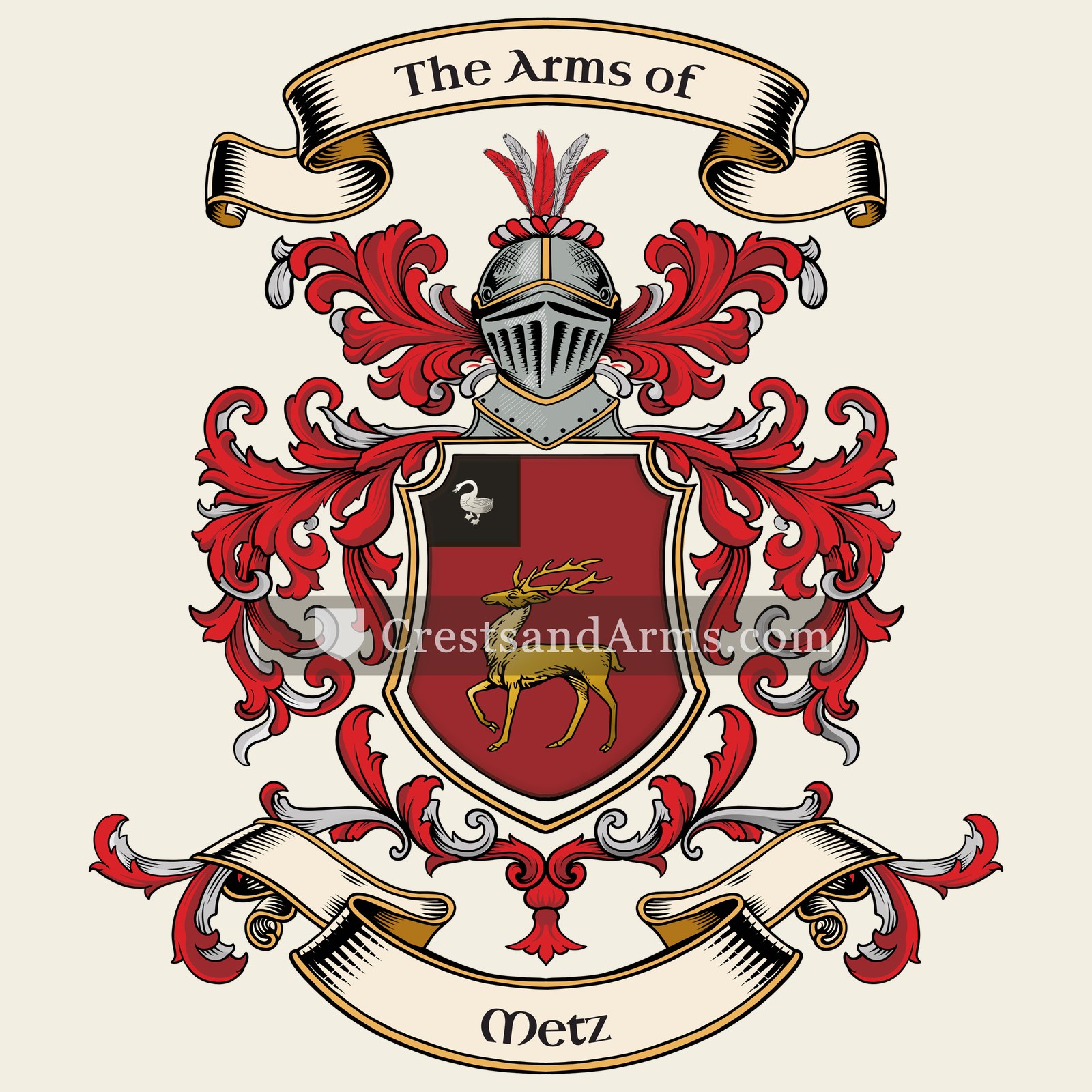
stagPeace and harmony, and one who will not fight unprovoked
Colours
Silver (Argent)Means: Peace and sincerity
Blue (Azure)Means: Loyalty and truth
Black (Sable)Means: Constancy
Historical info
Source
J. B. Rietstap, Armorial Général, Gouda: G. B. van Goor Zonen, 1884–87
Blazon (the actual original written record)
“Coupé: au 1 parti: a. d'arg. à l'aigle de sa.; b. d'or à un cerf ramp. au nat.; au 2 d'azur à un semeur cont., la tête et les jambes nus, hab. d'une chemise d'arg. et d'une culotte de sa., pass. dans un champ de sin. et jetant les semences. Cq. cour. C.: un vol, coupé d'arg. sur azur. L. d'arg. et d'azur.”
BavariaBavaria, c. 1765
Digital archive packCoat of arms PNG, gold border print PDF, vector SVG and the certificate of authenticity. Sent to your email in minutes.
Map of Germany showing where the Metz arms are recorded
The Metz arms were recorded in Bavaria, c. 1765.
Bavaria was a country of old landed families and walled market towns. Estates passed down the same line for centuries, and both the landowners and the leading townsmen kept arms, which is why so many Bavarian names sit in the registers.
This is where the arms were entered in the register. Families often moved to other parts of the country, so the same name can turn up in more than one region.
The body that granted and recorded arms in Germany in this period.
Francis I, Holy Roman Emperor
Sovereign of the period
Francis I, Holy Roman Emperor
1745–1765
Reigning in Belgium when the Metz arms are first recorded.
How Arms Worked in Germany
In the Holy Roman Empire, coats of arms were often granted to individuals by the Emperor or his representatives. These arms were then passed down through the generations to all legitimate descendants of the original holder. Younger branches of a family usually kept the same shield design without needing to change it, as the arms belonged to the entire lineage.
Granting authority
The Holy Roman Emperor held the sole power to grant new coats of arms throughout his vast imperial territories.
How they got arms
Families typically obtained their coats of arms through a formal imperial grant or by proving their noble status to the authorities.
Where arms were recorded
These grants were officially recorded in the Imperial Chancery registers, which began keeping formal records of such honors during the Middle Ages.
The family's standing
Recorded among the armigerous families of Bavaria.
Origin & History of the Metz Family in Germany
The surname Metz is a topographic name that originated in the German-speaking regions of Europe. It is closely linked to the ancient city of Metz, which is located in the Moselle region. In the German language, the name often functioned as a descriptor for individuals who migrated from that specific area to other parts of the country. By the mid-18th century, families carrying this name had established deep roots in the southern state of Bavaria. Records from 1765 confirm that members of the Metz family were active participants in the local economy and social structure of the Bavarian countryside during this period. These early ancestors likely worked as farmers or tradespeople, contributing to the development of their local villages. Over time, the name became a permanent fixture in the region as families settled down, raised children, and integrated into the complex administrative systems of the Holy Roman Empire.
Metz Meaning & Related Branches
Root word
Metze
A Middle High German term referring to a knife or blade.
This name
MetzAn occupational surname for a butcher or someone who worked with knives.
also spelled
Mets
Metzer
Related arms
Metsvariant spelling
Documented Sources
J. B. Rietstap, Armorial Général, Gouda: G. B. van Goor Zonen, 1884–87
Archives: State Archives in Belgium (Rijksarchief), Parochieregisters van Brabant
Debrabandere, Frans, Woordenboek van de familienamen in België en Noord-Frankrijk, 2003
Digital archive packCoat of arms PNG, gold border print PDF, vector SVG and the certificate of authenticity. Sent to your email in minutes.


 stagPeace and harmony, and one who will not fight unprovoked
 swanGrace, light and the poet's art
 stagPeace and harmony, and one who will not fight unprovoked
 swanGrace, light and the poet's art


 dovePeace, love and the Holy Spirit


 eagleNobility, strength and a keen mind