Map of Austria showing where the Meurer arms are recorded
The Meurer arms were recorded in Holstein, c. 1772.
Holstein was farming country between the North Sea and the Baltic, held in large estates. The same families kept the same land for generations, and generations of holding is what fills a register.
This is where the arms were entered in the register. Families often moved to other parts of the country, so the same name can turn up in more than one region.
Region
Holstein
First recorded
1772
Granting Authority for the Meurer Arms
Imperial and Royal chancery
Sodacan · CC BY-SA 3.0
The body that granted and recorded arms in Austria in this period.
Joseph II, Holy Roman Emperor
Sovereign of the period
Joseph II, Holy Roman Emperor
1765–1790
Reigning in Austria when the Meurer arms are first recorded.
How Arms Worked in Austria
Austrian coats of arms were often linked directly to noble titles granted by the Emperor. These symbols belonged to the entire family line rather than just one individual. When a family grew, new branches kept the original design without needing to change it. This system allowed all members of a noble house to share the same identity across many generations.
Granting authority
The Imperial and Royal chancery managed all heraldic matters and controlled the official granting of arms throughout the Austrian lands.
How they got arms
Families typically received their arms through a formal imperial decree that often accompanied the elevation of a person to noble status.
Where arms were recorded
Official records of these grants were kept in the Imperial Register of Nobility which began its formal documentation process in 1453.
The family's standing
Recorded among the armigerous families of Holstein.
Origin & History of the Meurer Family in Austria
The surname Meurer finds its roots in the medieval German occupational tradition, specifically deriving from the word "Maurer," which translates to a mason or stone worker. While the family established a notable presence in the northern region of Holstein by 1772, the name also appears in historical records across the Austrian Empire during the same era. In the context of Austria, the name often surfaced in areas where rapid urban development required skilled craftsmen to build cathedrals, fortifications, and government structures. As these workers moved along trade routes from the north toward the southern reaches of the Habsburg lands, they integrated into local communities by documenting their trade as their primary identifier. This migration pattern reflects the broader movement of skilled laborers who were essential to the growth of Austrian towns throughout the eighteenth century. By maintaining their trade identity, the Meurer family became part of the professional backbone that supported the infrastructure of the period.
Coat of Arms & Family Crest Details
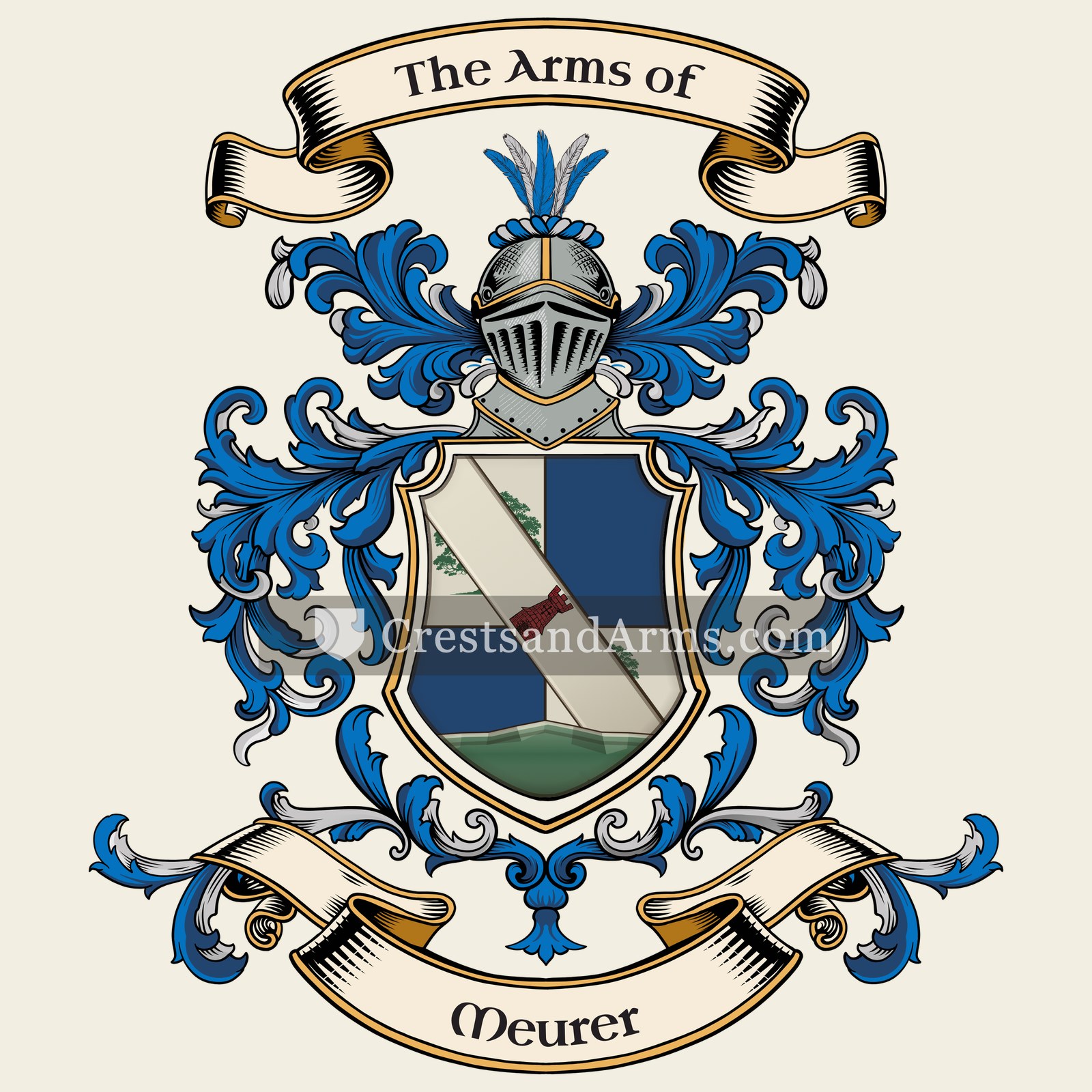
Symbols on this shield
mountThe ground held, and steadfastness upon it
bendDefence, and the scarf of a commander
towerGrandeur and solidity, and a stronghold defended
treeLife, endurance and deep roots
Colours
Silver (Argent)Means: Peace and sincerity
Blue (Azure)Means: Loyalty and truth
Green (Vert)Means: Hope
Red (Gules)Means: Military strength
Historical info
Source
J. B. Rietstap, Armorial Général, Gouda: G. B. van Goor Zonen, 1884–87
Blazon (the actual original written record)
“Ec.: aux 1 et 4 d'arg. à un chêne de sin., terrassé du même; aux 2 et 3 d'azur à la bande d'arg. Sur le tout de Maurer, qui est d'or à un mur crén. de gu., maçonné de sa., mouv. de la p., surm. d'une aigle de sa., bq. et m. d'or. Deux cq., le 1 cour. C.: 1° l'aigle, cont. (Meurer); 1. d'or et de sa.; 2° deux cornes de bélier d'or; 1. d'arg. et de gu.”
HolsteinHolstein, c. 1631
Digital archive packCoat of arms PNG, gold border print PDF, vector SVG and the certificate of authenticity. Sent to your email in minutes.
Map of Germany showing where the Meurer arms are recorded
The Meurer arms were recorded in Holstein, c. 1631.
Holstein was farming country between the North Sea and the Baltic, held in large estates. The same families kept the same land for generations, and generations of holding is what fills a register.
This is where the arms were entered in the register. Families often moved to other parts of the country, so the same name can turn up in more than one region.
The body that granted and recorded arms in Germany in this period.
Ferdinand II, Holy Roman Emperor
Sovereign of the period
Ferdinand II, Holy Roman Emperor
1619–1637
Reigning in Austria when the Meurer arms are first recorded.
How Arms Worked in Germany
In the Holy Roman Empire, coats of arms were often granted to individuals by the Emperor or his representatives. These arms were then passed down through the generations to all legitimate descendants of the original holder. Younger branches of a family usually kept the same shield design without needing to change it, as the arms belonged to the entire lineage.
Granting authority
The Holy Roman Emperor held the sole power to grant new coats of arms throughout his vast imperial territories.
How they got arms
Families typically obtained their coats of arms through a formal imperial grant or by proving their noble status to the authorities.
Where arms were recorded
These grants were officially recorded in the Imperial Chancery registers, which began keeping formal records of such honors during the Middle Ages.
The family's standing
Recorded among the armigerous families of Holstein.
Origin & History of the Meurer Family in Germany
The family name Meurer traces its roots to the occupational traditions of medieval Germany. It is derived from the German word *Meurer*, which is a regional variation of *Maurer*, meaning a mason or a builder of stone walls. During the Middle Ages, surnames were often adopted to describe a person’s trade, and families who specialized in masonry were essential for constructing the churches, castles, and fortifications that defined the German landscape. By the early 17th century, the family had established a documented presence in the northern region of Holstein. This area was a hub of trade and agricultural development, and the presence of the Meurer name in 1631 suggests that these early ancestors were likely settled members of the local community who contributed to the building of the region. As the family grew, they moved through various German territories, carrying their occupational name as a testament to the craftsmanship of their ancestors.
Related Branches & Arms
Root word
Murer
A person who works with stone or builds walls.
This name
MeurerAn occupational surname for a stonemason or a builder of masonry structures.
also spelled
Meurerer
Meurrer
Murer
Moyrer
Moyer
Related arms
Pillersdorfsimilar arms
Murervariant spelling
Documented Sources
J. B. Rietstap, Armorial Général, Gouda: G. B. van Goor Zonen, 1884–87
Heintze, Albert. Die deutschen Familiennamen: geschichtlich, geographisch, sprachlich. 1903
Bahlow, Hans. Deutsches Namenlexikon: Familien- und Vornamen nach Ursprung und Sinn erklärt. 1967
Österreichisches Staatsarchiv (Austrian State Archive), Allgemeines Verwaltungsarchiv, Niederösterreichische Statthalterei
Digital archive packCoat of arms PNG, gold border print PDF, vector SVG and the certificate of authenticity. Sent to your email in minutes.


 towerGrandeur and solidity, and a stronghold defended
 towerGrandeur and solidity, and a stronghold defended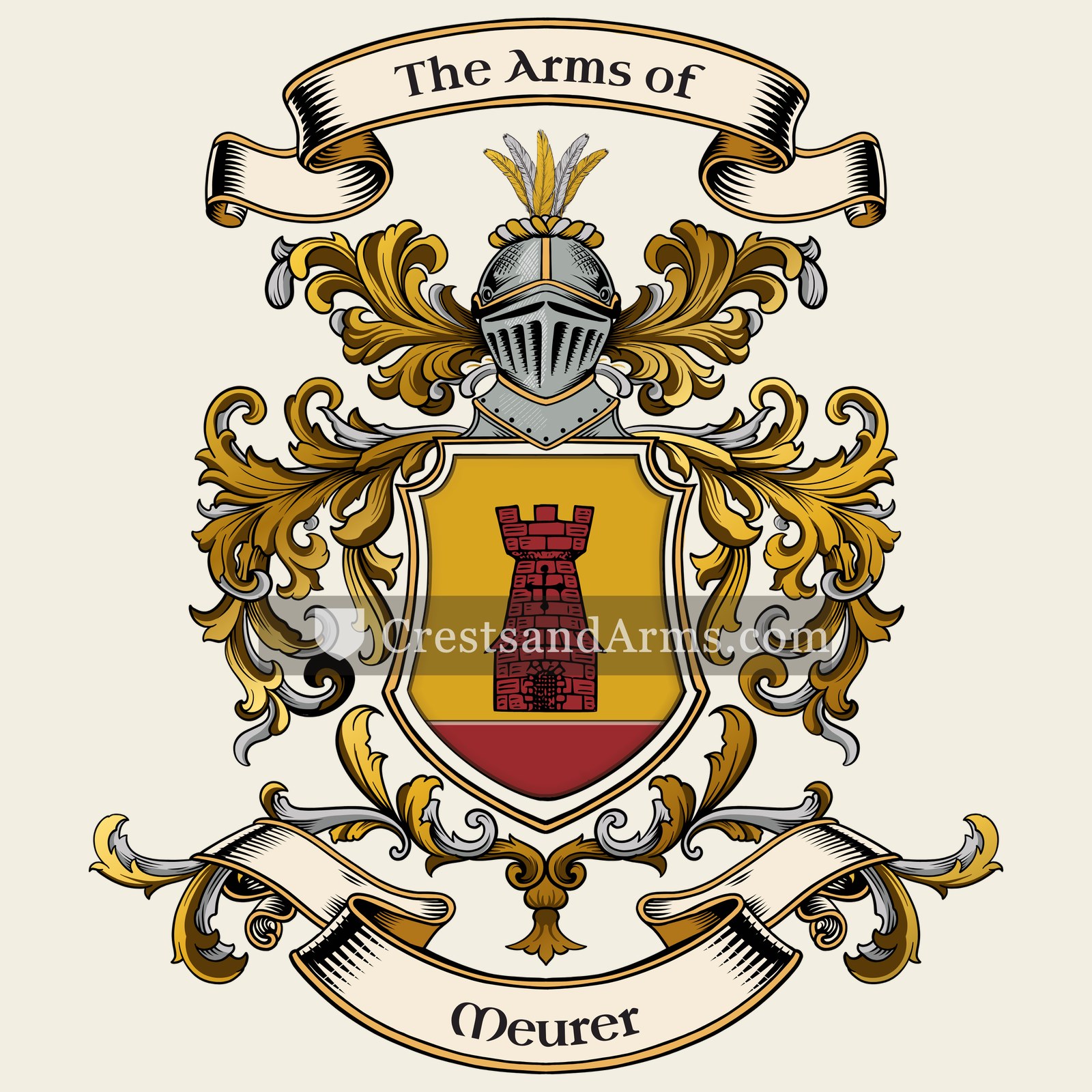


 mountThe ground held, and steadfastness upon it
 bendDefence, and the scarf of a commander
 treeLife, endurance and deep roots