Map of Netherlands showing where the Meyers arms are recorded
The Meyers arms were recorded in Breda, c. 1815.
This is where the arms were entered in the register. Families often moved to other parts of the country, so the same name can turn up in more than one region.
Region
Breda
Town
Breda
First recorded
1815
Granting Authority for the Meyers Arms
Hoge Raad van Adel
Photograph made by me · CC BY-SA 3.0
The body that granted and recorded arms in Netherlands in this period.
William I of the Netherlands
Sovereign of the period
William I of the Netherlands
1815–1840
Reigning in Netherlands when the Meyers arms are first recorded.
How Arms Worked in Netherlands
In the Netherlands, coats of arms were often used by noble families and those who held specific public offices. These arms were passed down through the generations to legitimate descendants. Younger branches of a family usually kept the original design without needing to add special marks. This system ensured that the family identity remained clear and consistent over many years.
Granting authority
The Hoge Raad van Adel is the official body that regulates and manages noble titles and coats of arms in the Netherlands.
How they got arms
Families typically obtained their coats of arms through official royal grants or by proving their long-standing historical use of the symbols.
Where arms were recorded
Coats of arms are officially recorded in the registers held by the Hoge Raad van Adel, which began its work in 1814.
The family's standing
Recorded among the armigerous families of Netherlands.
Origin & History of the Meyers Family in Netherlands
The surname Meyers is a patronymic name, which means it originally identified a person as the son of someone named Meyer. In the Dutch language, the name Meyer historically referred to a steward, a bailiff, or a tenant farmer who managed land for a landlord. By the time the family was documented in Breda in 1815, the name had transitioned from a job description into a permanent family identifier. During the early 19th century, the Netherlands underwent significant administrative changes under the Napoleonic Code, which required citizens to adopt and register fixed surnames for tax and military purposes. The presence of the Meyers family in Breda during this period suggests they were part of this formal registration process, likely settling into the urban landscape of the city as it transitioned from a fortified military stronghold into a growing center of trade and civil administration.
Coat of Arms & Family Crest Details
Symbols on this shield
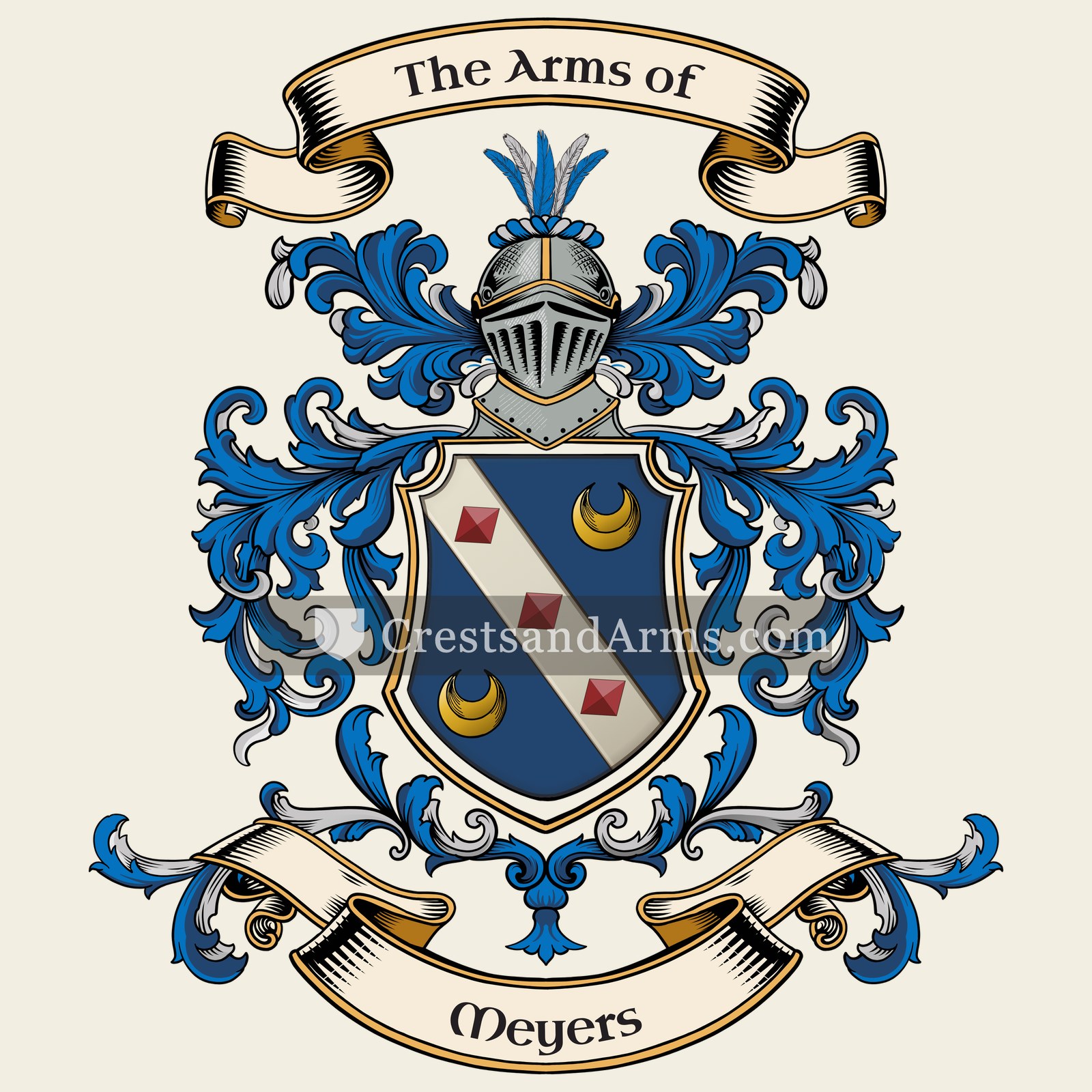
bendDefence, and the scarf of a commander
lozengeHonour and nobility, and the arms of a woman
crescentHonour by the sovereign, and the second son
Colours
Blue (Azure)Means: Loyalty and truth
Silver (Argent)Means: Peace and sincerity
Red (Gules)Means: Military strength
Gold (Or)Means: Generosity
Historical info
Source
J. B. Rietstap, Armorial Général, Gouda: G. B. van Goor Zonen, 1884–87
Blazon (the actual original written record)
“D'azur à la bande d'arg., ch. de trois fusées de gu., aboutées en bande, et acc. de deux croiss. affr. d'or, lesdits croiss. posés en bandes. C.: un croiss. montant d'or.”
LiegeLiege, c. 1737
Digital archive packCoat of arms PNG, gold border print PDF, vector SVG and the certificate of authenticity. Sent to your email in minutes.
Map of Belgium showing where the Meyers arms are recorded
The Meyers arms were recorded in Liege, c. 1737.
Liege was a prosperous town and its surrounding country, living on metalworking and trade. Merchant families grew rich, bought land outside the walls, and took arms as landowners rather than tradesmen.
This is where the arms were entered in the register. Families often moved to other parts of the country, so the same name can turn up in more than one region.
The body that granted and recorded arms in Belgium in this period.
Charles VI, Holy Roman Emperor
Sovereign of the period
Charles VI, Holy Roman Emperor
1711–1740
Reigning in Netherlands when the Meyers arms are first recorded.
How Arms Worked in Belgium
In Belgium, a coat of arms is considered personal property that is passed down through the male line to legitimate descendants. Families often use the same shield design across generations to show their shared heritage. If a branch of the family wants to change the design, they must apply for an official update to their specific version of the arms.
Granting authority
The Conseil héraldique is the official body that regulates and approves all coats of arms in Belgium.
How they got arms
Families obtain their coats of arms through formal royal grants or by confirming their historical right to use existing designs.
Where arms were recorded
All approved coats of arms are officially recorded in the public registers of the Conseil héraldique since 1844.
The family's standing
Recorded among the armigerous families of Liege.
Origin & History of the Meyers Family in Belgium
The surname Meyers has deep roots in the region of Liège, where records confirm family members were established as early as 1737. The name itself is a variation of the Middle Dutch word "meier," which originally referred to a steward or a bailiff who managed land for a nobleman or a religious institution. In the social structure of the eighteenth-century Prince-Bishopric of Liège, individuals holding this title were often responsible for collecting taxes, overseeing agricultural production, and maintaining order within their local jurisdictions. Because these roles required a degree of literacy and administrative skill, those bearing the name were frequently integrated into the local middle class. As the family grew, they became part of the complex social fabric of the Meuse River valley, navigating the shifting political landscape of a region caught between French and Germanic cultural influences. This history reflects a transition from a functional job title to a permanent family name that persisted through generations of life in the Liège area.
Coat of Arms & Family Crest Details
Symbols on this shield
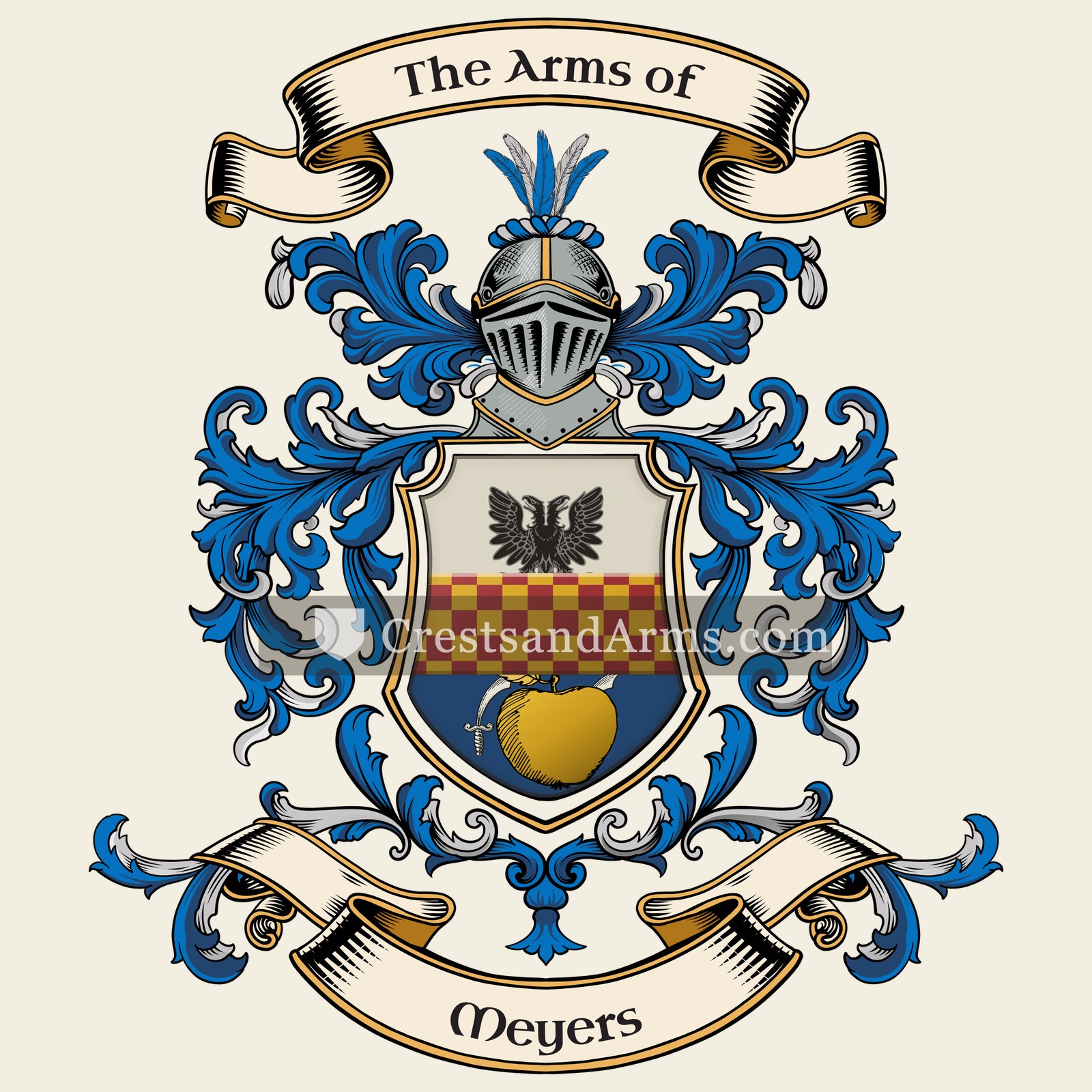
fessThe military belt, and readiness to serve
chequyConstancy, and the counting-board
eagleNobility, strength and a keen mind
swordJustice, and military honour
applePeace, plenty and long-standing settlement
Colours
Silver (Argent)Means: Peace and sincerity
Blue (Azure)Means: Loyalty and truth
Gold (Or)Means: Generosity
Red (Gules)Means: Military strength
Black (Sable)Means: Constancy
Historical info
Source
J. B. Rietstap, Armorial Général, Gouda: G. B. van Goor Zonen, 1884–87
Blazon (the actual original written record)
“Coupé: au 1 d'arg. à une tête et col de l'aigle de Prusse, mouv. du coupé; au 2 d'azur à deux épées d'arg., garnies d'or, passées en saut., br. sur une orange d'or, tigée et feuillée de sin., la tige en bas. A la fasce échiq. d'or et de gu. de trois tires, br. sur le coupé. C.: un chapeau d'arg., retr. du même, sommé de trois pl. d'arg., le bord ch. d'une aigle de gu. L.: d'arg. et de sa.”
Germanyc. 1765
Digital archive packCoat of arms PNG, gold border print PDF, vector SVG and the certificate of authenticity. Sent to your email in minutes.
Map of Germany showing where the Meyers arms are recorded
The Meyers arms were recorded in Germany, c. 1765.
Arms such as these were typically recorded in Bavaria.
Bavaria was a country of old landed families and walled market towns. Estates passed down the same line for centuries, and both the landowners and the leading townsmen kept arms, which is why so many Bavarian names sit in the registers.
This is where the arms were entered in the register. Families often moved to other parts of the country, so the same name can turn up in more than one region.
The body that granted and recorded arms in Germany in this period.
Francis I, Holy Roman Emperor
Sovereign of the period
Francis I, Holy Roman Emperor
1745–1765
Reigning in Netherlands when the Meyers arms are first recorded.
How Arms Worked in Germany
In the Holy Roman Empire, coats of arms were often granted to individuals by the Emperor or his representatives. These arms were then passed down through the generations to all legitimate descendants of the original holder. Younger branches of a family usually kept the same shield design without needing to change it, as the arms belonged to the entire lineage.
Granting authority
The Holy Roman Emperor held the sole power to grant new coats of arms throughout his vast imperial territories.
How they got arms
Families typically obtained their coats of arms through a formal imperial grant or by proving their noble status to the authorities.
Where arms were recorded
These grants were officially recorded in the Imperial Chancery registers, which began keeping formal records of such honors during the Middle Ages.
The family's standing
Recorded among the armigerous families of Germany.
Origin & History of the Meyers Family in Germany
The surname Meyers finds its roots in the German word *Meier*, which originally described a person who managed land or served as a steward for a local lord. During the Middle Ages, this title evolved from a professional role into a hereditary family name as society became more structured. By the time your ancestors were documented in Bavaria in 1765, the name was already well-established across the German-speaking regions. Families with this name often held positions of local responsibility, such as overseeing harvests or collecting taxes for the nobility. This connection to land management meant that many people named Meyers lived in stable agricultural communities for generations. Because the name was tied to a common profession, it spread naturally across different provinces as families moved in search of better farmland or administrative roles.
Meyers Meaning & Related Branches
Root word
maior
Latin term meaning greater, superior, or a high-ranking official.
This name
MeyersOccupational title for a steward, bailiff, or manager of a large estate.
also spelled
Meyerss
Meyersz
Meyersse
Myers
Documented Sources
J. B. Rietstap, Armorial Général, Gouda: G. B. van Goor Zonen, 1884–87
Leenders, K.A.H.W., Van Turnhoutervoorde tot Turnhout: Een onderzoek naar de geschiedenis van de bewoning en de ontginning in de Kempen, 1996
Meertens, P.J., De betekenis van de Nederlandse familienamen, 1959


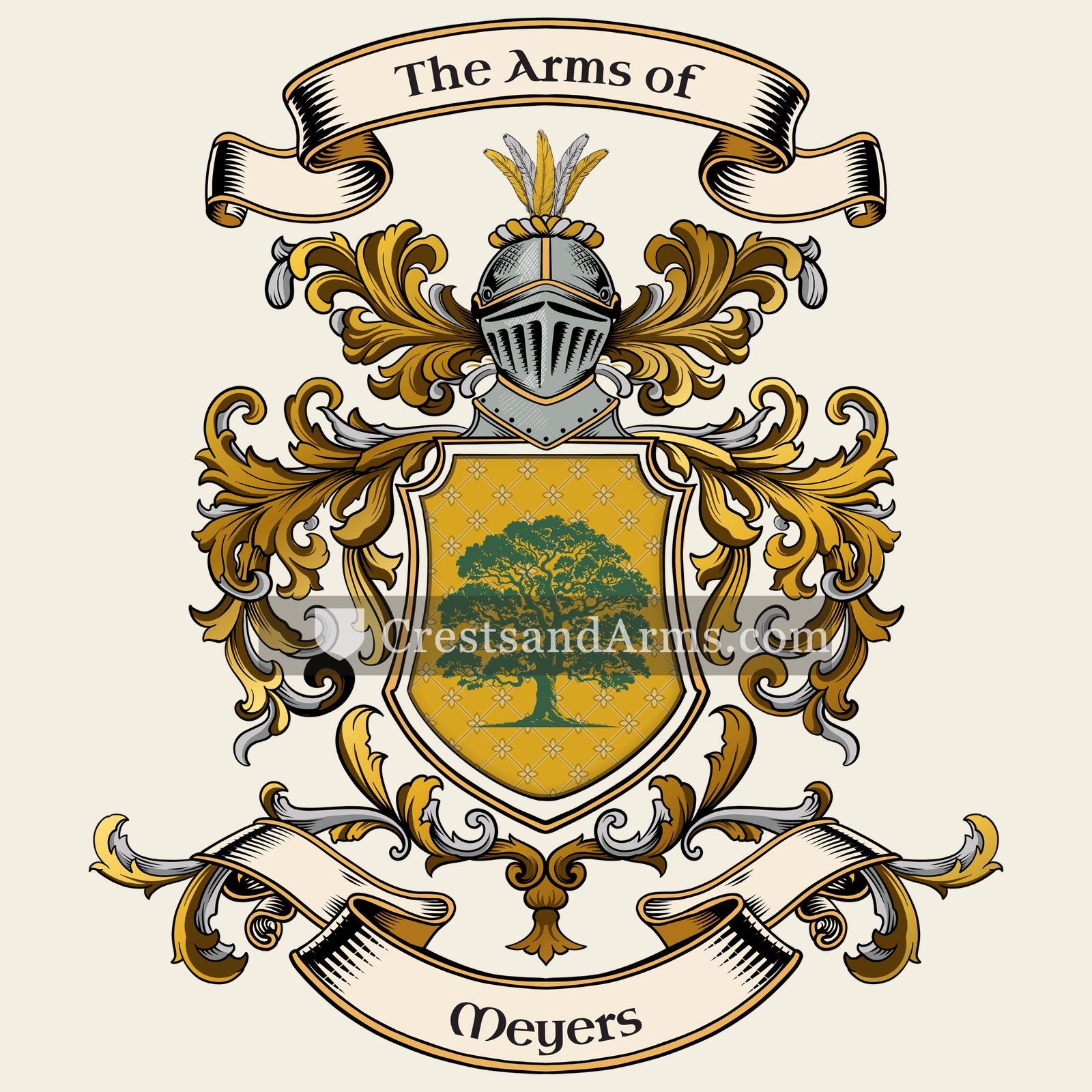
 treeLife, endurance and deep roots
 treeLife, endurance and deep roots


 bendDefence, and the scarf of a commander
 lozengeHonour and nobility, and the arms of a woman
 crescentHonour by the sovereign, and the second son


 fessThe military belt, and readiness to serve
 chequyConstancy, and the counting-board
 eagleNobility, strength and a keen mind
 swordJustice, and military honour
 applePeace, plenty and long-standing settlement