Map of France showing where the Michaud arms are recorded
The Michaud arms were recorded in Franche-Comte, c. 1663.
Franche-Comte sat between France and the Empire and changed hands more than once. Border families held their land under arms and expected to defend it, so a shield was a practical thing rather than an ornament.
This is where the arms were entered in the register. Families often moved to other parts of the country, so the same name can turn up in more than one region.
The body that granted and recorded arms in France in this period.
Louis XIV of France
Sovereign of the period
Louis XIV of France
1643–1715
Reigning in France when the Michaud arms are first recorded.
How Arms Worked in France
In France, a coat of arms was a mark of honor that passed down through the male line to all legitimate descendants. Families often used the same shield without changes to show their shared heritage. If a branch wanted to stand out, they could add a small mark to their shield to show their specific place in the family tree.
Granting authority
The Juge d'armes de France acted as the official authority that regulated and verified coats of arms across the country.
How they got arms
Families typically inherited their arms from ancestors, though they could also receive them through royal grants or by proving their noble status.
Where arms were recorded
Coats of arms were officially recorded in the Armorial Général de France, which began its main collection in the year 1696.
The family's standing
Recorded among the armigerous families of Franche-Comte.
Origin & History of the Michaud Family in France
The surname Michaud originated in France as a diminutive form of the name Michel, which is the French version of Michael. During the medieval period, it was common for families to adopt nicknames based on a father’s first name, and over time, these names became permanent hereditary surnames. By the seventeenth century, the Michaud family was well-established in the Franche-Comté region, a mountainous area near the border of modern-day Switzerland. Life in this province was defined by its unique legal status and its proximity to trade routes crossing the Jura Mountains. Families in this region often worked as farmers, craftsmen, or local officials, contributing to the distinct cultural identity of the area. The presence of the Michaud name in official records from 1663 highlights the family's deep roots in this historic province, where they lived through the transition of the region from Spanish control to its permanent integration into the Kingdom of France.
Coat of Arms & Family Crest Details
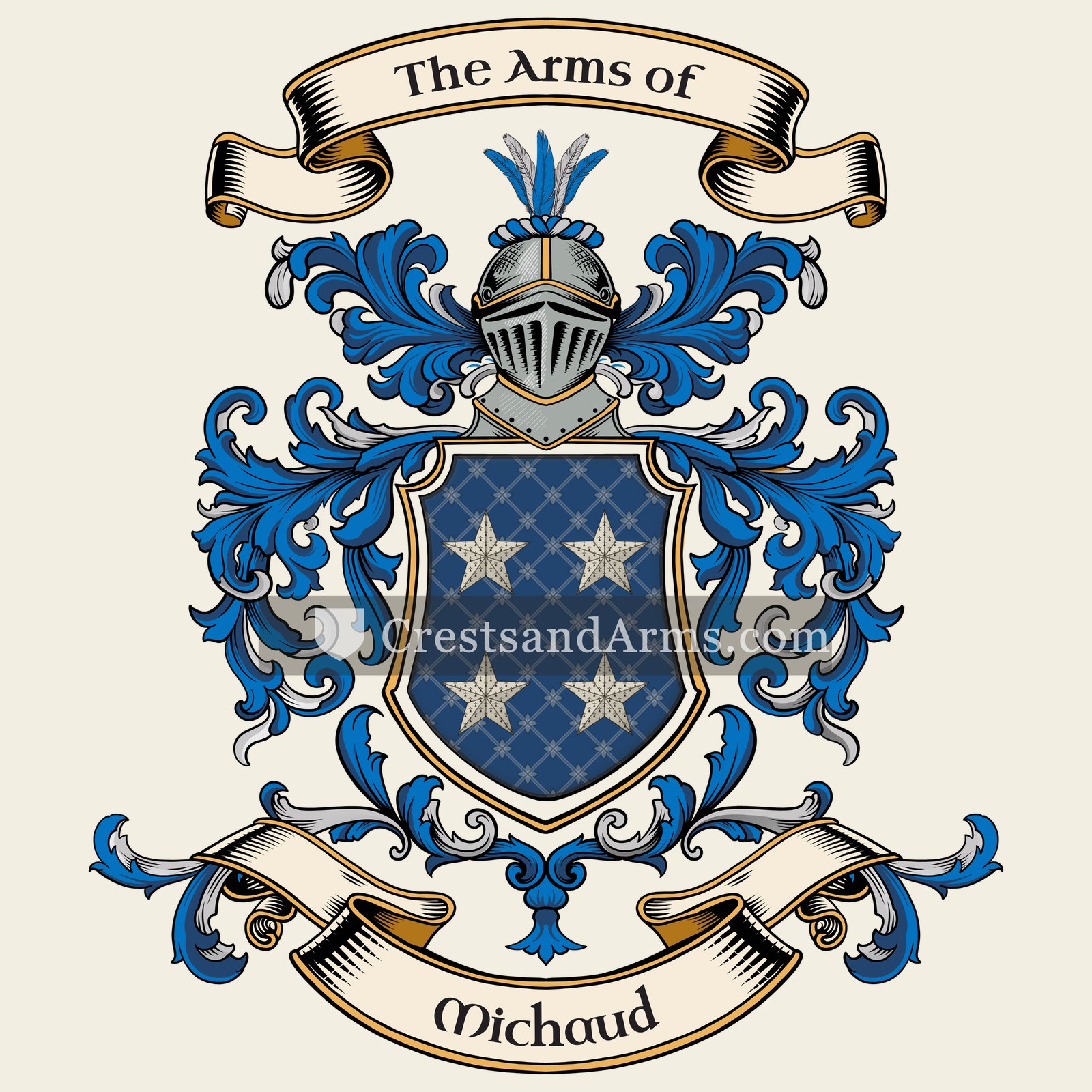
Symbols on this shield
mulletThe third son, and a divine quality from above
Colours
Blue (Azure)Means: Loyalty and truth
ErmineMeans: Dignity
Historical info
Source
J. B. Rietstap, Armorial Général, Gouda: G. B. van Goor Zonen, 1884–87
Blazon (the actual original written record)
“D'azur à deux peignes d'arg. à un seul rang de dents, posés en fasces, l'un sur l'autre, les dents du premier dirigées en haut et celles de l'autre dirigées en bas; le tout cant. de quatre molettes (6) d'er.”
SwitzerlandNeufchâtel, c. 1745
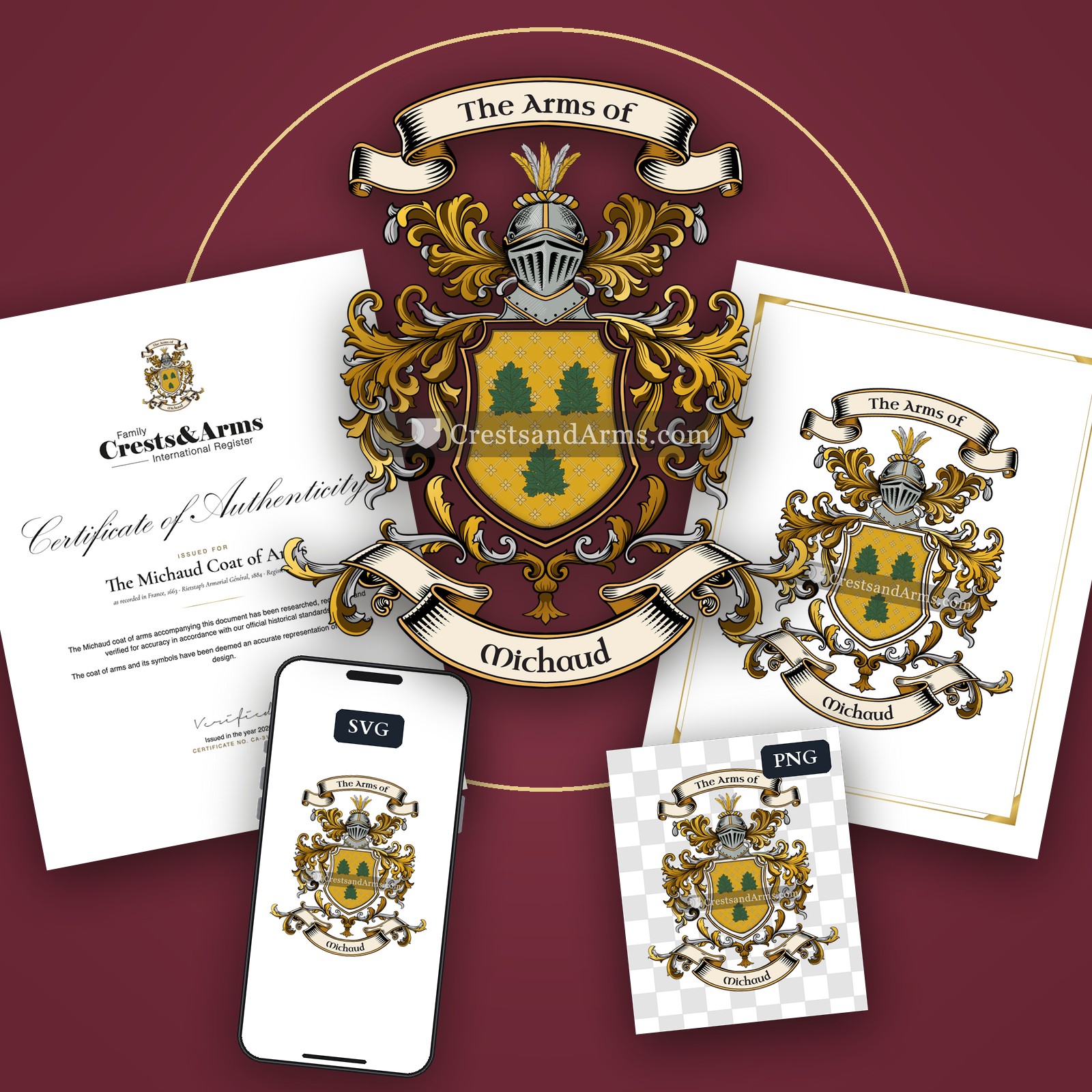
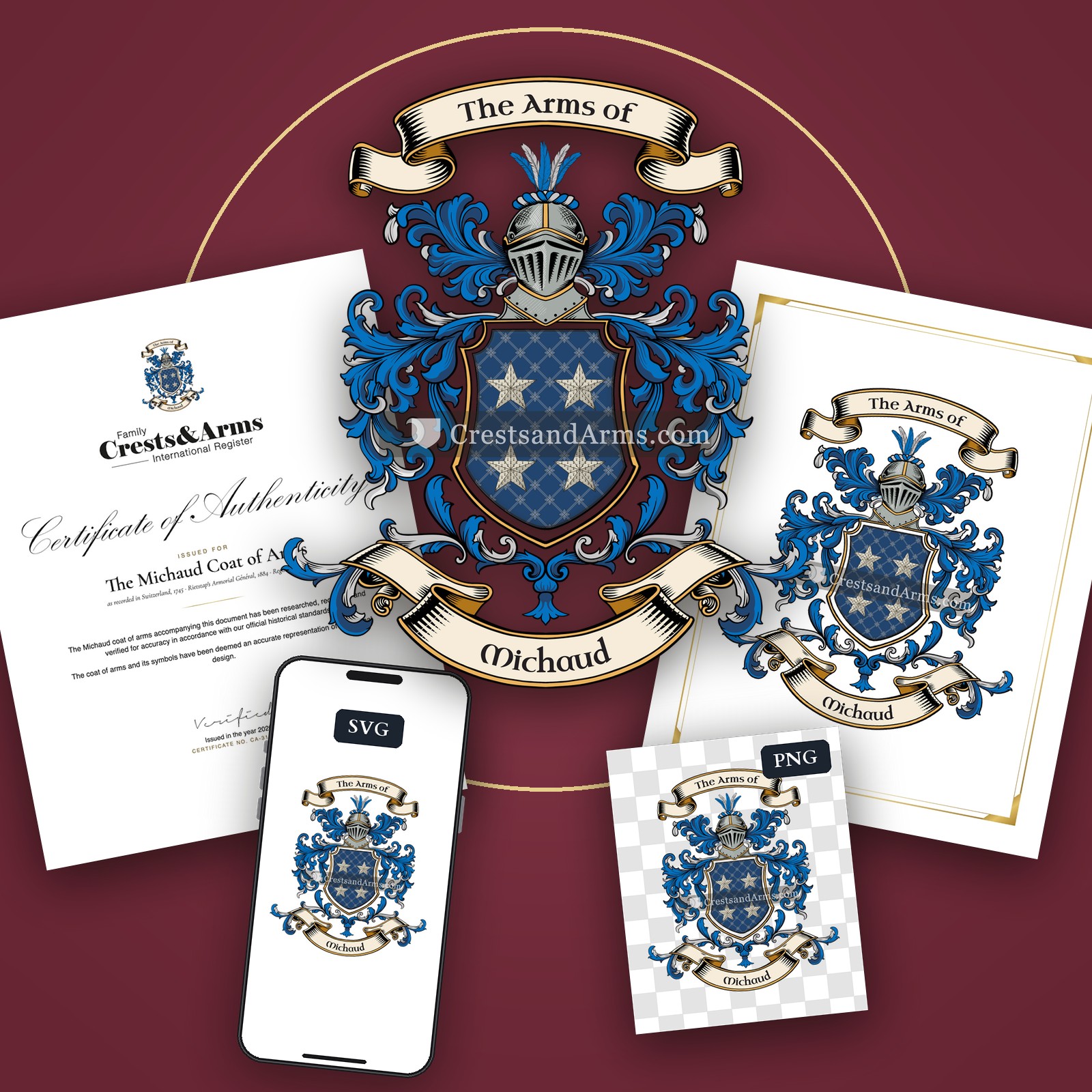
Digital archive packCoat of arms PNG, gold border print PDF, vector SVG and the certificate of authenticity. Sent to your email in minutes.
Map of Switzerland showing where the Michaud arms are recorded
The Michaud arms were recorded in Neufchâtel, c. 1745.
This is where the arms were entered in the register. Families often moved to other parts of the country, so the same name can turn up in more than one region.
The body that granted and recorded arms in Switzerland in this period.
How Arms Worked in Switzerland
In Switzerland, coats of arms were not restricted to the nobility and were often adopted by common citizens and families. These symbols were passed down through generations to show family identity. When branches of a family grew, they often changed small details of the design to distinguish their own line from the original group.
Granting authority
Cantonal and civic authorities managed the use of coats of arms within their specific regions and local jurisdictions.
How they got arms
Families typically assumed their own coats of arms based on local custom rather than receiving them from a central monarch.
Where arms were recorded
Arms were recorded in various cantonal and civic registers starting from the fourteenth century throughout the Swiss region.
The family's standing
Recorded among the armigerous families of Switzerland.
Origin & History of the Michaud Family in Switzerland
The surname Michaud finds its roots in the French-speaking regions of Switzerland, where it functioned as a patronymic name derived from the given name Michel. By the mid-eighteenth century, the family had established a notable presence in the canton of Neuchâtel. Records from 1745 confirm that members of the Michaud family were integrated into the local social and economic fabric of this region. During this era, families in Neuchâtel often lived in small, tight-knit communities where they worked as skilled artisans, farmers, or tradespeople. The name reflects a long history of migration and settlement within the Jura Mountains, as families moved across the borderlands between France and Switzerland to seek new opportunities. Because Neuchâtel was a principality with unique political ties to Prussia at the time, the Michaud family lived through a period of significant cultural exchange that helped shape their identity in the region.
Michaud Meaning & Related Branches
Root word
Michel
Hebrew name meaning who is like God
This name
MichaudA diminutive form indicating a descendant or follower of Michael
also spelled
Michault
Misho
Related arms
Michaultvariant spelling
Michauxvariant spelling
Micheauvariant spelling
Michotvariant spelling
Documented Sources
J. B. Rietstap, Armorial Général, Gouda: G. B. van Goor Zonen, 1884–87
Dauzat, Albert. Dictionnaire étymologique des noms et prénoms de France. 1951
Archives départementales du Doubs. Série B: Cours et juridictions. 1663
Fichot, Jean-Marie. Histoire de la Franche-Comté. 1976
Digital archive packCoat of arms PNG, gold border print PDF, vector SVG and the certificate of authenticity. Sent to your email in minutes.


 leafHappiness and abundance
 leafHappiness and abundance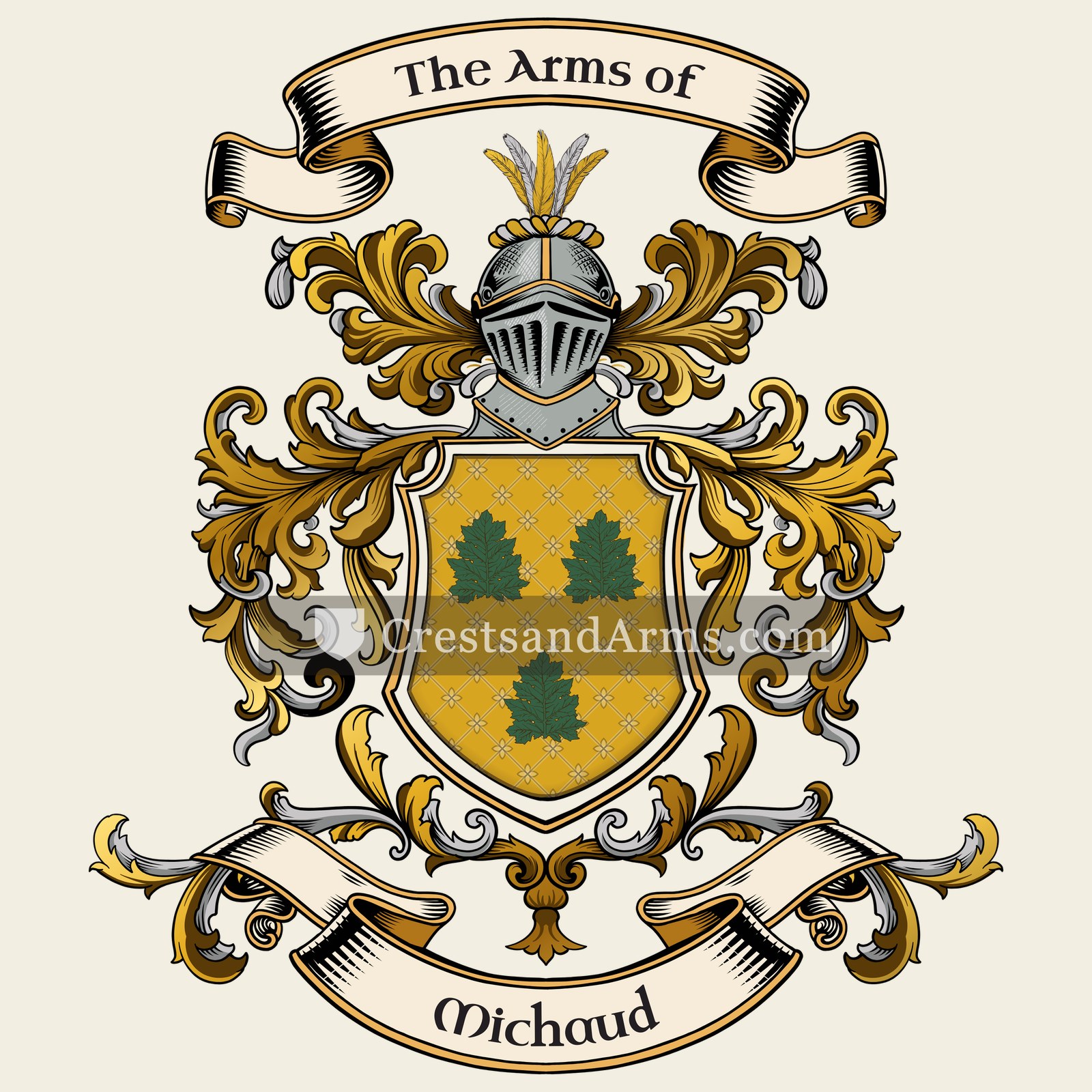


 mulletThe third son, and a divine quality from above