Map of England showing where the Middleton arms are recorded
The Middleton arms were recorded in London, c. 1613.
This is where the arms were entered in the register. Families often moved to other parts of the country, so the same name can turn up in more than one region.
The body that granted and recorded arms in England in this period.
James VI and I
Sovereign of the period
James VI and I
1603–1625
Reigning in England when the Middleton arms are first recorded.
How Arms Worked in England
English heraldry allowed arms to be shared by all legitimate descendants of the original owner. These symbols were treated as personal property that moved through the generations to all children. While the eldest son kept the original design, other family members could use the same shield without needing to change it or register their own unique versions.
Granting authority
The College of Arms in London has regulated the use of coats of arms throughout England and Wales since 1484.
How they got arms
Families typically obtained their coats of arms through a formal grant from the Crown or by proving their ancient right to them.
Where arms were recorded
All official coats of arms are recorded in the registers kept at the College of Arms, which date back to the fifteenth century.
The family's standing
Recorded among the armigerous families of England.
Origin & History of the Middleton Family in England
The surname Middleton is a classic example of a locative name, meaning it was originally adopted by people who lived in a "middle town" or a settlement situated between two larger locations. Because many villages across England shared this descriptive geography, the name emerged independently in several different counties rather than originating from a single common ancestor. By the early 17th century, the family had established a notable presence in London, a period when the city was rapidly expanding as a center for trade and government. Records from 1613 show that members of the Middleton family were already integrated into the social and economic life of the capital, likely participating in the bustling merchant networks that defined the era. As these individuals moved through the city, they carried a name that reflected the practical, landscape-based naming traditions of medieval England.
Coat of Arms & Family Crest Details
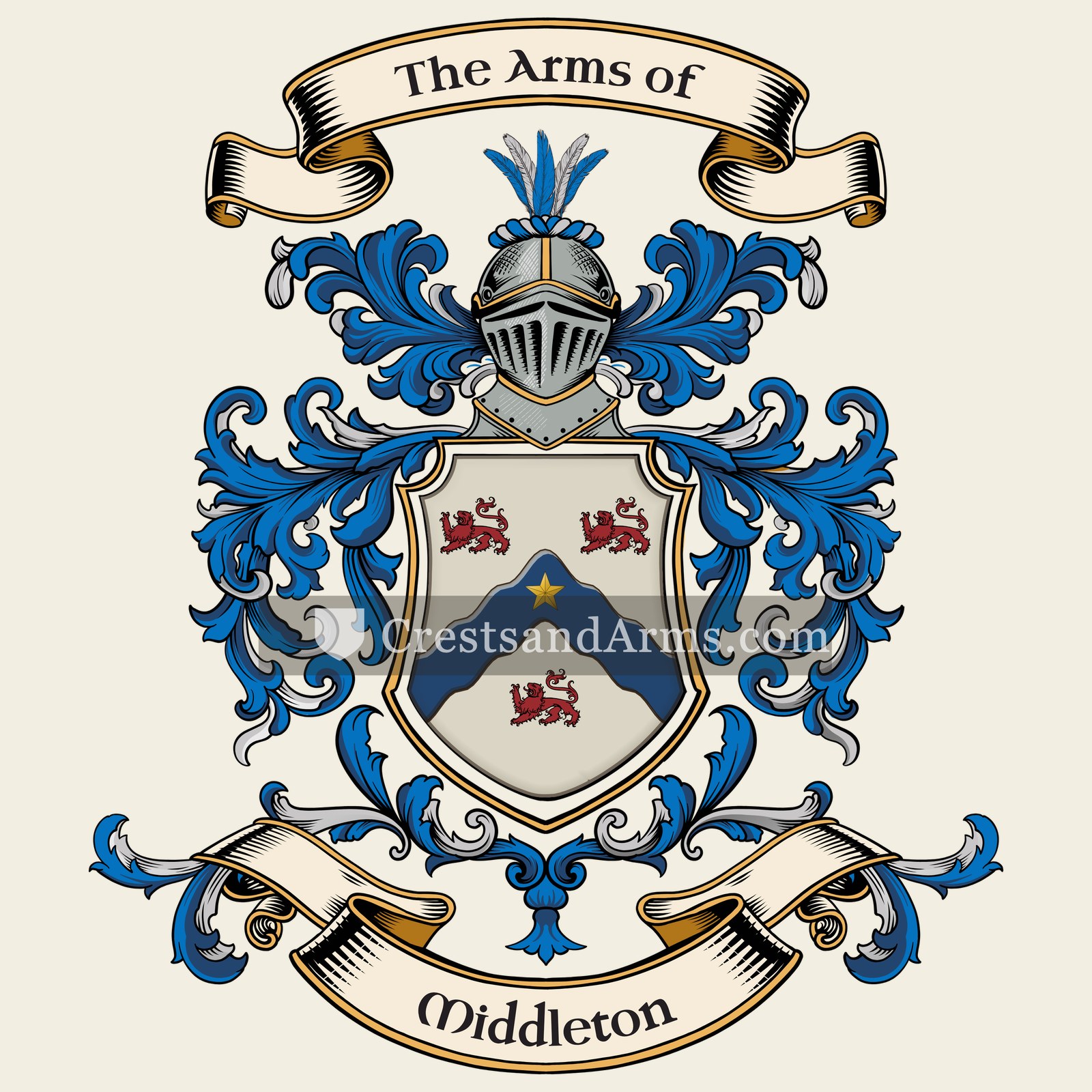
Symbols on this shield
lionCourage, strength and royalty
Colours
Gold (Or)Means: Generosity
Red (Gules)Means: Military strength
Historical info
Source
Sir Bernard Burke, The General Armory of England, Scotland, Ireland and Wales, London: Harrison & Sons, 1884
Blazon (the actual original written record)
“Per fess or and gu. a lion ramp. counterchanged, holding in the dexter paw an astrolabe ppr”
AberdeenFraserburgh · Aberdeen, c. 1672
Digital archive packCoat of arms PNG, gold border print PDF, vector SVG and the certificate of authenticity. Sent to your email in minutes.
Map of Scotland showing where the Middleton arms are recorded
The Middleton arms were recorded in Aberdeen, c. 1672.
Aberdeen was a granite trading town on the north-east coast with farming country behind it. Merchants who prospered bought estates inland, and buying an estate was what brought a family its arms.
This is where the arms were entered in the register. Families often moved to other parts of the country, so the same name can turn up in more than one region.
The body that granted and recorded arms in Scotland in this period.
Charles II of England
Sovereign of the period
Charles II of England
1660–1685
Reigning in England when the Middleton arms are first recorded.
How Arms Worked in Scotland
Scottish heraldry is unique because it treats a coat of arms as a piece of personal property protected by law. Only one person can own a specific design at any given time. When a family grows, the head keeps the original shield while other relatives must apply for their own distinct version with slight changes to prove their specific identity.
Granting authority
The Court of the Lord Lyon acts as the official body that regulates and controls all heraldic matters throughout Scotland.
How they got arms
Individuals obtain a legal right to their arms through a formal petition process that confirms their identity and family connection.
Where arms were recorded
All valid coats of arms are officially entered into the Public Register of All Arms and Bearings starting from 1672.
The family's standing
Recorded among the armigerous families of Aberdeen.
Origin & History of the Middleton Family in Scotland
The surname Middleton is a locational name, meaning it was originally given to families who lived in a place called Middleton, which translates to the middle farm or middle settlement. While the name appears in various parts of Britain, the Scottish branch has deep roots in the northeastern region near Aberdeen. By 1672, records confirm that members of the family were well-established in this area, often working as landowners or professionals within the local community. These early Middletons were part of the social fabric of Aberdeenshire, living through a time of significant political and religious change in Scotland. Their presence in the region suggests that they were settled, stable members of society who contributed to the local economy and regional development during the late seventeenth century.
Coat of Arms & Family Crest Details
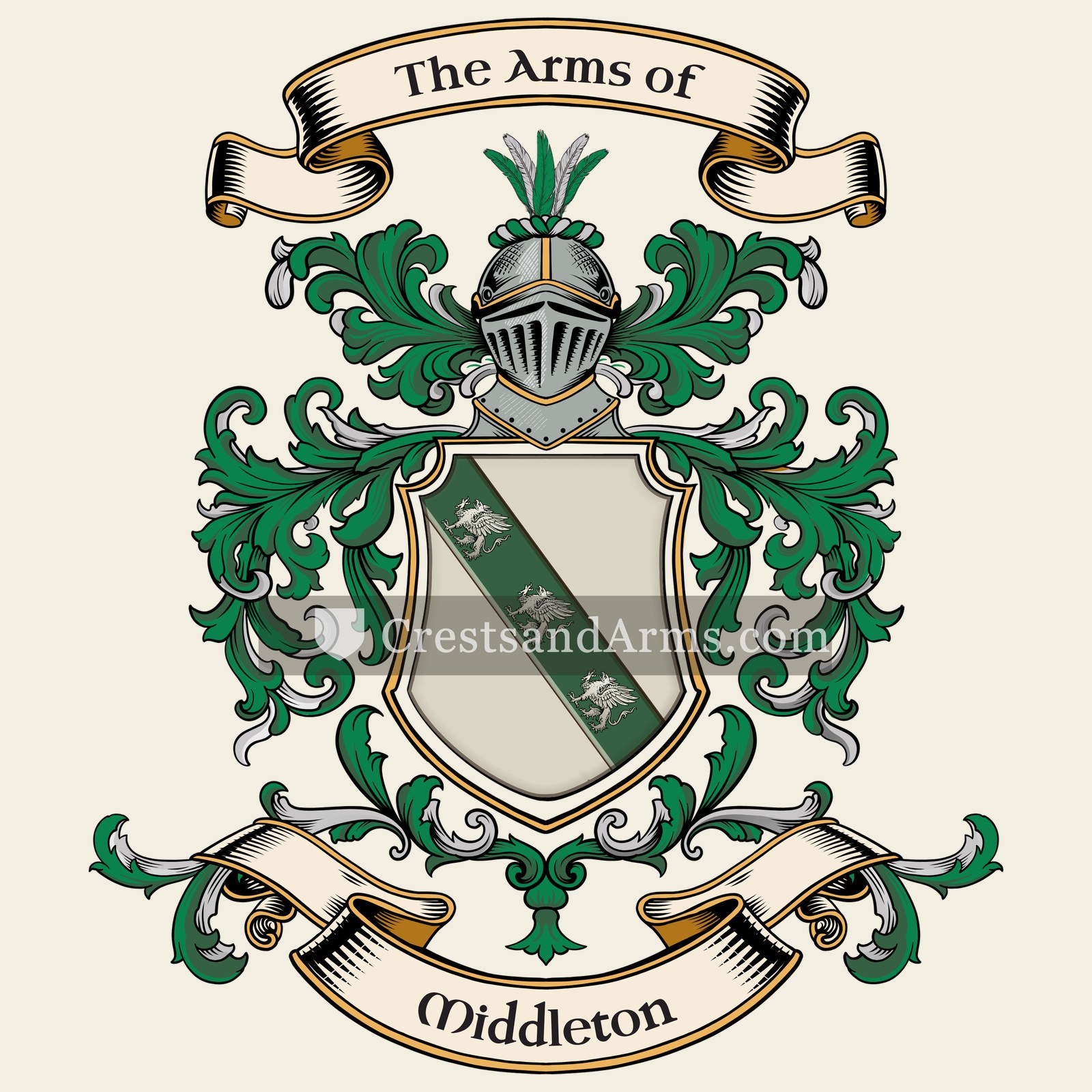
Symbols on this shield
chevronProtection, and faithful service completed
lionCourage, strength and royalty
mulletThe third son, and a divine quality from above
Colours
Silver (Argent)Means: Peace and sincerity
Blue (Azure)Means: Loyalty and truth
Red (Gules)Means: Military strength
Gold (Or)Means: Generosity
Historical info
Source
Sir Bernard Burke, The General Armory of England, Scotland, Ireland and Wales, London: Harrison & Sons, 1884
Blazon (the actual original written record)
“Ar. on a chev. wavy az. betw. three lions' heads erased gu. a star or”
IrelandPrincipal Herald, c. 1645
Digital archive packCoat of arms PNG, gold border print PDF, vector SVG and the certificate of authenticity. Sent to your email in minutes.
Map of Ireland showing where the Middleton arms are recorded
The Middleton arms were recorded in Principal Herald, c. 1645.
Arms such as these were typically recorded in Dublin.
Dublin was the seat of government in Ireland and the place where grants were sought and recorded. Families with business at the castle or the courts settled nearby, and settling there put their arms on record.
This is where the arms were entered in the register. Families often moved to other parts of the country, so the same name can turn up in more than one region.
The body that granted and recorded arms in Ireland in this period.
Charles I of England
Sovereign of the period
Charles I of England
1625–1649
Reigning in England when the Middleton arms are first recorded.
How Arms Worked in Ireland
The Ulster King of Arms granted coats of arms to individuals who proved their social standing and good character. These symbols were typically inherited by all legitimate descendants of the original holder. If a family branch wanted a unique look, they could apply for a specific change to their design through the office to ensure their identity remained distinct.
Granting authority
The Ulster King of Arms acted as the official body that regulated and issued all coats of arms throughout Ireland.
How they got arms
Families obtained their arms through formal grants issued by the office after proving their eligibility and paying the required fees.
Where arms were recorded
All official grants were recorded in the registers held by the Ulster King of Arms starting from the year 1552.
The family's standing
Recorded among the armigerous families of Ireland.
Origin & History of the Middleton Family in Ireland
The Middleton name arrived in Ireland as part of the broader movement of English settlers during the seventeenth century. By 1645, records confirm that members of the family were already established in Dublin, which was then a bustling center of trade and colonial administration. These early settlers often arrived as merchants, soldiers, or government officials seeking new opportunities in a changing political landscape. Because the name is of English origin, it likely represented a family that maintained strong ties to their homeland while adapting to life in a new country. Over time, these individuals integrated into the local economy and social structure of the city. Their presence in the capital during the mid-1600s suggests that the family was part of the growing urban middle class that helped shape the development of Dublin during a period of significant historical transition.
Middleton Meaning & Related Branches
Root word
Middel-tun
Old English for middle settlement or enclosure.
This name
MiddletonRefers to a person who lived in a settlement located between other places.
also spelled
Middelton
Mydelton
Myddleton
Related arms
Middelton de Hackneyvariant spelling
Midelton, or Middletonvariant spelling
Aty, or Attyerecorded with Middleton, same area
Baesherecorded with Middleton, same area
Documented Sources
Sir Bernard Burke, The General Armory of England, Scotland, Ireland and Wales, London: Harrison & Sons, 1884
Bardsley, Charles Wareing, A Dictionary of English and Welsh Surnames, 1901
Reaney, P.H., A Dictionary of British Surnames, 1958
The National Archives, Kew, Records of the Prerogative Court of Canterbury, PROB 11 (Wills and administrations from the early 17th century)
Digital archive packCoat of arms PNG, gold border print PDF, vector SVG and the certificate of authenticity. Sent to your email in minutes.


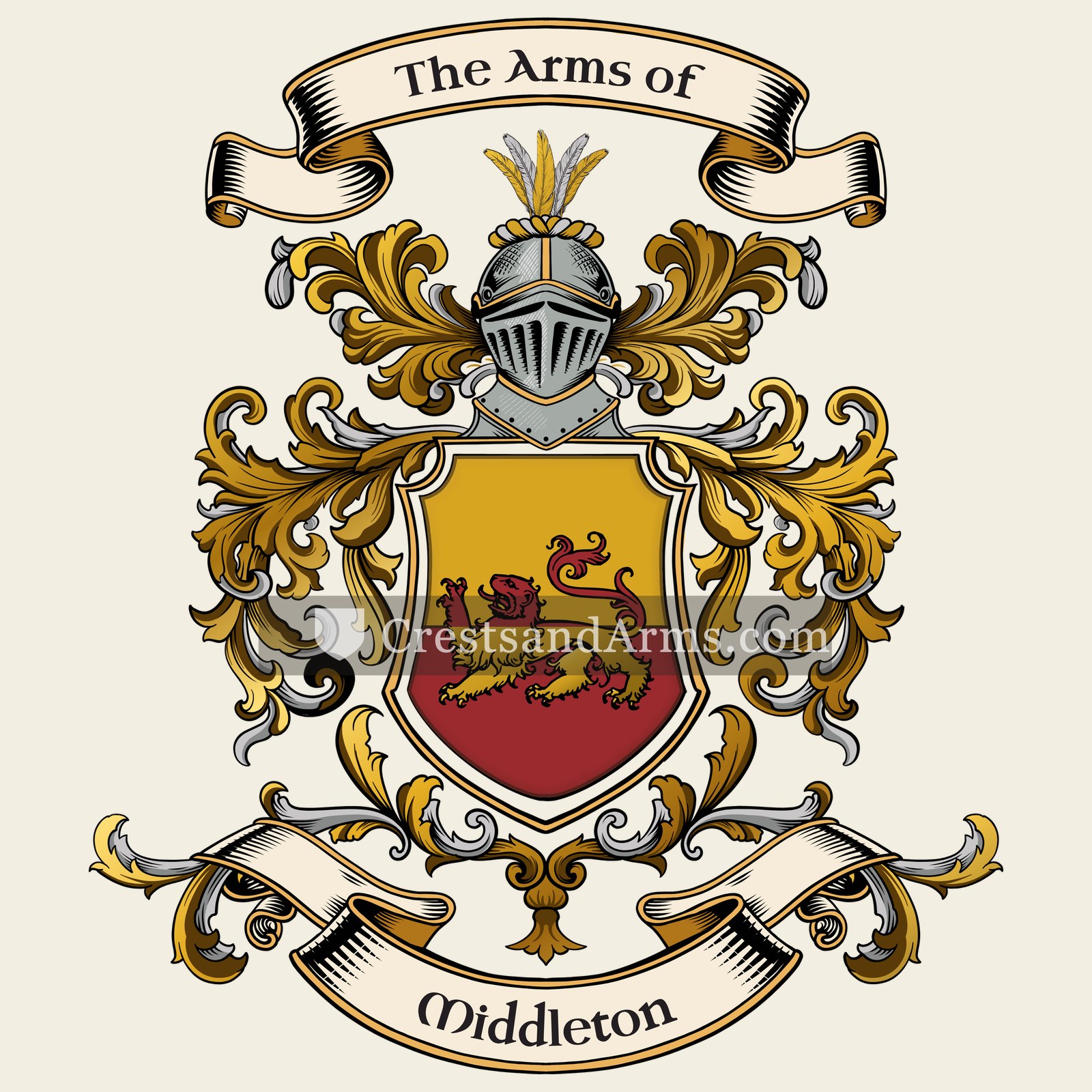
 bendDefence, and the scarf of a commander
 griffinValour and vigilance, guarding great treasure
 bendDefence, and the scarf of a commander
 griffinValour and vigilance, guarding great treasure


 lionCourage, strength and royalty


 chevronProtection, and faithful service completed
 mulletThe third son, and a divine quality from above