Map of Italy showing where the Miele arms are recorded
The Miele arms were recorded in Naples, c. 1775.
Naples was the largest city in Italy and the seat of a kingdom. Its noble houses were numerous, and the kingdom kept formal lists of the families entitled to arms, which is why so many appear in the records.
This is where the arms were entered in the register. Families often moved to other parts of the country, so the same name can turn up in more than one region.
The body that granted and recorded arms in Italy in this period.
Alvise Giovanni Mocenigo
Sovereign of the period
Alvise Giovanni Mocenigo
1763–1778
Reigning in Italy when the Miele arms are first recorded.
How Arms Worked in Italy
In the Italian states, coats of arms were often used by noble families to show their status and history. These symbols were passed down through the generations to all legitimate male descendants. Younger branches of a family usually kept the original design but sometimes added small changes to distinguish their specific line from the main branch.
Granting authority
Various local rulers and city governments controlled the use of coats of arms across the different Italian states.
How they got arms
Families often assumed their own arms or received them as official grants from local lords, popes, or city councils.
Where arms were recorded
Arms were recorded in local city archives or private family books rather than in one single national register.
The family's standing
Recorded among the armigerous families of Naples.
Origin & History of the Miele Family in Italy
The surname Miele originates from the Italian word for honey, which suggests that the family’s earliest ancestors likely worked as beekeepers or traded in honey and wax. During the medieval period, many Italian surnames were adopted based on a person’s trade, nickname, or physical traits. By the time the family was firmly established in Naples in 1775, the name had become a well-recognized part of the local social fabric. Naples was a major center for commerce and culture at that time, and families living there often held roles in the city's vibrant markets or served in local administrative positions. The Miele family name reflects this history of craftsmanship and trade, marking them as people who were deeply integrated into the daily economic life of southern Italy long before the late 18th century.
Coat of Arms & Family Crest Details
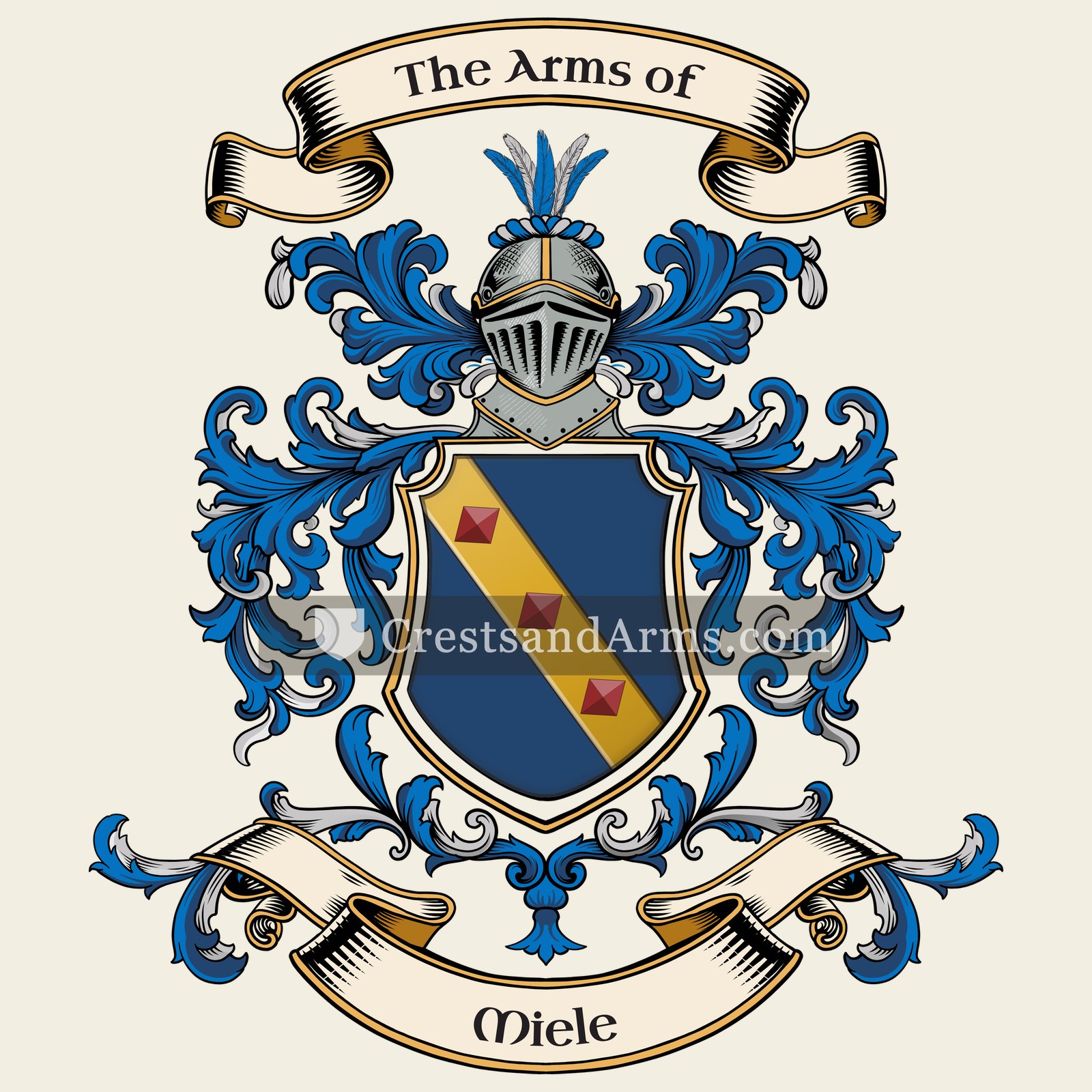
Symbols on this shield
bendDefence, and the scarf of a commander
lozengeHonour and nobility, and the arms of a woman
Colours
Blue (Azure)Means: Loyalty and truth
Gold (Or)Means: Generosity
Red (Gules)Means: Military strength
Historical info
Source
Sir Bernard Burke, The General Armory of England, Scotland, Ireland and Wales, London: Harrison & Sons, 1884
Blazon (the actual original written record)
“Az. on a bend or, three lozenges gu. (another, sa.)”
KentKent, c. 1620
Digital archive packCoat of arms PNG, gold border print PDF, vector SVG and the certificate of authenticity. Sent to your email in minutes.
Map of England showing where the Miele arms are recorded
The Miele arms were recorded in Kent, c. 1620.
Kent sits between London and the short crossing to Europe, and the trade passing through made it wealthy. Merchant families bought land with that money, and it was landowners who took coats of arms.
This is where the arms were entered in the register. Families often moved to other parts of the country, so the same name can turn up in more than one region.
The body that granted and recorded arms in England in this period.
James VI and I
Sovereign of the period
James VI and I
1603–1625
Reigning in Italy when the Miele arms are first recorded.
How Arms Worked in England
English heraldry allowed arms to be shared by all legitimate descendants of the original owner. These symbols were treated as personal property that moved through the generations to all children. While the eldest son kept the original design, other family members could use the same shield without needing to change it or register their own unique versions.
Granting authority
The College of Arms in London has regulated the use of coats of arms throughout England and Wales since 1484.
How they got arms
Families typically obtained their coats of arms through a formal grant from the Crown or by proving their ancient right to them.
Where arms were recorded
All official coats of arms are recorded in the registers kept at the College of Arms, which date back to the fifteenth century.
The family's standing
Recorded among the armigerous families of Kent.
Origin & History of the Miele Family in England
The family name Miele carries a distinct history that traces back to the early seventeenth century in the county of Kent, England. By 1620, records confirm that members of the family were already established within this region, which was a hub for trade and agriculture during the Stuart period. The name itself is often linked to linguistic roots suggesting a connection to the trade of honey or the work of a beekeeper, as the word reflects terms for honey in several European languages. Settling in Kent placed the family in a strategically important area near the English Channel, where they likely participated in the local economy of the coastal towns or the fertile farming communities of the Garden of England. Over time, the family became part of the social fabric of the region, contributing to the local workforce and the development of their community during a time of significant transition in English history.
Related Branches & Arms
Root word
Mel
Latin term for honey
This name
MieleAn occupational name for a beekeeper or a merchant who sold honey.
also spelled
Melle
Melay
Meel
Meell
Documented Sources
J. B. Rietstap, Armorial Général, Gouda: G. B. van Goor Zonen, 1884–87
De Felice, Emidio. Dizionario dei cognomi italiani. 1978
Archivio di Stato di Napoli, Stato Civile della Restaurazione
Digital archive packCoat of arms PNG, gold border print PDF, vector SVG and the certificate of authenticity. Sent to your email in minutes.


 fessThe military belt, and readiness to serve
 lionCourage, strength and royalty
 mulletThe third son, and a divine quality from above
 fessThe military belt, and readiness to serve
 lionCourage, strength and royalty
 mulletThe third son, and a divine quality from above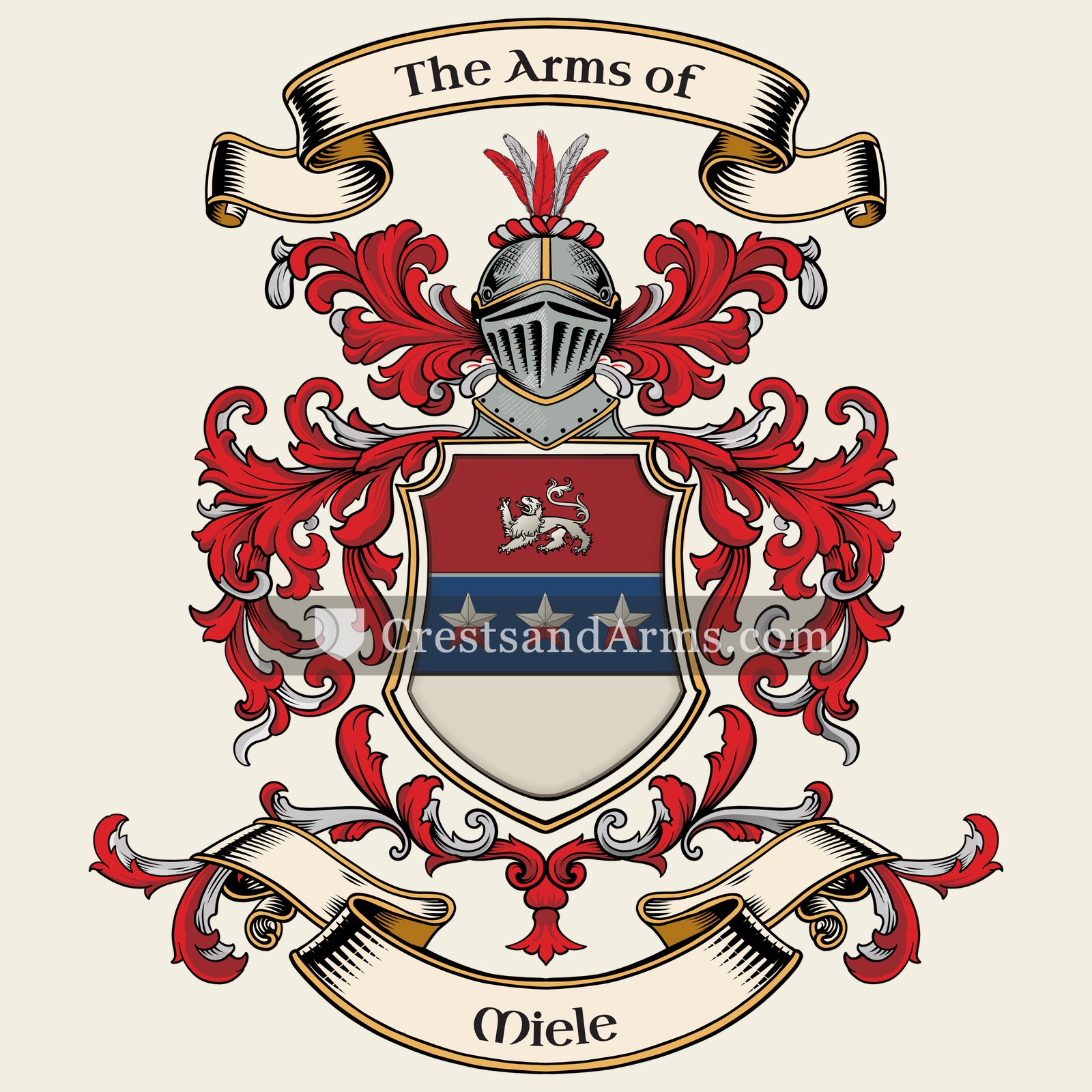


 bendDefence, and the scarf of a commander
 lozengeHonour and nobility, and the arms of a woman