Map of Poland showing where the Mier arms are recorded
The Mier arms were recorded in Poland, c. 1772.
Arms such as these were typically recorded in Mazovia.
Mazovia held Warsaw, the Polish court and the assemblies where the szlachta met. Poland's nobles were unusually numerous and every one of them bore arms, and Warsaw is where those arms were argued over and recorded.
This is where the arms were entered in the register. Families often moved to other parts of the country, so the same name can turn up in more than one region.
Region
Mazovia
First recorded
1772
Granting Authority for the Mier Arms
Ennoblement by the Sejm
Author: Olek Remesz · CC BY-SA 3.0
The body that granted and recorded arms in Poland in this period.
Stanisław August Poniatowski
Sovereign of the period
Stanisław August Poniatowski
1764–1795
Reigning in Poland when the Mier arms are first recorded.
How Arms Worked in Poland
Polish noble families shared a single coat of arms across many different surnames, creating large clans rather than individual designs. These symbols were held collectively by all members of the clan regardless of their specific family name. When a new family joined the nobility, they were adopted into an existing clan and began using that group's established shield.
Granting authority
The Sejm, which was the Polish parliament, held the power to grant noble status and the right to bear arms.
How they got arms
Families typically received their coat of arms through a formal act of ennoblement granted by the Sejm for distinguished service.
Where arms were recorded
These grants were officially recorded in the Crown Metrica, which served as the central archive for state documents starting in the sixteenth century.
The family's standing
Recorded among the armigerous families of Poland.
Origin & History of the Mier Family in Poland
The history of the Mier family in Poland is deeply rooted in the historical region of Mazovia, where records confirm their presence by 1772. During this period, Mazovia was a central hub of Polish social and political life, and families living there were often tied to the management of land and local administration. The name Mier likely evolved from regional naming customs that identified individuals by their specific place of origin or their occupation within the local agricultural economy. As the family established themselves in this province, they became part of the complex social fabric of the Polish-Lithuanian Commonwealth. Their presence in the late eighteenth century suggests they were active participants in a time of great transition for Poland, as the region navigated the pressures of shifting borders and changing political structures. By maintaining a steady presence in Mazovia, the Mier family contributed to the long-standing cultural identity of the area through their daily work and community involvement.
Meaning of the Mier family crest colors & symbols
Symbols on this shield
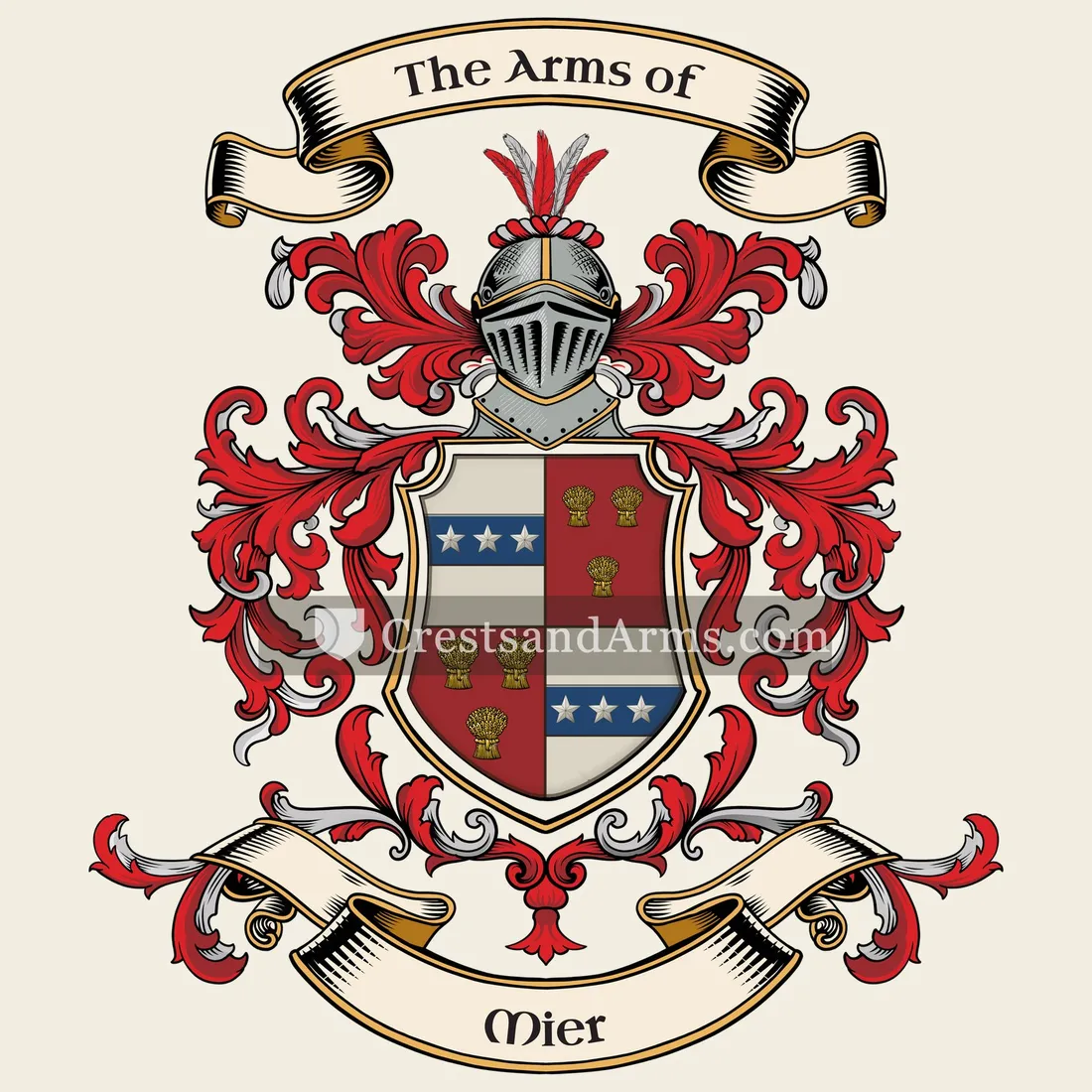
fessThe military belt, and readiness to serve
mulletThe third son, and a divine quality from above
wheatsheafPlenty, and the harvest of one's own labour
Colours
Silver (Argent)Means: Peace and sincerity
Red (Gules)Means: Military strength
Blue (Azure)Means: Loyalty and truth
Gold (Or)Means: Generosity
Historical info
Source
J. B. Rietstap, Armorial Général, Gouda: G. B. van Goor Zonen, 1884–87
Blazon (the actual original written record)
“Ec.: aux 1 et 4 d'arg. à la fasce d'azur. ch. de trois étoiles (5) du champ; aux 2 et 3 de gu. à trois gerbes d'or. Cq. cour. C.: un buste de More de profil, tort. de gu. L.: à dextre d'or et de gu., à sen. d'arg. et d'azur. T.: deux Mores, hab. de tabliers de sin. bordés d'or, portant un carquois et tenant un arc. D.: DURUM PATIENTIÂ; ou: TOUT POUR LE MIEUX.”
GaliciaGalicia, c. 1777
Digital archive packCoat of arms PNG, gold border print PDF, vector SVG and the certificate of authenticity. Sent to your email in minutes.
Map of Austria showing where the Mier arms are recorded
The Mier arms were recorded in Galicia, c. 1777.
Galicia was eastern country of large estates and small farming villages, held by families who had been there for a very long time. Land was what entitled a family to arms, and land there rarely changed hands.
This is where the arms were entered in the register. Families often moved to other parts of the country, so the same name can turn up in more than one region.
Region
Galicia
First recorded
1777
Granting Authority for the Mier Arms
Imperial and Royal chancery
Sodacan · CC BY-SA 3.0
The body that granted and recorded arms in Austria in this period.
Joseph II, Holy Roman Emperor
Sovereign of the period
Joseph II, Holy Roman Emperor
1765–1790
Reigning in Poland when the Mier arms are first recorded.
How Arms Worked in Austria
Austrian coats of arms were often linked directly to noble titles granted by the Emperor. These symbols belonged to the entire family line rather than just one individual. When a family grew, new branches kept the original design without needing to change it. This system allowed all members of a noble house to share the same identity across many generations.
Granting authority
The Imperial and Royal chancery managed all heraldic matters and controlled the official granting of arms throughout the Austrian lands.
How they got arms
Families typically received their arms through a formal imperial decree that often accompanied the elevation of a person to noble status.
Where arms were recorded
Official records of these grants were kept in the Imperial Register of Nobility which began its formal documentation process in 1453.
The family's standing
Recorded among the armigerous families of Galicia.
Origin & History of the Mier Family in Austria
The history of the Mier family in the Austrian Empire is deeply connected to the region of Galicia, which became part of the Habsburg monarchy following the First Partition of Poland in 1772. By 1777, the family was well-established in this territory, serving as part of the local landed gentry during a time of significant administrative change. As the Austrian government sought to integrate Galicia into its centralized bureaucracy, families like the Miers played a vital role in local governance and land management. They navigated the transition from Polish administration to Austrian rule by maintaining their social standing and property rights under the new imperial laws. This period marked a shift for the family as they became subjects of the Habsburg crown, balancing their traditional regional influence with the requirements of an expanding European empire.
Mier Meaning & Related Branches
Root word
Miernik
A person who measures land or performs surveying tasks.
This name
MierDerived from a professional title for a land surveyor or measurer.
also spelled
Myer
Miere
Miers
Meer
Related arms
Kennedy de Clowburnsimilar arms
Myervariant spelling
Documented Sources
J. B. Rietstap, Armorial Général, Gouda: G. B. van Goor Zonen, 1884–87
Krzysztof Chłapowski, Starostowie niegrodowi w Koronie 1565–1795, 2017
Archiwum Główne Akt Dawnych (AGAD), Metryka Koronna, Series MK
Archiwum Państwowe w Warszawie, Księgi grodzkie warszawskie, Series KG
Digital archive packCoat of arms PNG, gold border print PDF, vector SVG and the certificate of authenticity. Sent to your email in minutes.


 bendDefence, and the scarf of a commander
 mulletThe third son, and a divine quality from above
 bendDefence, and the scarf of a commander
 mulletThe third son, and a divine quality from above
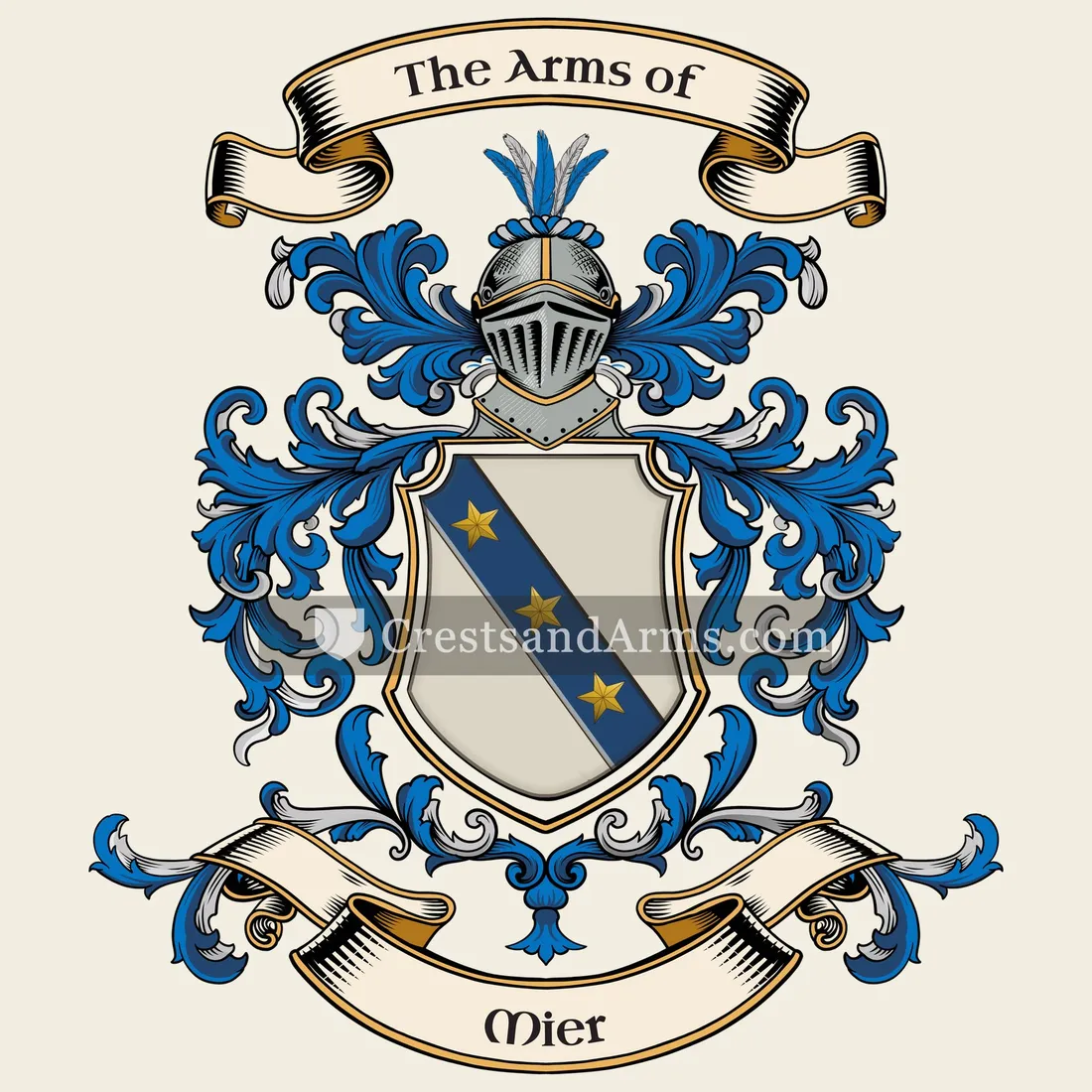


 fessThe military belt, and readiness to serve
 wheatsheafPlenty, and the harvest of one's own labour