A record of documented arms, meaning and origin, researched for the Milius family lines. Documented in 3 countries.
Reg. 7055 · Danish, M–O
Coat of Arms & Family Crest Details
Symbols on this shield
bendDefence, and the scarf of a commander
mountThe ground held, and steadfastness upon it
cross symbolChristian faith and service
swanGrace, light and the poet's art
mulletThe third son, and a divine quality from above
roseThe seventh son, and beauty with grace
stagPeace and harmony, and one who will not fight unprovoked
lilyPurity and the promise of resurrection
armA person of action, industrious and laborious
Colours
Blue (Azure)Means: Loyalty and truth
Red (Gules)Means: Military strength
Green (Vert)Means: Hope
Silver (Argent)Means: Peace and sincerity
Gold (Or)Means: Generosity
Historical info
Source
J. B. Rietstap, Armorial Général, Gouda: G. B. van Goor Zonen, 1884–87
Blazon (the actual original written record)
“Ec.: au 1 d'azur à un cygne cont. d'arg., cour. d'or, surmontant deux étoiles (5) d'or; au 2 tranché d'azur à trois roses d'arg., 2 et 1, sur gu. à un cerf élancé au nat.; à la bande d'or, br. sur le tranché; au 3 de gu. à un lis de jardin tigé au nat., sur une terrasse de sin., entre deux bras de carn., mouv. de deux rocs de sa. et empoignant la tige du lis; au 4 d'azur à un moine de profil, pass. sur une terrasse de sin., les pieds nus, le capuchon rabattu, tenant sous son bras dextre une croix de sa. et de sa sen. un bâton. Sur le tout un écusson cour., coupé: a. d'arg. à trois roses de gu., tigées et feuillées de sin., mouv. ensemble du coupé; b. d'or à la moitié inférieure d'une roue au nat., mouv. du coupé. Cq. cour. C.: un griffon iss. d'or, cour. du même, ailé et membré de sa., tenant entre ses pattes une roue de moulin d'or. S.: deux griffons d'or, cour. du même, ailés et membrés de sa.”
Denmarkc. 1722
Digital archive packCoat of arms PNG, gold border print PDF, vector SVG and the certificate of authenticity. Sent to your email in minutes.
Map of Denmark showing where the Milius arms are recorded
The Milius arms were recorded in Denmark, c. 1722.
Arms such as these were typically recorded in Sjaælland.
Zealand held the Danish court, the crown's offices and Copenhagen itself. Families who served the king kept estates within reach of it, and royal service was the ordinary route to a coat of arms.
This is where the arms were entered in the register. Families often moved to other parts of the country, so the same name can turn up in more than one region.
The body that granted and recorded arms in Denmark in this period.
Frederik IV of Denmark
Sovereign of the period
Frederik IV of Denmark
1699–1730
Reigning in Denmark when the Milius arms are first recorded.
How Arms Worked in Denmark
Danish heraldry during this period was closely tied to noble status and royal favor rather than being open to all citizens. Arms were typically granted by the monarch to individuals, and these symbols were then shared by all members of the noble house. If a family line died out, the right to use those specific arms ended with them.
Granting authority
The Danish royal chancery held the power to issue and regulate official coats of arms for the kingdom.
How they got arms
Families usually received their arms through a formal royal grant that confirmed their noble status and rights.
Where arms were recorded
These grants were officially recorded in the Danish Royal Chancery records starting in the sixteenth century.
The family's standing
Recorded among the armigerous families of Denmark.
Origin & History of the Milius Family in Denmark
The history of the Milius family in Denmark begins to surface in official records during the early eighteenth century, specifically within the region of Sjælland. By 1722, members of the family were established in this area, living during a time when Denmark was transitioning toward more structured civil registration. The name Milius itself is often associated with Latinized naming traditions, which were common among educated individuals, clergy, or those moving into administrative roles during the late seventeenth and early eighteenth centuries. As the family settled into the local communities of Sjælland, they became part of the social fabric of rural and provincial Denmark. They lived through a period of significant agricultural reform and social change, eventually integrating into the local parish systems that tracked births, marriages, and deaths. While the name remains relatively rare, its presence in the early 1700s suggests that the family was part of the steady movement of people who helped shape the local history of the Danish islands.
Coat of Arms & Family Crest Details
Symbols on this shield
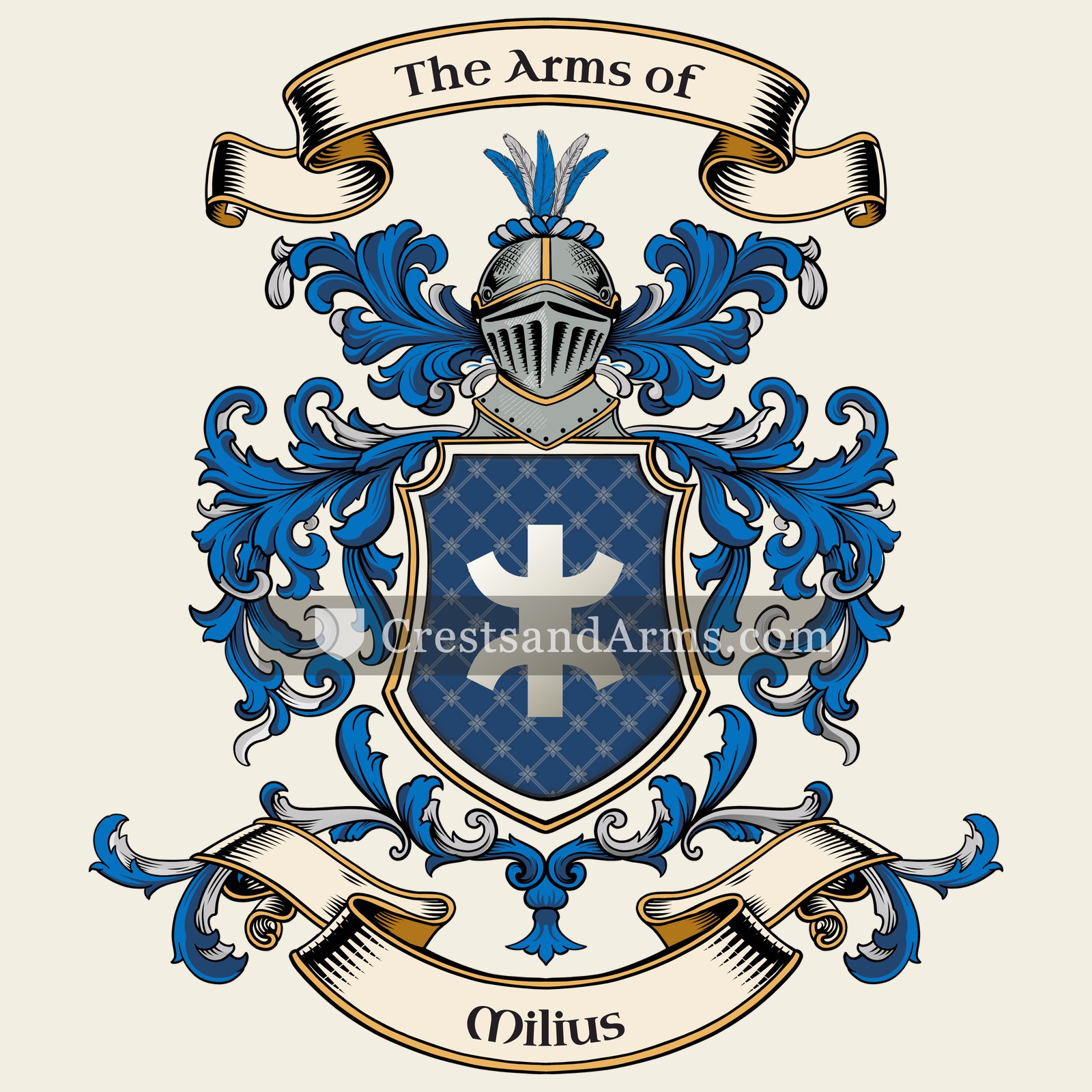
cross symbolChristian faith and service
millrind / fer de molineThe mill's iron, and the grinding of grain
Colours
Blue (Azure)Means: Loyalty and truth
Silver (Argent)Means: Peace and sincerity
Historical info
Source
J. B. Rietstap, Armorial Général, Gouda: G. B. van Goor Zonen, 1884–87
Blazon (the actual original written record)
“D'azur à une anille d'arg. en p., supp. une croix latine de sa., accolée d'un serpent du sec. Cq. cour. C.: un bras, paré d'azur, tenant une croix latine de sa. en barre; ou: cinq pl. d'aut., alt. d'azur et d'arg. L.: à dextre d'arg. et d'azur, à sen. d'arg. et de sa. S.: deux griffons d'or, tenant chacun une bannière de sa. ch. d'une couronne murale, le cercle d'or, les tours d'arg.”
Francec. 1663
Digital archive packCoat of arms PNG, gold border print PDF, vector SVG and the certificate of authenticity. Sent to your email in minutes.
Map of France showing where the Milius arms are recorded
The Milius arms were recorded in France, c. 1663.
Arms such as these were typically recorded in Bretagne.
More families held coats of arms in Bretagne than anywhere else in France. The land was divided into many small estates rather than a few large ones, so far more households counted as gentry, and each needed a shield of its own to be told apart.
This is where the arms were entered in the register. Families often moved to other parts of the country, so the same name can turn up in more than one region.
The body that granted and recorded arms in France in this period.
Louis XIV of France
Sovereign of the period
Louis XIV of France
1643–1715
Reigning in Denmark when the Milius arms are first recorded.
How Arms Worked in France
In France, a coat of arms was a mark of honor that passed down through the male line to all legitimate descendants. Families often used the same shield without changes to show their shared heritage. If a branch wanted to stand out, they could add a small mark to their shield to show their specific place in the family tree.
Granting authority
The Juge d'armes de France acted as the official authority that regulated and verified coats of arms across the country.
How they got arms
Families typically inherited their arms from ancestors, though they could also receive them through royal grants or by proving their noble status.
Where arms were recorded
Coats of arms were officially recorded in the Armorial Général de France, which began its main collection in the year 1696.
The family's standing
Recorded among the armigerous families of France.
Origin & History of the Milius Family in France
The history of the Milius family in France is deeply rooted in the rugged landscape of Bretagne, where records confirm their presence by the year 1663. During this period, the name was closely tied to the social and agricultural life of the northwestern provinces. Families in this region often lived in close-knit communities, and the name Milius likely evolved from local linguistic traditions or specific regional nicknames common to the Breton people. As the seventeenth century progressed, members of the family were frequently documented in parish registers, which served as the primary way to track births, marriages, and deaths in rural France. These early ancestors were likely involved in the traditional trades of the coastal areas, contributing to the local economy while maintaining their family identity across generations. By settling in Bretagne, the Milius family became part of a distinct cultural history that shaped the development of the region long before the modern era.
Coat of Arms & Family Crest Details
Symbols on this shield
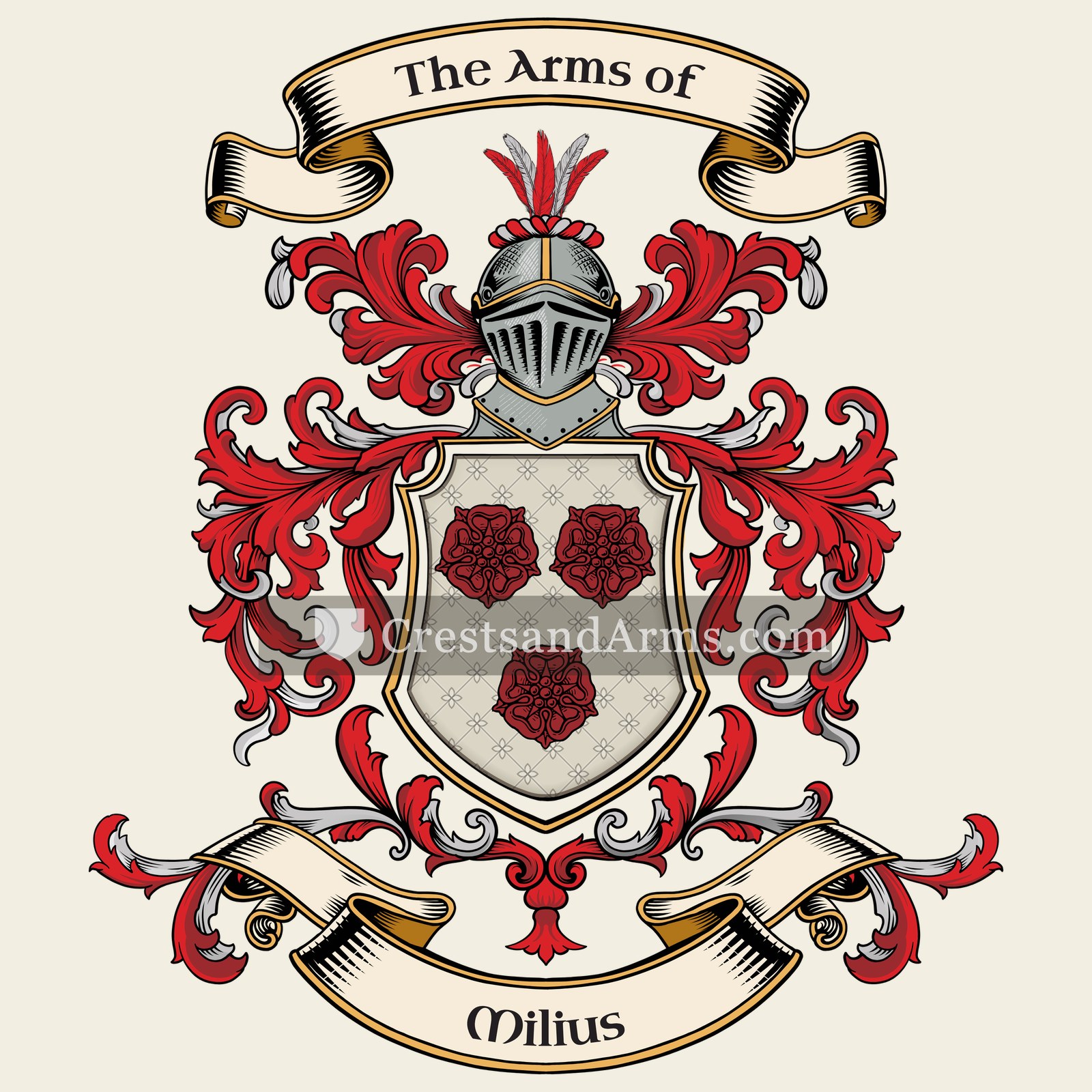
roseThe seventh son, and beauty with grace
Colours
Silver (Argent)Means: Peace and sincerity
Red (Gules)Means: Military strength
Historical info
Source
J. B. Rietstap, Armorial Général, Gouda: G. B. van Goor Zonen, 1884–87
Blazon (the actual original written record)
“D'arg. à la moitié inférieure d'une roue de moulin d'azur, de laquelle s'élèvent trois roses de gu., tigées et feuillées de sin. Cq. cour. C.: un griffon iss. de gu., tenant entre ses pattes une pignate d'arg. L. d'arg. et de gu.”
GermanyFrancfort s, c. 1765
Digital archive packCoat of arms PNG, gold border print PDF, vector SVG and the certificate of authenticity. Sent to your email in minutes.
Map of Germany showing where the Milius arms are recorded
The Milius arms were recorded in Francfort s, c. 1765.
This is where the arms were entered in the register. Families often moved to other parts of the country, so the same name can turn up in more than one region.
The body that granted and recorded arms in Germany in this period.
Francis I, Holy Roman Emperor
Sovereign of the period
Francis I, Holy Roman Emperor
1745–1765
Reigning in Denmark when the Milius arms are first recorded.
How Arms Worked in Germany
In the Holy Roman Empire, coats of arms were often granted to individuals by the Emperor or his representatives. These arms were then passed down through the generations to all legitimate descendants of the original holder. Younger branches of a family usually kept the same shield design without needing to change it, as the arms belonged to the entire lineage.
Granting authority
The Holy Roman Emperor held the sole power to grant new coats of arms throughout his vast imperial territories.
How they got arms
Families typically obtained their coats of arms through a formal imperial grant or by proving their noble status to the authorities.
Where arms were recorded
These grants were officially recorded in the Imperial Chancery registers, which began keeping formal records of such honors during the Middle Ages.
The family's standing
Recorded among the armigerous families of Germany.
Origin & History of the Milius Family in Germany
The surname Milius has deep roots in the German-speaking regions of Europe, where it likely originated as a Latinized version of a common Germanic name. During the eighteenth century, the name became firmly established in the bustling trade hub of Frankfurt am Main. By 1765, records confirm that members of the Milius family were active participants in the city's social and economic life. At this time, Frankfurt was a major center for commerce and banking, attracting families who sought to build stable lives through trade and craftsmanship. The presence of the Milius family in such a significant urban center suggests that they were part of the growing middle class that helped shape the city's identity during the Enlightenment. As the family settled into the region, they contributed to the local culture and the evolving history of a city that served as a crossroads for travelers and merchants across the continent.
Related Branches & Arms
Root word
Aemilius
Latin name derived from the word for rival or industrious.
This name
MiliusA Danish patronymic or variant form indicating descent from a person named Emil.
also spelled
Mylio
Mylis
Milius
Documented Sources
J. B. Rietstap, Armorial Général, Gouda: G. B. van Goor Zonen, 1884–87
Rigsarkivet (The Danish National Archives), Kirkebøger (Parish Registers), Sjælland Stift
Rigsarkivet (The Danish National Archives), Folketællinger (Census Records), 1787
Krarup, Alfred, Dansk Personalhistorisk Bibliografi, 1911
Nielsen, Oluf, Kjøbenhavns Diplomatarium, 1872
Digital archive packCoat of arms PNG, gold border print PDF, vector SVG and the certificate of authenticity. Sent to your email in minutes.


 bendDefence, and the scarf of a commander
 mountThe ground held, and steadfastness upon it
 cross symbolChristian faith and service
 swanGrace, light and the poet's art
 mulletThe third son, and a divine quality from above
 roseThe seventh son, and beauty with grace
 stagPeace and harmony, and one who will not fight unprovoked
 lilyPurity and the promise of resurrection
 armA person of action, industrious and laborious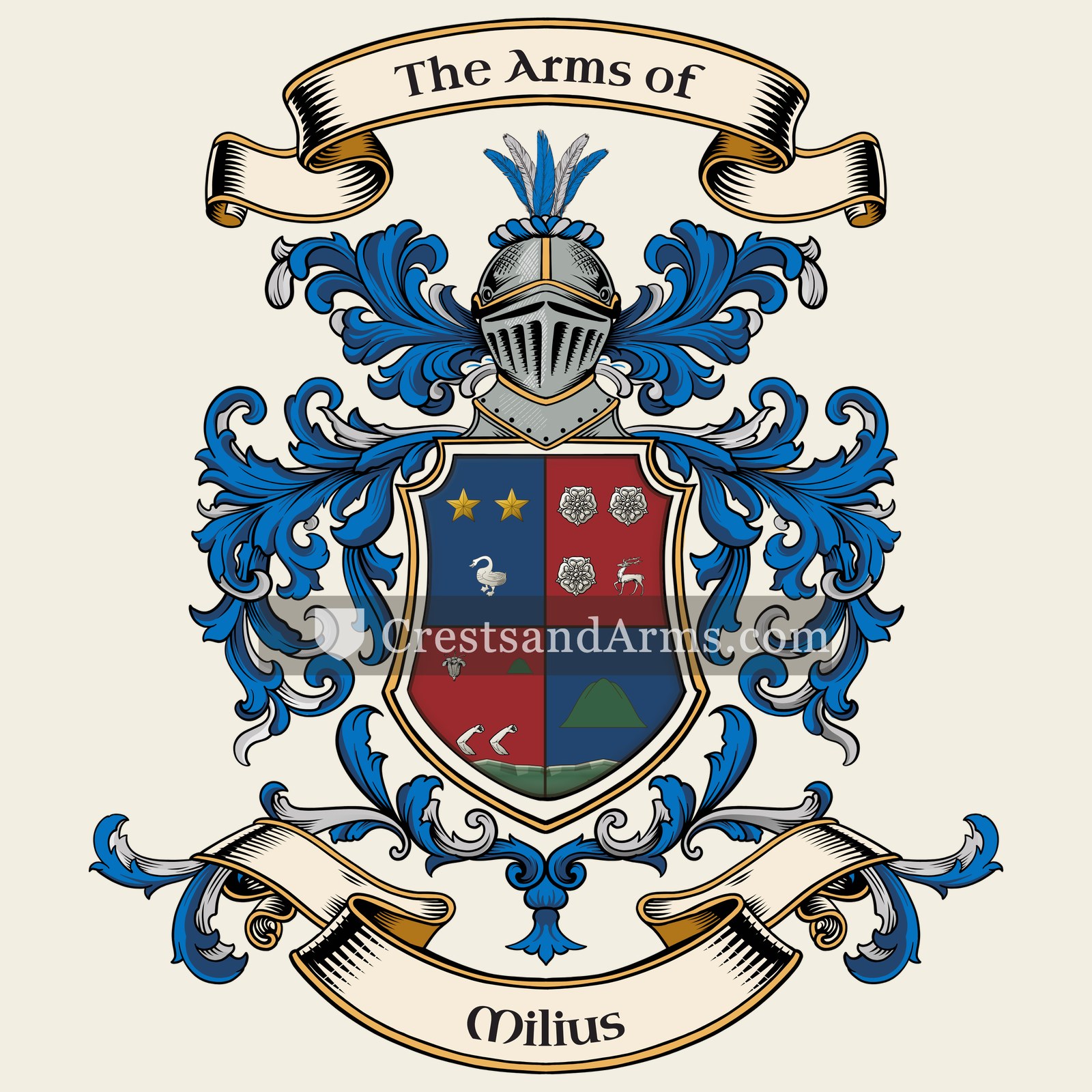


 millrind / fer de molineThe mill's iron, and the grinding of grain