Map of Britain showing where the Milton arms are recorded
The Milton arms were recorded in Britain, c. 1700.
Arms such as these were typically recorded in Kent.
Kent sits between London and the short crossing to Europe, and the trade passing through made it wealthy. Merchant families bought land with that money, and it was landowners who took coats of arms.
This is where the arms were entered in the register. Families often moved to other parts of the country, so the same name can turn up in more than one region.
The body that granted and recorded arms in Britain in this period.
William III of England
Sovereign of the period
William III of England
1694–1702
Reigning in Britain when the Milton arms are first recorded.
How Arms Worked in Britain
English heraldry allowed arms to be shared by all legitimate descendants of the original owner. These symbols were treated as personal property that moved through the generations to all children. While the eldest son kept the original design, other family members could use the same shield without needing to change it or register their own unique versions.
Granting authority
The College of Arms in London has regulated the use of coats of arms throughout England and Wales since 1484.
How they got arms
Families typically obtained their coats of arms through a formal grant from the Crown or by proving their ancient right to them.
Where arms were recorded
All official coats of arms are recorded in the registers kept at the College of Arms, which date back to the fifteenth century.
The family's standing
Recorded among the armigerous families of Britain.
Origin & History of the Milton Family in Britain
The surname Milton is a classic example of a locative name, which means it was originally derived from a specific place rather than a trade or a personal characteristic. The name is composed of the Old English words "mylen," meaning mill, and "tun," meaning an enclosure or settlement. This suggests that the earliest families to carry the name were likely those who lived near a prominent grain mill in a small village. While the name appears in various parts of England, the presence of the family in Kent by the year 1700 aligns with the historical importance of that region as a center for agriculture and milling. During this period, families often moved short distances to find work in growing rural communities, and the name Milton served as a simple way to identify individuals by their home village. Over time, as families migrated for better opportunities, the name spread from these small settlements to become a recognized part of the English landscape.
Coat of Arms & Family Crest Details
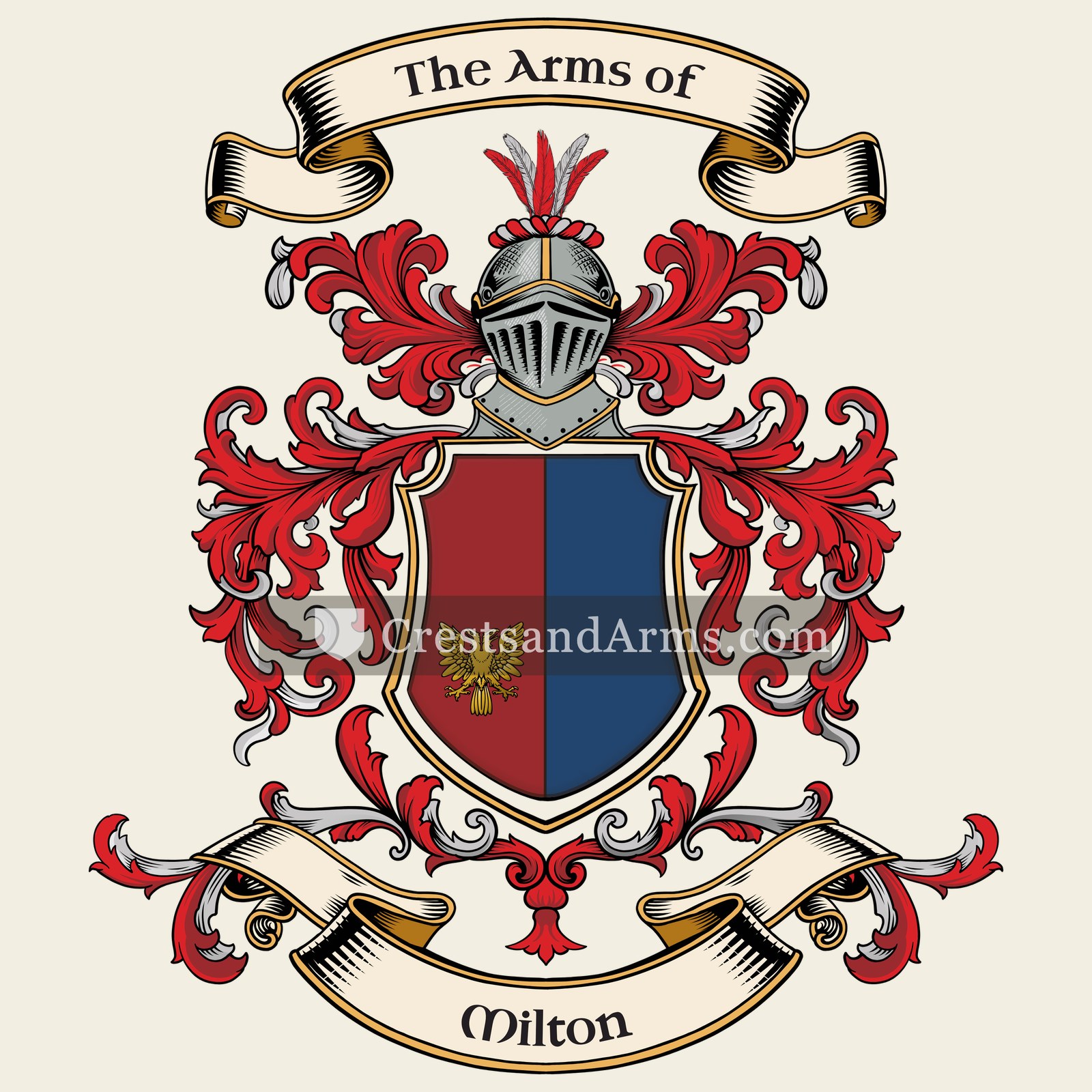
Symbols on this shield
paleMilitary strength, and a fortified defence
eagleNobility, strength and a keen mind
Colours
Red (Gules)Means: Military strength
Blue (Azure)Means: Loyalty and truth
Gold (Or)Means: Generosity
Historical info
Source
Sir Bernard Burke, The General Armory of England, Scotland, Ireland and Wales, London: Harrison & Sons, 1884
Blazon (the actual original written record)
“Per pale gu. and az. an eagle displ. or”
SalopSalop, c. 1620
Digital archive packCoat of arms PNG, gold border print PDF, vector SVG and the certificate of authenticity. Sent to your email in minutes.
Map of England showing where the Milton arms are recorded
The Milton arms were recorded in Salop, c. 1620.
Shropshire lay on the Welsh border, and border country needed men who could fight. Families held their land in return for service, and service in arms is what a coat of arms was originally for.
This is where the arms were entered in the register. Families often moved to other parts of the country, so the same name can turn up in more than one region.
The body that granted and recorded arms in England in this period.
James VI and I
Sovereign of the period
James VI and I
1603–1625
Reigning in Britain when the Milton arms are first recorded.
How Arms Worked in England
English heraldry allowed arms to be shared by all legitimate descendants of the original owner. These symbols were treated as personal property that moved through the generations to all children. While the eldest son kept the original design, other family members could use the same shield without needing to change it or register their own unique versions.
Granting authority
The College of Arms in London has regulated the use of coats of arms throughout England and Wales since 1484.
How they got arms
Families typically obtained their coats of arms through a formal grant from the Crown or by proving their ancient right to them.
Where arms were recorded
All official coats of arms are recorded in the registers kept at the College of Arms, which date back to the fifteenth century.
The family's standing
Recorded among the armigerous families of Salop.
Origin & History of the Milton Family in England
The surname Milton is a locative name, meaning it originated from individuals who lived in or near a "mill town." In Old English, the name is derived from the words *mylen*, meaning mill, and *tun*, meaning an enclosure or settlement. Because mills were essential hubs for grinding grain in medieval village life, many distinct families across England adopted this name independently based on their local geography. By the early 17th century, the name had spread throughout various counties, including a notable presence in Salop, also known as Shropshire, by 1620. During this period, families bearing the name were often tied to the agricultural and milling traditions of their local parishes, moving through the English countryside as trade and land ownership patterns shifted. These early bearers were typically commoners who helped define the rural landscape of England long before the name became associated with more famous historical figures.
Related Branches & Arms
Root word
mylen tun
Old English for mill and settlement or enclosure.
This name
MiltonRefers to a settlement or farmstead located near a mill.
also spelled
Mylton
Milten
Milleton
Mylleton
Related arms
Milletonvariant spelling
Milltown, Earl ofvariant spelling
Documented Sources
J. B. Rietstap, Armorial Général, Gouda: G. B. van Goor Zonen, 1884–87
Ekwall, Eilert. The Concise Oxford Dictionary of English Place-names. 1960
Reaney, P.H. A Dictionary of British Surnames. 1958
The National Archives, Kew. Prerogative Court of Canterbury wills, 1384–1858
Digital archive packCoat of arms PNG, gold border print PDF, vector SVG and the certificate of authenticity. Sent to your email in minutes.


 eagleNobility, strength and a keen mind
 eagleNobility, strength and a keen mind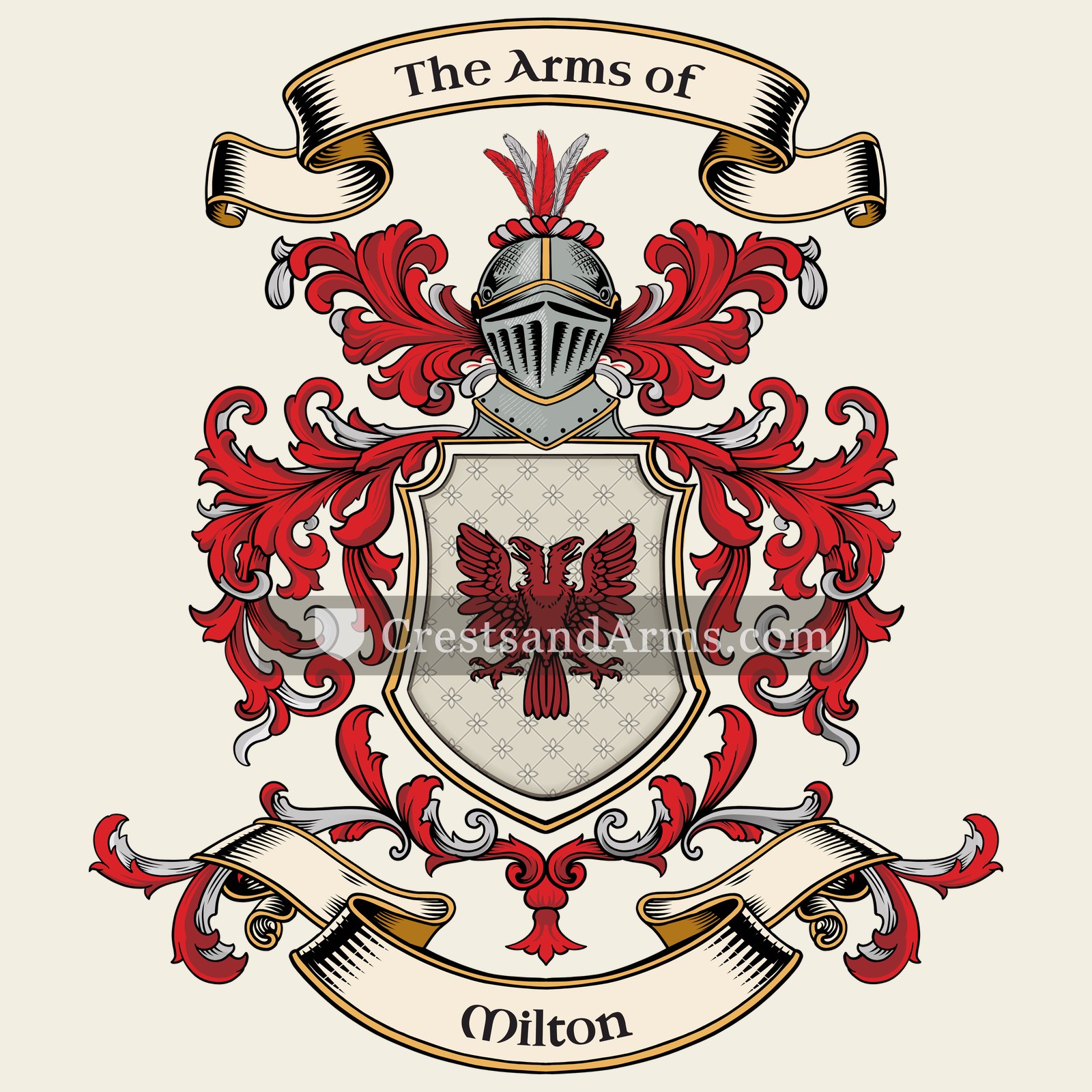


 paleMilitary strength, and a fortified defence