Map of Germany showing where the Mina arms are recorded
The Mina arms were recorded in Brandenburg, c. 1765.
Brandenburg was sandy farming country around Berlin, held in large estates by families who served as officers. Land and military service each brought arms, and most families there had both.
This is where the arms were entered in the register. Families often moved to other parts of the country, so the same name can turn up in more than one region.
The body that granted and recorded arms in Germany in this period.
Francis I, Holy Roman Emperor
Sovereign of the period
Francis I, Holy Roman Emperor
1745–1765
Reigning in Germany when the Mina arms are first recorded.
How Arms Worked in Germany
In the Holy Roman Empire, coats of arms were often granted to individuals by the Emperor or his representatives. These arms were then passed down through the generations to all legitimate descendants of the original holder. Younger branches of a family usually kept the same shield design without needing to change it, as the arms belonged to the entire lineage.
Granting authority
The Holy Roman Emperor held the sole power to grant new coats of arms throughout his vast imperial territories.
How they got arms
Families typically obtained their coats of arms through a formal imperial grant or by proving their noble status to the authorities.
Where arms were recorded
These grants were officially recorded in the Imperial Chancery registers, which began keeping formal records of such honors during the Middle Ages.
The family's standing
Recorded among the armigerous families of Brandenburg.
Origin & History of the Mina Family in Germany
The family name Mina has deep roots in the historical region of Brandenburg, where records confirm members of the family were established by 1765. During the eighteenth century, Brandenburg was a central part of the Kingdom of Prussia, a time when many families were closely tied to the land and the agricultural expansion of the region. The name likely evolved as a short form or a variation of longer Germanic or Latin-based names that were common in central Europe at the time. Families in this area often lived in small, tight-knit rural communities where they contributed to the local economy through farming or skilled craftsmanship. As the Prussian state grew in power and bureaucracy, families like the Minas became part of a structured society that kept detailed church and tax records. These early generations helped shape the local culture of Brandenburg before many families began to migrate further across Europe and eventually overseas in the centuries that followed.
Mina Meaning & Related Branches
Root word
Wilhelmina
Derived from Germanic elements meaning will, desire, and helmet or protection.
This name
MinaA diminutive form often signifying a resolute protector or one with a strong will.
also spelled
Meynau
Mynow
Maynow
Maynau
Documented Sources
J. B. Rietstap, Armorial Général, Gouda: G. B. van Goor Zonen, 1884–87
Brandenburgisches Landeshauptarchiv, General-Verzeichnis der Kirchenbücher der Mark Brandenburg
Heitmann, Clemens, Die Siedlungsgeschichte der Mark Brandenburg, 1958
Klee, Ernst, Das Personenlexikon zum Dritten Reich: Wer war was vor und nach 1945 (for context on regional naming patterns), 2003
Digital archive packCoat of arms PNG, gold border print PDF, vector SVG and the certificate of authenticity. Sent to your email in minutes.


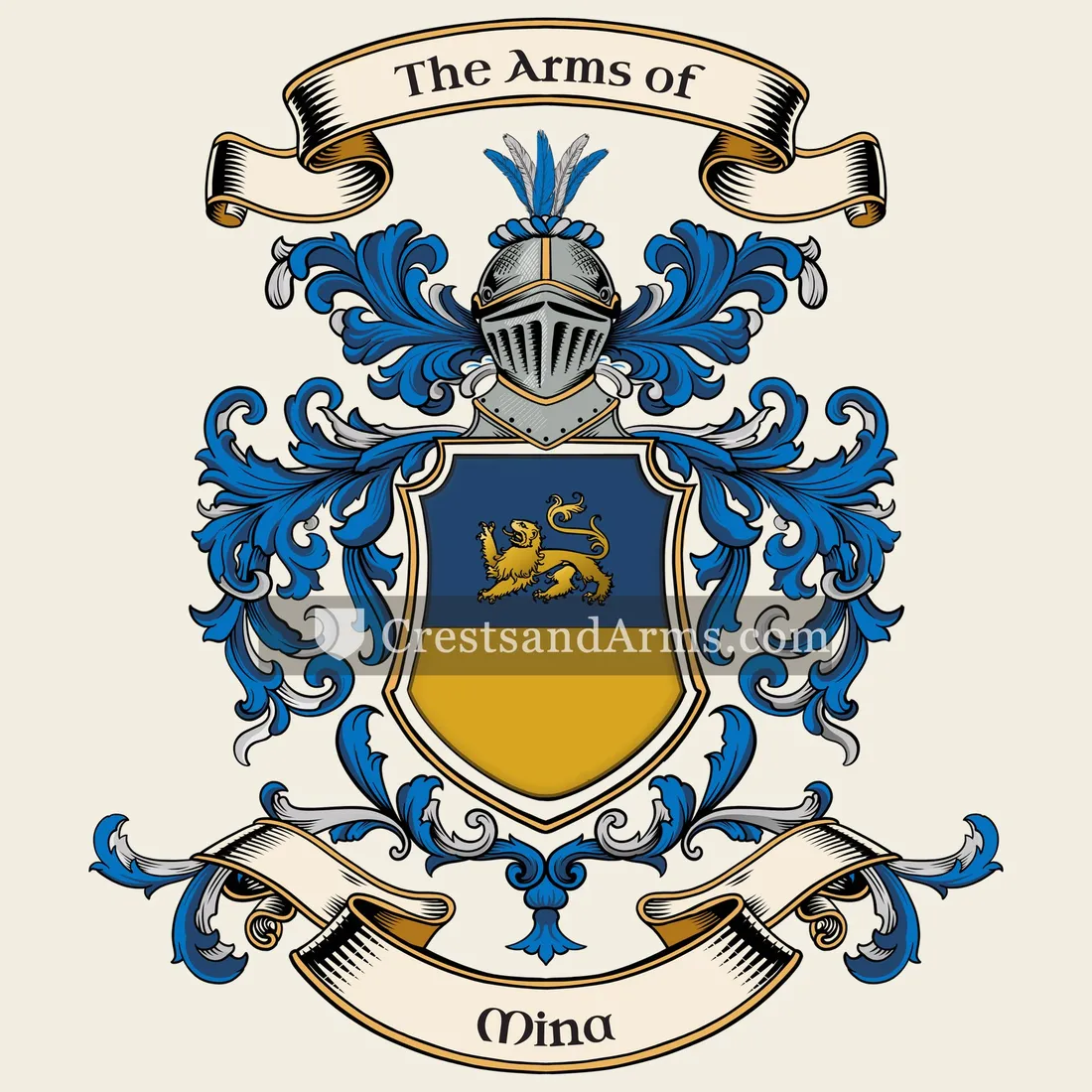
 lionCourage, strength and royalty
 lionCourage, strength and royalty