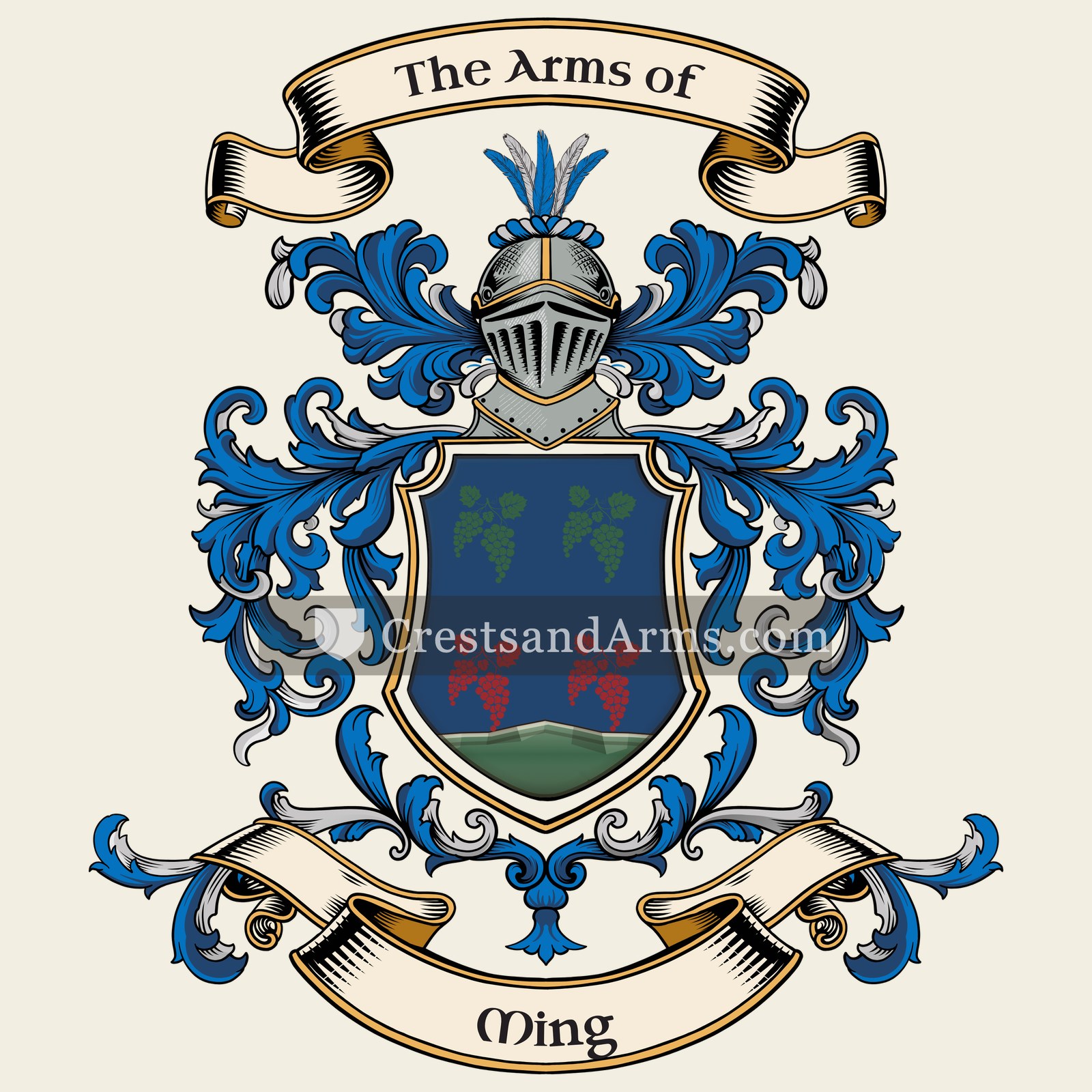
A record of documented arms, meaning and origin, researched for the Ming family of Switzerland.
Reg. 1952 · Swiss, M–O
Coat of Arms & Family Crest Details
Symbols on this shield
mountThe ground held, and steadfastness upon it
grapesPlenty, and the labour of the vine
Colours
Blue (Azure)Means: Loyalty and truth
Green (Vert)Means: Hope
Red (Gules)Means: Military strength
Historical info
Source
J. B. Rietstap, Armorial Général, Gouda: G. B. van Goor Zonen, 1884–87
Blazon (the actual original written record)
“D'azur à deux ceps de vigne pamprés de sin., passés en double saut., les deux rameaux supérieurs fruités chacun d'une grappe de raisins de gu., chaque cep iss. d'un coeur de gu., ces coeurs accostés sur un tertre de trois coupeaux de sin. et percés ensemble d'une épée d'arg. en fasce penchée de sen. vers dextre; chaque coeur supp. sur son flanc”
SwitzerlandValais, c. 1745
Digital archive packCoat of arms PNG, gold border print PDF, vector SVG and the certificate of authenticity. Sent to your email in minutes.
Map of Switzerland showing where the Ming arms are recorded
The Ming arms were recorded in Valais, c. 1745.
This is where the arms were entered in the register. Families often moved to other parts of the country, so the same name can turn up in more than one region.
The body that granted and recorded arms in Switzerland in this period.
How Arms Worked in Switzerland
In Switzerland, coats of arms were not restricted to the nobility and were often adopted by common citizens and families. These symbols were passed down through generations to show family identity. When branches of a family grew, they often changed small details of the design to distinguish their own line from the original group.
Granting authority
Cantonal and civic authorities managed the use of coats of arms within their specific regions and local jurisdictions.
How they got arms
Families typically assumed their own coats of arms based on local custom rather than receiving them from a central monarch.
Where arms were recorded
Arms were recorded in various cantonal and civic registers starting from the fourteenth century throughout the Swiss region.
The family's standing
Recorded among the armigerous families of Switzerland.
Origin & History of the Ming Family in Switzerland
The family name Ming has deep roots in the mountainous landscape of the Swiss canton of Valais, where records confirm their presence as early as 1745. Historically, families in this region were often tied to specific alpine villages where they worked as farmers, cattle herders, or tradespeople. The name itself likely originated as a descriptive term or a shortened form of a local given name, which was a common way for surnames to develop in small, isolated communities. Because Valais served as a vital crossroads for travel through the high mountain passes, the Ming family would have been part of a resilient society that adapted to the harsh climate and the unique political structure of the Swiss cantons. Over generations, these early ancestors established themselves as permanent members of their local parishes, leaving behind a legacy of community involvement and agricultural tradition that defined life in the valley.
Related Branches & Arms
Root word
Min
Derived from the Germanic word for love or affection.
This name
MingA surname indicating a beloved person or one associated with friendly disposition.
also spelled
Mynnig
Minnick
Minig
Documented Sources
J. B. Rietstap, Armorial Général, Gouda: G. B. van Goor Zonen, 1884–87
Archives de l'État du Valais, Registres paroissiaux de l'ancien diocèse de Sion
Archives de l'État du Valais, Recensements de la population du Valais
Gessler, E. A., Die Familiennamen des Kantons Wallis, 1941
Zermatten, Maurice, Le Valais: terre de contrastes, 1978
Digital archive packCoat of arms PNG, gold border print PDF, vector SVG and the certificate of authenticity. Sent to your email in minutes.


 mountThe ground held, and steadfastness upon it
 grapesPlenty, and the labour of the vine
 mountThe ground held, and steadfastness upon it
 grapesPlenty, and the labour of the vine