A record of documented arms, meaning and origin, researched for the Minion family lines. Documented in 2 countries.
Reg. 6388 · Belgian, M–O
Coat of Arms & Family Crest Details
Symbols on this shield
chiefAuthority, wisdom and dominion
roseThe seventh son, and beauty with grace
lionCourage, strength and royalty
Colours
Blue (Azure)Means: Loyalty and truth
Silver (Argent)Means: Peace and sincerity
Gold (Or)Means: Generosity
Red (Gules)Means: Military strength
Historical info
Source
J. B. Rietstap, Armorial Général, Gouda: G. B. van Goor Zonen, 1884–87
Blazon (the actual original written record)
“Parti: au 1 losangé d'azur et d'arg.; au 2 d'arg. au lion de gu., arm. et lamp. d'azur. Au chef de l'écu d'or, br. sur le parti et ch. de deux roses de gu., bout. d'or, barbées de sin. Cq. cour. C.: une rose de gu., tigée et feuillée de sin. L. d'or et de gu.”
BelgiumLuxemb, c. 1738
Digital archive packCoat of arms PNG, gold border print PDF, vector SVG and the certificate of authenticity. Sent to your email in minutes.
Map of Belgium showing where the Minion arms are recorded
The Minion arms were recorded in Luxemb, c. 1738.
This is where the arms were entered in the register. Families often moved to other parts of the country, so the same name can turn up in more than one region.
The body that granted and recorded arms in Belgium in this period.
Charles VI, Holy Roman Emperor
Sovereign of the period
Charles VI, Holy Roman Emperor
1711–1740
Reigning in Belgium when the Minion arms are first recorded.
How Arms Worked in Belgium
In Belgium, a coat of arms is considered personal property that is passed down through the male line to legitimate descendants. Families often use the same shield design across generations to show their shared heritage. If a branch of the family wants to change the design, they must apply for an official update to their specific version of the arms.
Granting authority
The Conseil héraldique is the official body that regulates and approves all coats of arms in Belgium.
How they got arms
Families obtain their coats of arms through formal royal grants or by confirming their historical right to use existing designs.
Where arms were recorded
All approved coats of arms are officially recorded in the public registers of the Conseil héraldique since 1844.
The family's standing
Recorded among the armigerous families of Belgium.
Origin & History of the Minion Family in Belgium
The history of the Minion family in the region of modern-day Belgium and Luxembourg is rooted in the social and administrative shifts of the eighteenth century. By 1738, records confirm that members of the family were established in the Luxembourg area, which at that time was part of the Austrian Netherlands. The name itself likely evolved from older regional dialects, possibly serving as a descriptive term for a person’s status or character within their local community. As families during this era were often tied to specific trades or agricultural land, the Minions were integrated into the rural economy of the Ardennes. They lived through a period of significant transition as the region moved between various European powers, which influenced how their family records were documented in parish registers and tax rolls. These early ancestors were part of a resilient population that maintained deep connections to their local parishes, leaving behind a trail of baptismal and marriage entries that provide a glimpse into their daily lives long before the borders of modern Belgium were fully defined.
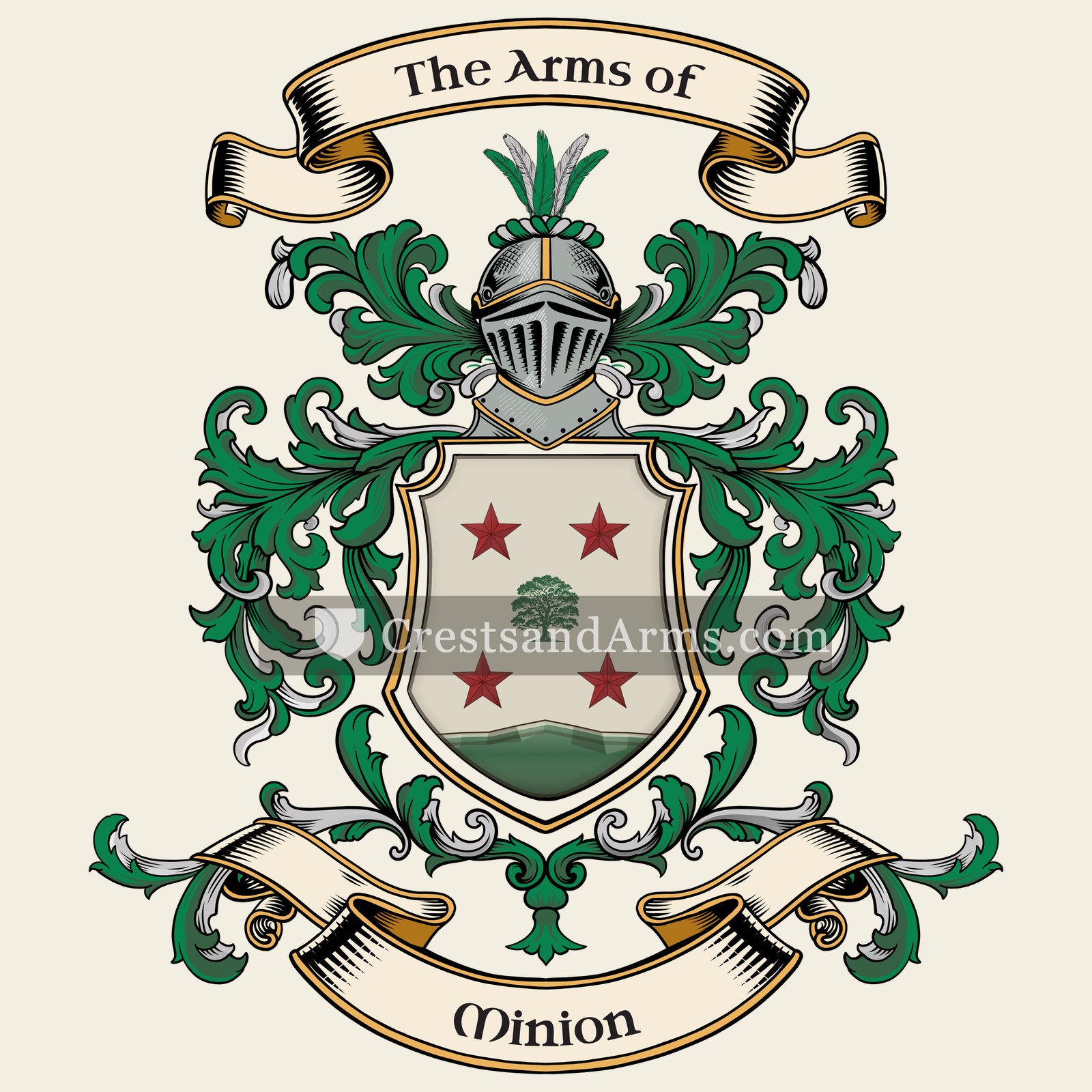
Coat of Arms & Family Crest Details
Symbols on this shield
mountThe ground held, and steadfastness upon it
treeLife, endurance and deep roots
mulletThe third son, and a divine quality from above
Colours
Silver (Argent)Means: Peace and sincerity
Green (Vert)Means: Hope
Red (Gules)Means: Military strength
Historical info
Source
J. B. Rietstap, Armorial Général, Gouda: G. B. van Goor Zonen, 1884–87
Blazon (the actual original written record)
“D'arg. à un arbre terrassé de sin., ch. en coeur d'un croiss. de gu. et cantonné de quatre étoiles du même.”
Ile-de-FranceIle-de-France, c. 1663
Digital archive packCoat of arms PNG, gold border print PDF, vector SVG and the certificate of authenticity. Sent to your email in minutes.
Map of France showing where the Minion arms are recorded
The Minion arms were recorded in Ile-de-France, c. 1663.
Ile-de-France is the country around Paris, and proximity to the court mattered. Families who served the crown were rewarded with land near it, and land near the capital carried arms almost as a matter of course.
This is where the arms were entered in the register. Families often moved to other parts of the country, so the same name can turn up in more than one region.
The body that granted and recorded arms in France in this period.
Louis XIV of France
Sovereign of the period
Louis XIV of France
1643–1715
Reigning in Belgium when the Minion arms are first recorded.
How Arms Worked in France
In France, a coat of arms was a mark of honor that passed down through the male line to all legitimate descendants. Families often used the same shield without changes to show their shared heritage. If a branch wanted to stand out, they could add a small mark to their shield to show their specific place in the family tree.
Granting authority
The Juge d'armes de France acted as the official authority that regulated and verified coats of arms across the country.
How they got arms
Families typically inherited their arms from ancestors, though they could also receive them through royal grants or by proving their noble status.
Where arms were recorded
Coats of arms were officially recorded in the Armorial Général de France, which began its main collection in the year 1696.
The family's standing
Recorded among the armigerous families of Ile-de-France.
Origin & History of the Minion Family in France
The family name Minion traces its roots to the historic region of Île-de-France, where members of the family were firmly established by 1663. In the French language, the term mignon historically described someone who was delicate, graceful, or favored, often serving as a nickname for a person with a refined or pleasing personality. During the seventeenth century, families in this region were frequently tied to the local agricultural or artisan economies that supported the growing influence of Paris. As the name spread through parish records, it became associated with the daily life of the French peasantry and the rising middle class. These early ancestors lived through a period of significant social change in France, navigating the transition from feudal traditions to the more centralized royal administration of the era. By maintaining their presence in the heart of the country, the Minion family became part of the long-standing demographic fabric of the French capital and its surrounding provinces.
Related Branches & Arms
Root word
mignon
A French term meaning delicate, dainty, or darling.
This name
MinionA nickname for a small, graceful, or endearing person.
also spelled
Minion
Mignone
Mignoun
Minyon
Documented Sources
J. B. Rietstap, Armorial Général, Gouda: G. B. van Goor Zonen, 1884–87
Archives: Archives de l'État à Arlon, Registres paroissiaux de la province de Luxembourg
Archives: Archives générales du Royaume, État civil et registres paroissiaux
Book: Lefèvre, Joseph, L'administration autrichienne aux Pays-Bas, 1942
Book: Petit, Raymond, Histoire de la province de Luxembourg, 1976
Digital archive packCoat of arms PNG, gold border print PDF, vector SVG and the certificate of authenticity. Sent to your email in minutes.


 chiefAuthority, wisdom and dominion
 roseThe seventh son, and beauty with grace
 lionCourage, strength and royalty
 chiefAuthority, wisdom and dominion
 roseThe seventh son, and beauty with grace
 lionCourage, strength and royalty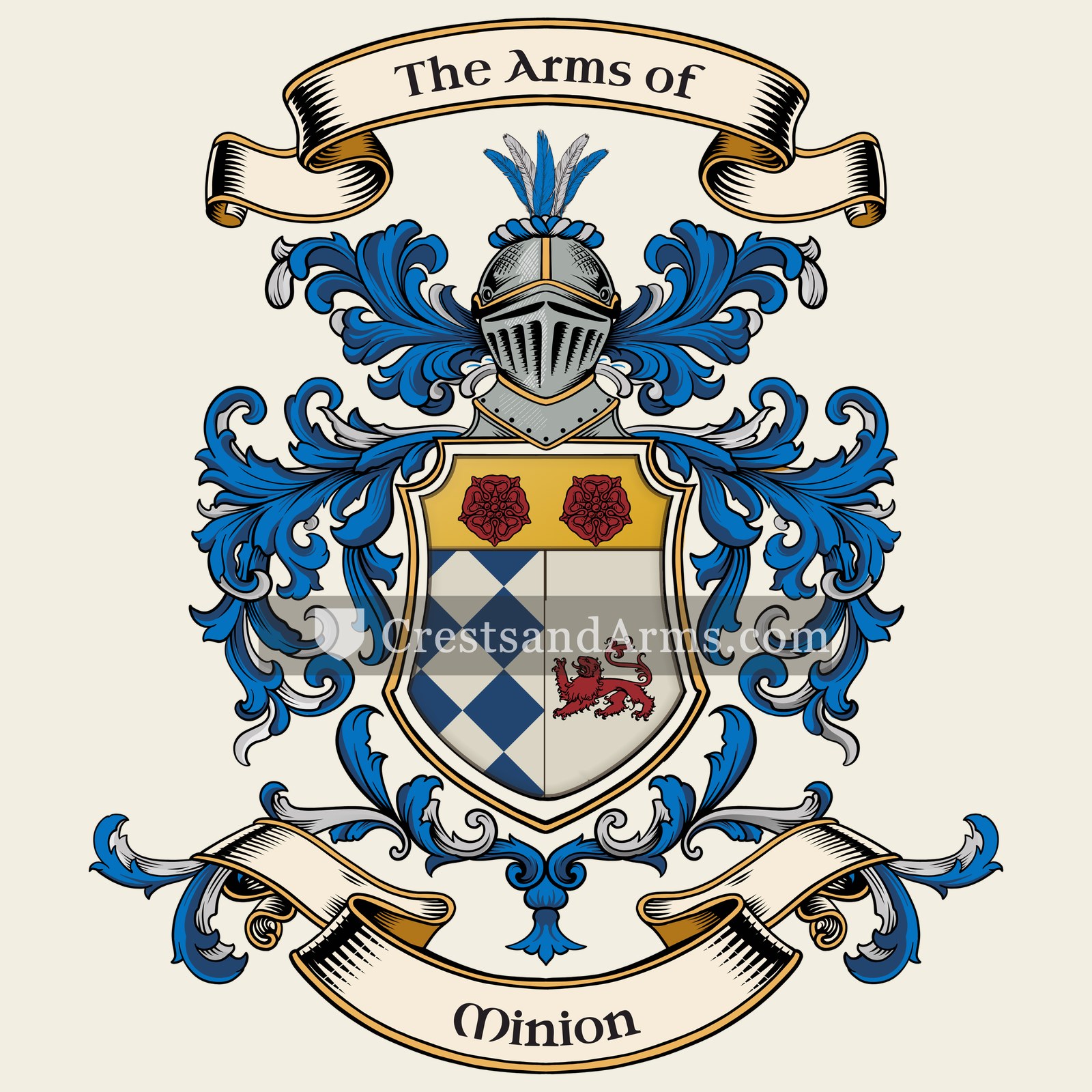


 mountThe ground held, and steadfastness upon it
 treeLife, endurance and deep roots
 mulletThe third son, and a divine quality from above