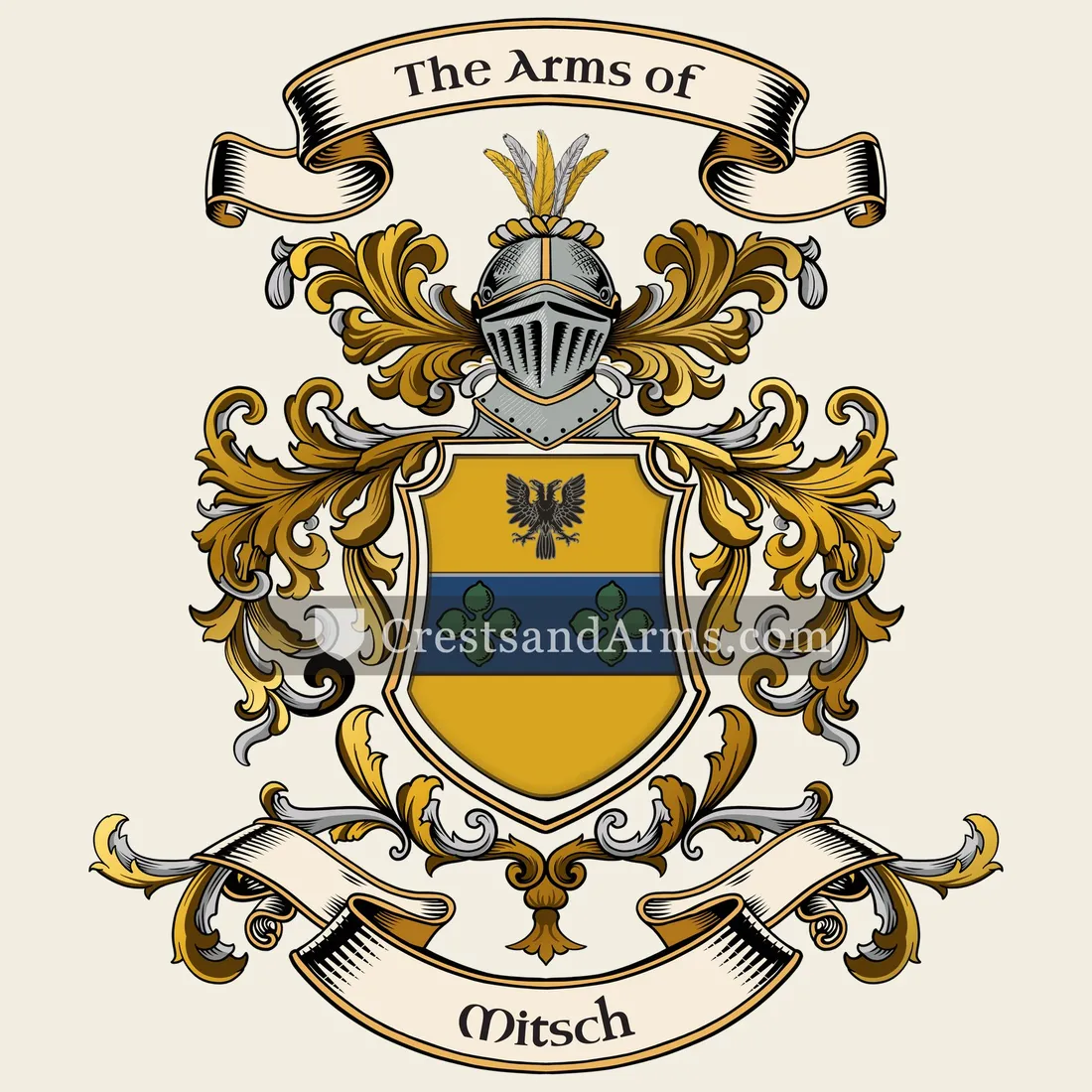
A record of documented arms, meaning and origin, researched for the Mitsch family of Austria.
Reg. 2928 · Austrian, M–O
Meaning of the Mitsch family crest colors & symbols
Symbols on this shield
fessThe military belt, and readiness to serve
eagleNobility, strength and a keen mind
plant quatrefoilGood fortune and the fourfold gospel
Colours
Gold (Or)Means: Generosity
Blue (Azure)Means: Loyalty and truth
Black (Sable)Means: Constancy
Green (Vert)Means: Hope
Historical info
Source
J. B. Rietstap, Armorial Général, Gouda: G. B. van Goor Zonen, 1884–87
Blazon (the actual original written record)
“D'or à l'aigle ép. de sa.; à la fasce d'azur, br. sur ladite aigle et ch. d'une abeille d'or entre deux quartefeuilles de sin. Deux cq. cour. C.: 1º un vol à l'antique, l'aile de derrière d'or, l'aile de devant de sa. ch. d'une abeille d'or; 1. d'or et de sa.; 2 un lion iss. d'or, tenant un faisceau de cinq flèches du même; 1. d'or et d'azur. D.: LABORE ET HONORE.”
Austriac. 1872
Digital archive packCoat of arms PNG, gold border print PDF, vector SVG and the certificate of authenticity. Sent to your email in minutes.
Map of Austria showing where the Mitsch arms are recorded
The Mitsch arms were recorded in Austria, c. 1872.
Arms such as these were typically recorded in Tyrol.
Tyrol was mountain country in western Austria, where the valleys were held by families who had been there a very long time. Old tenure counted for more than money, and old families carried arms.
This is where the arms were entered in the register. Families often moved to other parts of the country, so the same name can turn up in more than one region.
Region
Tyrol
First recorded
1872
Granting Authority for the Mitsch Arms
Imperial and Royal chancery
Sodacan · CC BY-SA 3.0
The body that granted and recorded arms in Austria in this period.
Franz Joseph I of Austria
Sovereign of the period
Franz Joseph I of Austria
1848–1916
Reigning in Austria when the Mitsch arms are first recorded.
How Arms Worked in Austria
Austrian coats of arms were often linked directly to noble titles granted by the Emperor. These symbols belonged to the entire family line rather than just one individual. When a family grew, new branches kept the original design without needing to change it. This system allowed all members of a noble house to share the same identity across many generations.
Granting authority
The Imperial and Royal chancery managed all heraldic matters and controlled the official granting of arms throughout the Austrian lands.
How they got arms
Families typically received their arms through a formal imperial decree that often accompanied the elevation of a person to noble status.
Where arms were recorded
Official records of these grants were kept in the Imperial Register of Nobility which began its formal documentation process in 1453.
The family's standing
Recorded among the armigerous families of Austria.
Origin & History of the Mitsch Family in Austria
The surname Mitsch is a patronymic name, which means it originated as a short form of the name Michael. This name was common throughout the German-speaking regions of Central Europe, particularly in areas influenced by Bavarian and Austrian dialects. By the late 19th century, records confirm that families bearing this name were well-established in the mountainous region of Tyrol. During this period, the people of Tyrol lived in a society deeply connected to alpine agriculture and trade routes that linked northern and southern Europe. Families like the Mitsch clan often settled in these valleys to work as skilled craftsmen or farmers. Because Tyrol served as a vital crossroads for travelers and merchants, the family name spread through local parish registers and official census documents as the population moved between small villages and growing towns.
Mitsch Meaning & Related Branches
Root word
Dimitrios
Derived from Demeter, the Greek goddess of agriculture and harvest.
This name
MitschA diminutive form of the name Demetrius, common in Slavic and Germanic regions.
also spelled
Mitschah
Mitschae
Mitschaa
Mitsha
Documented Sources
J. B. Rietstap, Armorial Général, Gouda: G. B. van Goor Zonen, 1884–87
Kohl, Johann Georg. Reise durch die österreichischen Provinzen. 1842
Tiroler Landesarchiv. Standesbücher der Pfarreien. 1872
Heintze, Albert. Die deutschen Familien-Namen: geschichtlich, geographisch, sprachlich. 1882
Digital archive packCoat of arms PNG, gold border print PDF, vector SVG and the certificate of authenticity. Sent to your email in minutes.


 fessThe military belt, and readiness to serve
 eagleNobility, strength and a keen mind
 plant quatrefoilGood fortune and the fourfold gospel
 fessThe military belt, and readiness to serve
 eagleNobility, strength and a keen mind
 plant quatrefoilGood fortune and the fourfold gospel