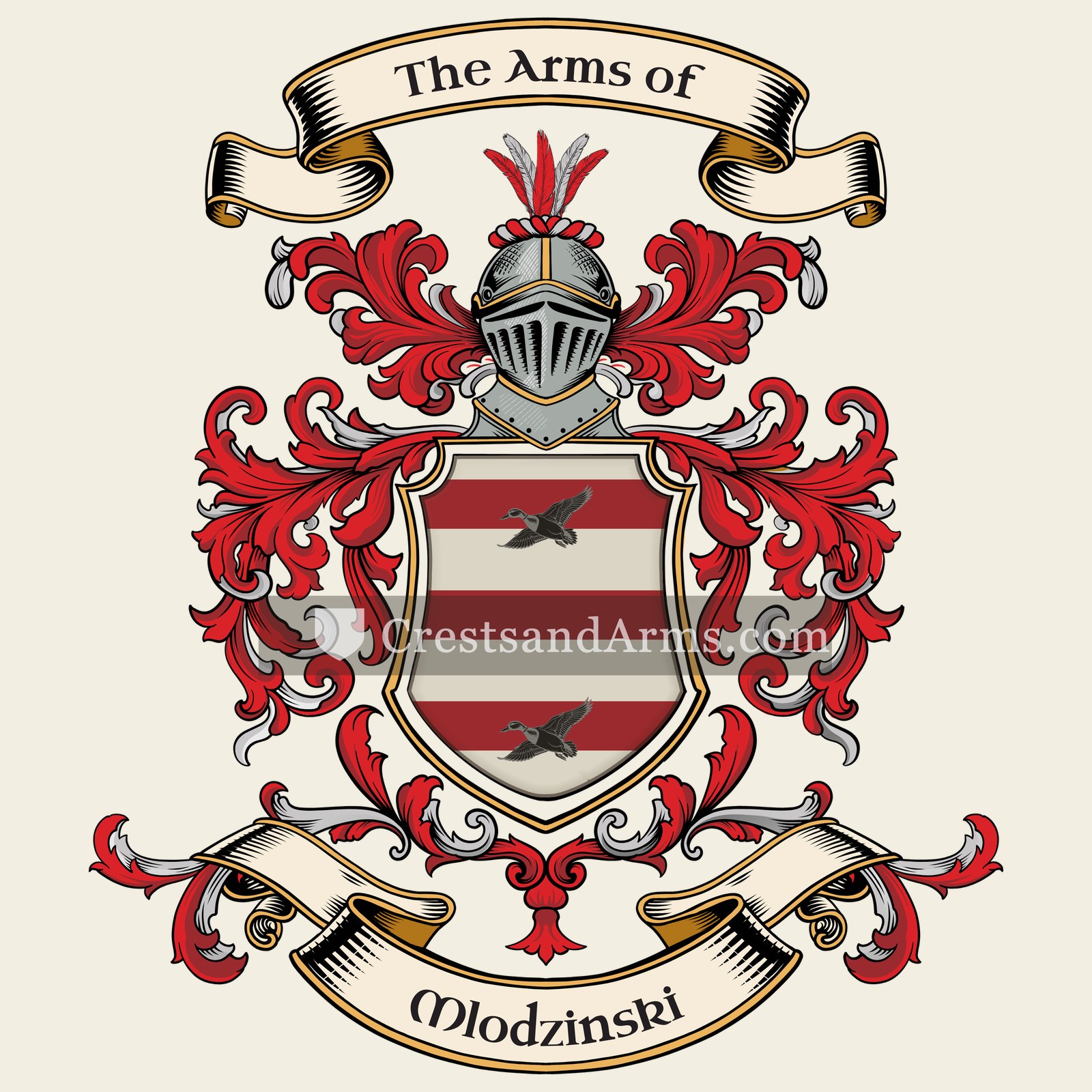
A record of documented arms, meaning and origin, researched for the Mlodzinski family of Poland.
Reg. 5531 · Polish, M–O
Coat of Arms & Family Crest Details
Symbols on this shield
fessThe military belt, and readiness to serve
duckResourcefulness on land and water
Colours
Silver (Argent)Means: Peace and sincerity
Red (Gules)Means: Military strength
Black (Sable)Means: Constancy
Historical info
Source
J. B. Rietstap, Armorial Général, Gouda: G. B. van Goor Zonen, 1884–87
Blazon (the actual original written record)
“D'arg. à deux têtes et cols d'oie adossées de sa., entrelacées avec trois fasces de gu. Cq. cour. C.: un homme d'armes iss., coiffé d'un morion, posé de profil, tenant une hallebarde.”
SaxonyPrusse · Saxony, c. 1772
Digital archive packCoat of arms PNG, gold border print PDF, vector SVG and the certificate of authenticity. Sent to your email in minutes.
Map of Poland showing where the Mlodzinski arms are recorded
The Mlodzinski arms were recorded in Saxony, c. 1772.
Saxony had mines, trade and old landed families all at once. Silver made some fortunes and land held others, and both sorts of family kept arms, which is why Saxon names appear so often in the registers.
This is where the arms were entered in the register. Families often moved to other parts of the country, so the same name can turn up in more than one region.
Region
Saxony
Town
Prusse
First recorded
1772
Granting Authority for the Mlodzinski Arms
Ennoblement by the Sejm
Author: Olek Remesz · CC BY-SA 3.0
The body that granted and recorded arms in Poland in this period.
Stanisław August Poniatowski
Sovereign of the period
Stanisław August Poniatowski
1764–1795
Reigning in Poland when the Mlodzinski arms are first recorded.
How Arms Worked in Poland
Polish noble families shared a single coat of arms across many different surnames, creating large clans rather than individual designs. These symbols were held collectively by all members of the clan regardless of their specific family name. When a new family joined the nobility, they were adopted into an existing clan and began using that group's established shield.
Granting authority
The Sejm, which was the Polish parliament, held the power to grant noble status and the right to bear arms.
How they got arms
Families typically received their coat of arms through a formal act of ennoblement granted by the Sejm for distinguished service.
Where arms were recorded
These grants were officially recorded in the Crown Metrica, which served as the central archive for state documents starting in the sixteenth century.
The family's standing
Recorded among the armigerous families of Saxony.
Origin & History of the Mlodzinski Family in Poland
The family name Mlodzinski originates from the Slavic linguistic tradition, where it is derived from the root word "mlody," meaning young. Historically, this name likely functioned as a descriptive nickname for a younger son or a newcomer to a specific village. By the year 1772, records confirm that members of the family were established in the region of Saxony. During this period, Saxony served as a significant crossroads for trade and migration within the Holy Roman Empire. The presence of the family in this area suggests they were part of the broader movement of people across Central Europe during the late eighteenth century. As they settled into these German-speaking lands, the family likely integrated into the local agricultural or artisan communities that defined the Saxon landscape at the time.
Related Branches & Arms
Root word
młody
A Slavic adjective meaning young or youthful.
This name
MlodzinskiRefers to a descendant of a young person or a newcomer to a location.
also spelled
Meldzinsky
Documented Sources
J. B. Rietstap, Armorial Général, Gouda: G. B. van Goor Zonen, 1884–87
Kohlheim, Rosa and Volker Kohlheim, Duden Familiennamen: Herkunft und Bedeutung von 20.000 Nachnamen, 2005


 fessThe military belt, and readiness to serve
 duckResourcefulness on land and water
 fessThe military belt, and readiness to serve
 duckResourcefulness on land and water