Map of Belgium showing where the Mls arms are recorded
The Mls arms were recorded in Liege, c. 1737.
Liege was a prosperous town and its surrounding country, living on metalworking and trade. Merchant families grew rich, bought land outside the walls, and took arms as landowners rather than tradesmen.
This is where the arms were entered in the register. Families often moved to other parts of the country, so the same name can turn up in more than one region.
The body that granted and recorded arms in Belgium in this period.
Charles VI, Holy Roman Emperor
Sovereign of the period
Charles VI, Holy Roman Emperor
1711–1740
Reigning in Belgium when the Mls arms are first recorded.
How Arms Worked in Belgium
In Belgium, a coat of arms is considered personal property that is passed down through the male line to legitimate descendants. Families often use the same shield design across generations to show their shared heritage. If a branch of the family wants to change the design, they must apply for an official update to their specific version of the arms.
Granting authority
The Conseil héraldique is the official body that regulates and approves all coats of arms in Belgium.
How they got arms
Families obtain their coats of arms through formal royal grants or by confirming their historical right to use existing designs.
Where arms were recorded
All approved coats of arms are officially recorded in the public registers of the Conseil héraldique since 1844.
The family's standing
Recorded among the armigerous families of Liege.
Origin & History of the Mls Family in Belgium
The family name Mls is deeply rooted in the historical landscape of Liège, where records confirm the presence of family members as early as 1737. During this period, Liège was a major industrial and cultural hub within the Prince-Bishopric of Liège, a territory known for its unique political status and strong traditions in metalworking and trade. Families living in this region often navigated a complex society defined by the transition from feudal structures to early modern commerce. The name itself likely evolved from local linguistic patterns common to the Meuse River valley, reflecting the diverse cultural influences of the Walloon region. By establishing themselves in such a vibrant urban center during the eighteenth century, the early members of the Mls family were likely integrated into the active professional and social life of the city, contributing to the local community during a time of significant regional growth.
Mls Meaning & Related Branches
Root word
Aemilius
Latin name derived from the word for rival or industrious.
This name
MlsA shortened form of the name Emil, signifying an industrious or eager person.
also spelled
Molss
Molz
Molse
Documented Sources
J. B. Rietstap, Armorial Général, Gouda: G. B. van Goor Zonen, 1884–87
Archives de l'État à Liège, Registres paroissiaux de la ville de Liège, 1737
Kupper, Jean-Louis, Liège et l'Église impériale, XIe-XIIe siècles, 1981
Stiennon, Jacques, Histoire de Liège, 1991
Digital archive packCoat of arms PNG, gold border print PDF, vector SVG and the certificate of authenticity. Sent to your email in minutes.


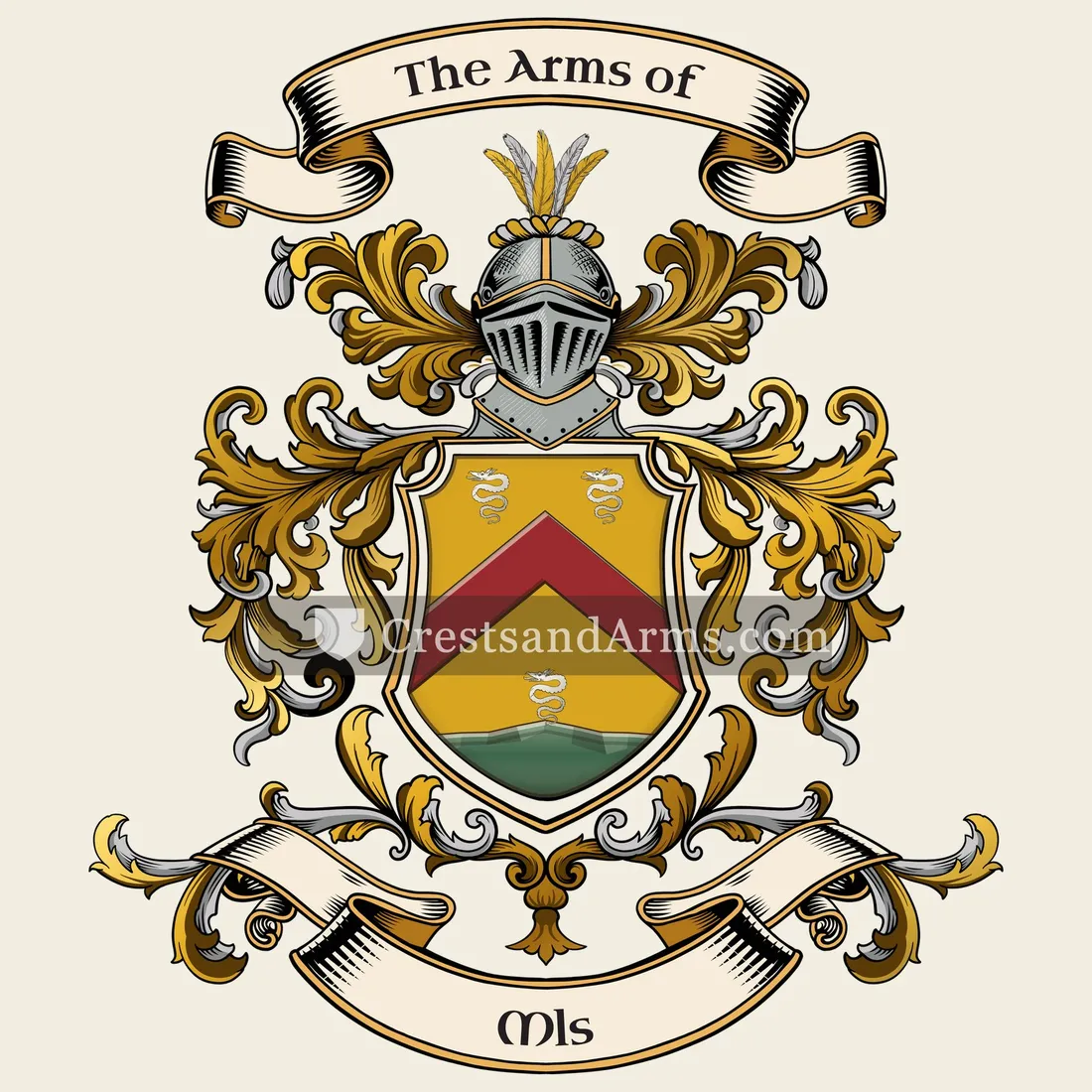
 chevronProtection, and faithful service completed
 mountThe ground held, and steadfastness upon it
 serpentWisdom, healing and prudence
 chevronProtection, and faithful service completed
 mountThe ground held, and steadfastness upon it
 serpentWisdom, healing and prudence