Map of France showing where the Moe arms are recorded
The Moe arms were recorded in Flandre, c. 1663.
Flandre grew rich on cloth, and its towns were among the busiest in Europe. Merchant families bought land with their profits and took arms to go with it, so trade put as many names in the registers here as land did.
This is where the arms were entered in the register. Families often moved to other parts of the country, so the same name can turn up in more than one region.
The body that granted and recorded arms in France in this period.
Louis XIV of France
Sovereign of the period
Louis XIV of France
1643–1715
Reigning in France when the Moe arms are first recorded.
How Arms Worked in France
In France, a coat of arms was a mark of honor that passed down through the male line to all legitimate descendants. Families often used the same shield without changes to show their shared heritage. If a branch wanted to stand out, they could add a small mark to their shield to show their specific place in the family tree.
Granting authority
The Juge d'armes de France acted as the official authority that regulated and verified coats of arms across the country.
How they got arms
Families typically inherited their arms from ancestors, though they could also receive them through royal grants or by proving their noble status.
Where arms were recorded
Coats of arms were officially recorded in the Armorial Général de France, which began its main collection in the year 1696.
The family's standing
Recorded among the armigerous families of Flandre.
Origin & History of the Moe Family in France
The family name Moe has deep roots in the historical region of Flanders, where records confirm members of the family were established by 1663. During the seventeenth century, Flanders was a bustling center of trade and agriculture, and families like the Moes were often tied to the land or local commerce in these growing communities. The name itself likely evolved from regional dialects, reflecting the linguistic blend of Dutch and French that characterized the area. As the family moved through the changing political landscapes of the Low Countries, they maintained their presence in the region by adapting to the local customs and economic shifts of the time. This early history suggests a family that was well-integrated into the social fabric of Flanders, contributing to the development of their local towns during a period of significant regional transition.
Moe Meaning & Related Branches
Root word
Maud
Derived from the Germanic name Mahthildis meaning strength in battle.
This name
MoeA French habitational surname referring to individuals from the town of Meaux.
also spelled
Moyes
Moie
Moy
Documented Sources
J. B. Rietstap, Armorial Général, Gouda: G. B. van Goor Zonen, 1884–87
Algemeen Rijksarchief, Parochieregisters van de Zuidelijke Nederlanden, 1663
De Smet, A., Geschiedenis van de Vlaamse familienamen, 1974
Vandenbroeke, C., Sociale geschiedenis van het Vlaamse volk, 1981
Digital archive packCoat of arms PNG, gold border print PDF, vector SVG and the certificate of authenticity. Sent to your email in minutes.


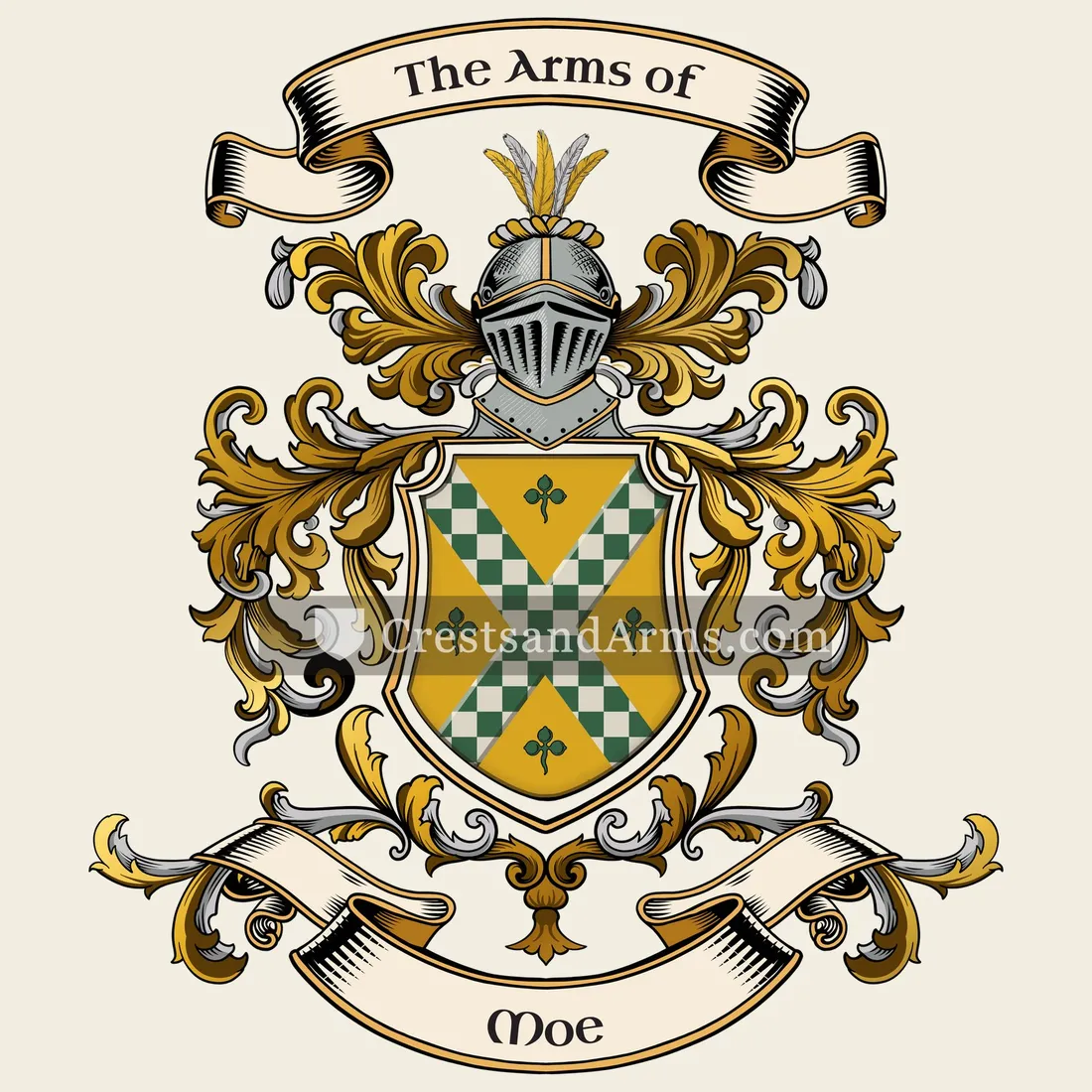
 saltireResolution, and St Andrew's cross
 chequyConstancy, and the counting-board
 trefoilPerpetuity, and the Trinity
 saltireResolution, and St Andrew's cross
 chequyConstancy, and the counting-board
 trefoilPerpetuity, and the Trinity