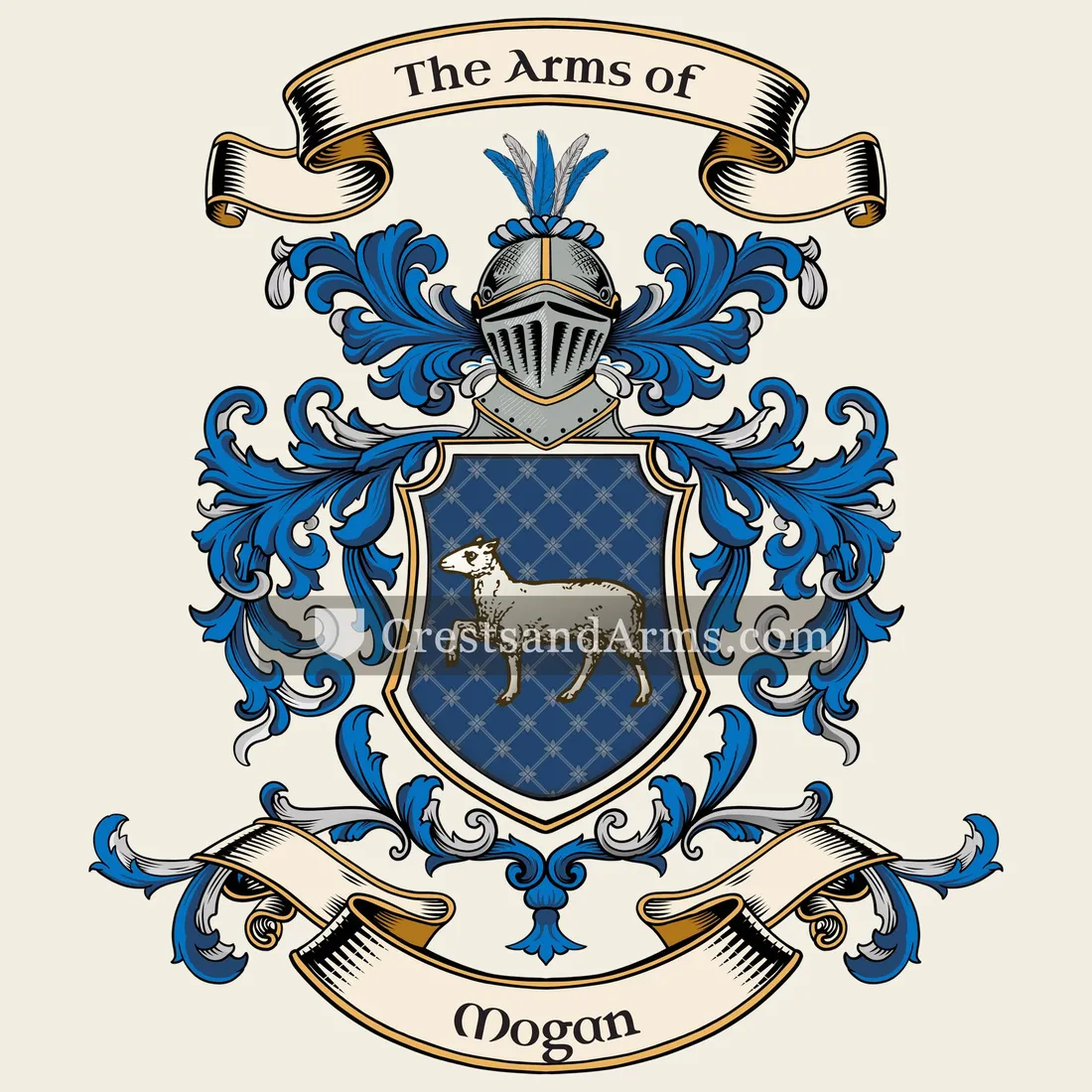
A record of documented arms, meaning and origin, researched for the Mogan family of Germany.
Reg. 4212 · German, M–O
Meaning of the Mogan family crest colors & symbols
Symbols on this shield
lambGentleness, patience and faith
Colours
Blue (Azure)Means: Loyalty and truth
Silver (Argent)Means: Peace and sincerity
Historical info
Source
J. B. Rietstap, Armorial Général, Gouda: G. B. van Goor Zonen, 1884–87
Blazon (the actual original written record)
“D'azur à un agneau pascal pass. d'arg., onglé d'or, la tête entourée d'une auréole du même, tenant un guidon de gu. bordé d'arg., attaché à une hampe d'or sommée d'une croix de sa. Cq. cour. C.: l'agneau iss. avec le guidon.”
HesseHesse, c. 1737
Digital archive packCoat of arms PNG, gold border print PDF, vector SVG and the certificate of authenticity. Sent to your email in minutes.
Map of Germany showing where the Mogan arms are recorded
The Mogan arms were recorded in Hesse, c. 1737.
Hesse was central German country, divided among a large number of small landowners and prosperous towns. So many separate households held ground there that the region produced an unusual number of coats of arms.
This is where the arms were entered in the register. Families often moved to other parts of the country, so the same name can turn up in more than one region.
The body that granted and recorded arms in Germany in this period.
Charles VI, Holy Roman Emperor
Sovereign of the period
Charles VI, Holy Roman Emperor
1711–1740
Reigning in Germany when the Mogan arms are first recorded.
How Arms Worked in Germany
In the Holy Roman Empire, coats of arms were often granted to individuals by the Emperor or his representatives. These arms were then passed down through the generations to all legitimate descendants of the original holder. Younger branches of a family usually kept the same shield design without needing to change it, as the arms belonged to the entire lineage.
Granting authority
The Holy Roman Emperor held the sole power to grant new coats of arms throughout his vast imperial territories.
How they got arms
Families typically obtained their coats of arms through a formal imperial grant or by proving their noble status to the authorities.
Where arms were recorded
These grants were officially recorded in the Imperial Chancery registers, which began keeping formal records of such honors during the Middle Ages.
The family's standing
Recorded among the armigerous families of Hesse.
Origin & History of the Mogan Family in Germany
The family name Mogan has deep roots in the region of Hesse, Germany, where records confirm members of the family were living as early as 1737. During the eighteenth century, Hesse was a collection of territories known for its strong agricultural traditions and distinct local dialects. Families like the Mogans often lived in small rural villages where they worked as farmers, craftsmen, or laborers. Life in this region was shaped by the local nobility and the influence of the Holy Roman Empire, which governed daily affairs through strict legal and religious structures. As the family grew, they became part of the social fabric of these Hessian communities, contributing to the local economy and participating in the parish life that defined the era. Over time, the name remained tied to this specific German landscape, reflecting the migration patterns and regional identities that were common for families in central Europe during the pre-industrial age.
Mogan Meaning & Related Branches
Root word
Mago
A Germanic root related to strength, power, or a mighty person.
This name
MoganA patronymic surname derived from a diminutive form of a name meaning powerful or strong.
also spelled
Mogenn
Moggin
Moggan
Documented Sources
J. B. Rietstap, Armorial Général, Gouda: G. B. van Goor Zonen, 1884–87
Hessisches Staatsarchiv Marburg, Kirchenbücher der evangelischen Kirchengemeinden in Hessen, 1737
Knetsch, Carl, Die hessische Landesgeschichte, 1928
Zimmermann, Friedrich, Die Geschichte der hessischen Landbevölkerung im 18. Jahrhundert, 1954
Digital archive packCoat of arms PNG, gold border print PDF, vector SVG and the certificate of authenticity. Sent to your email in minutes.


 lambGentleness, patience and faith
 lambGentleness, patience and faith