Map of Germany showing where the Mohl arms are recorded
The Mohl arms were recorded in Bade, c. 1870.
This is where the arms were entered in the register. Families often moved to other parts of the country, so the same name can turn up in more than one region.
The body that granted and recorded arms in Germany in this period.
Wilhelm I
Sovereign of the period
Wilhelm I
1861–1888
Reigning in Germany when the Mohl arms are first recorded.
How Arms Worked in Germany
Prussian heraldry was strictly tied to social rank and noble status rather than being a free choice for every citizen. These symbols were treated as permanent family property that moved through the generations to all legitimate heirs. If a family branch wanted to change their design to stand out, they had to apply for official permission to alter their specific version of the shield.
Granting authority
The Prussian Heroldsamt acted as the central state office that managed and strictly controlled all noble titles and coats of arms.
How they got arms
Families usually obtained their arms through formal royal grants or by proving their long-standing noble status to the state authorities.
Where arms were recorded
All official coats of arms were kept in the rolls of the Prussian Heroldsamt, which functioned from 1706 until 1918.
The family's standing
Recorded among the armigerous families of Germany.
Origin & History of the Mohl Family in Germany
The surname Mohl has deep roots in the German-speaking regions of Europe, particularly within the southwestern area known as Baden. The name is often classified as a topographical or descriptive surname, likely originating from Middle High German terms related to soft or marshy ground. Families bearing this name were often established as farmers or landholders who lived near these specific landscape features. By the time records place the family in the Baden region during the 1870s, the name had already been part of the local social fabric for many generations. During this era, the Baden region was undergoing significant political and social changes as it integrated into the newly formed German Empire. Families like the Mohls were part of a stable, agrarian society that helped shape the cultural identity of the region before the rapid industrialization of the late nineteenth century.
Meaning of the Mohl family crest colors & symbols
Colours
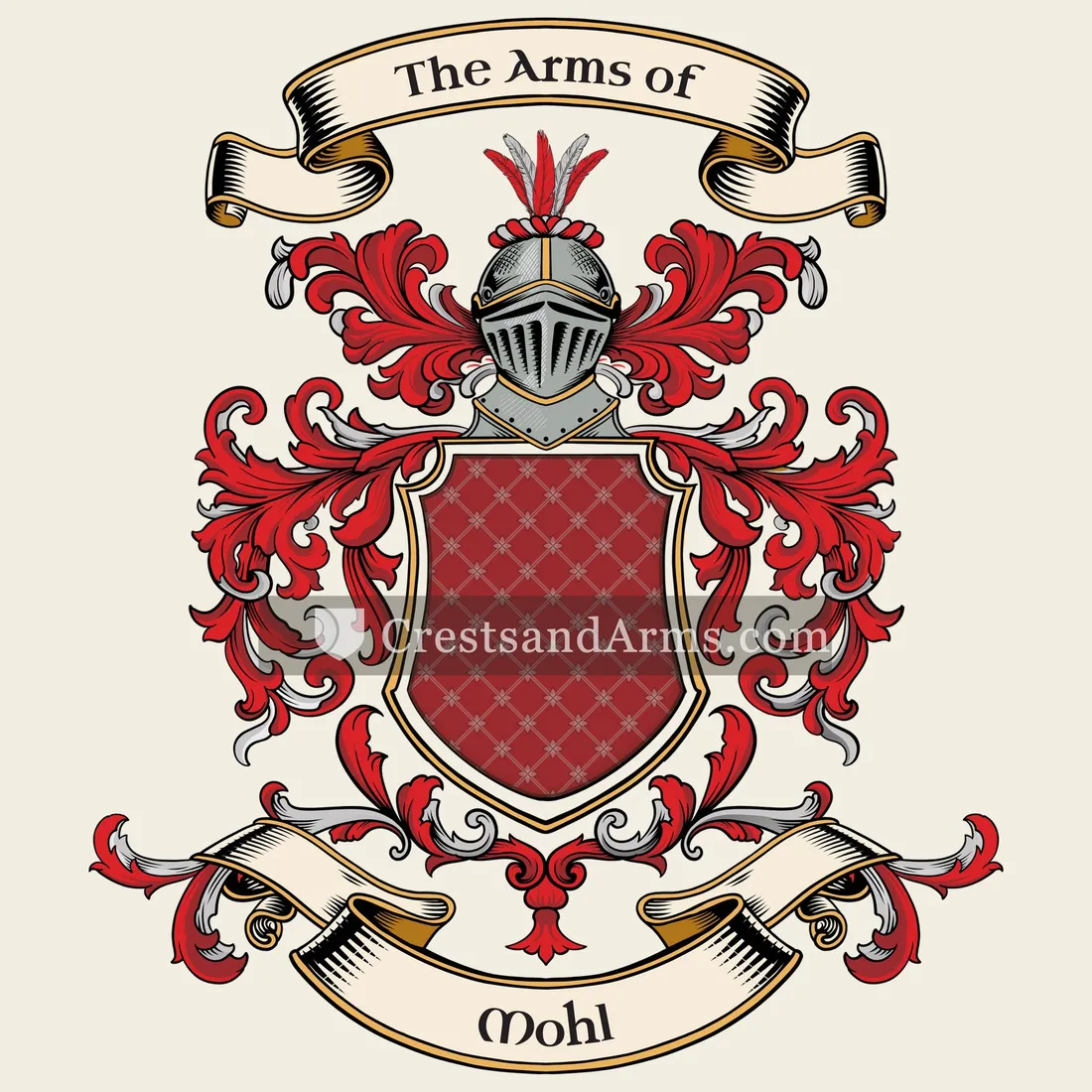
Red (Gules)Means: Military strength
Historical info
Source
J. B. Rietstap, Armorial Général, Gouda: G. B. van Goor Zonen, 1884–87
Blazon (the actual original written record)
“De gu. à trois crapauds assis d'arg. C.: un crapaud assis d'arg., entre un vol de gu.”
CourlandCourland, c. 1772
Digital archive packCoat of arms PNG, gold border print PDF, vector SVG and the certificate of authenticity. Sent to your email in minutes.
Map of Poland showing where the Mohl arms are recorded
The Mohl arms were recorded in Courland, c. 1772.
Courland was Baltic coast country held in large estates by a small number of families. They kept their land for generations and served as officers abroad, and both landholding and service brought arms with them.
This is where the arms were entered in the register. Families often moved to other parts of the country, so the same name can turn up in more than one region.
Region
Courland
First recorded
1772
Granting Authority for the Mohl Arms
Ennoblement by the Sejm
Author: Olek Remesz · CC BY-SA 3.0
The body that granted and recorded arms in Poland in this period.
Stanisław August Poniatowski
Sovereign of the period
Stanisław August Poniatowski
1764–1795
Reigning in Germany when the Mohl arms are first recorded.
How Arms Worked in Poland
Polish noble families shared a single coat of arms across many different surnames, creating large clans rather than individual designs. These symbols were held collectively by all members of the clan regardless of their specific family name. When a new family joined the nobility, they were adopted into an existing clan and began using that group's established shield.
Granting authority
The Sejm, which was the Polish parliament, held the power to grant noble status and the right to bear arms.
How they got arms
Families typically received their coat of arms through a formal act of ennoblement granted by the Sejm for distinguished service.
Where arms were recorded
These grants were officially recorded in the Crown Metrica, which served as the central archive for state documents starting in the sixteenth century.
The family's standing
Recorded among the armigerous families of Courland.
Origin & History of the Mohl Family in Poland
The history of the Mohl family in the region of Courland is deeply connected to the shifting borders and cultural exchanges of the Polish-Lithuanian Commonwealth. By 1772, when the first partition of Poland took place, the family was already established as part of the local landed gentry within this territory. The name itself is rooted in Germanic linguistic traditions, which was common for families living in the Baltic regions under the influence of the Polish crown. During this period, families like the Mohls often served as administrators or landowners who helped manage the complex social structure of the Baltic provinces. Because Courland was a fiefdom of the Polish-Lithuanian Commonwealth, the Mohl family navigated a unique environment where German heritage blended with Polish political and legal systems. Their presence in the region during the late eighteenth century reflects the broader movement of families who settled in these borderlands to oversee estates and participate in the regional government.
Mohl Meaning & Related Branches
Root word
Mollo
A Germanic personal name derived from the word for soft or gentle.
This name
MohlA topographic or occupational name referring to a person who lived near a mill or worked as a miller.
also spelled
Mohle
Mohll
Moll
Mol
Related arms
Mollvariant spelling
Documented Sources
J. B. Rietstap, Armorial Général, Gouda: G. B. van Goor Zonen, 1884–87
Bahlow, Hans, Deutsches Namenlexikon: Familien- und Vornamen nach Ursprung und Sinn erklärt, 1967
Heintze, Albert, Die deutschen Familiennamen: geschichtlich, geographisch, sprachlich, 1903
Generallandesarchiv Karlsruhe, Bestand 229: Personenstandsregister der badischen Standesämter, 1870
Digital archive packCoat of arms PNG, gold border print PDF, vector SVG and the certificate of authenticity. Sent to your email in minutes.


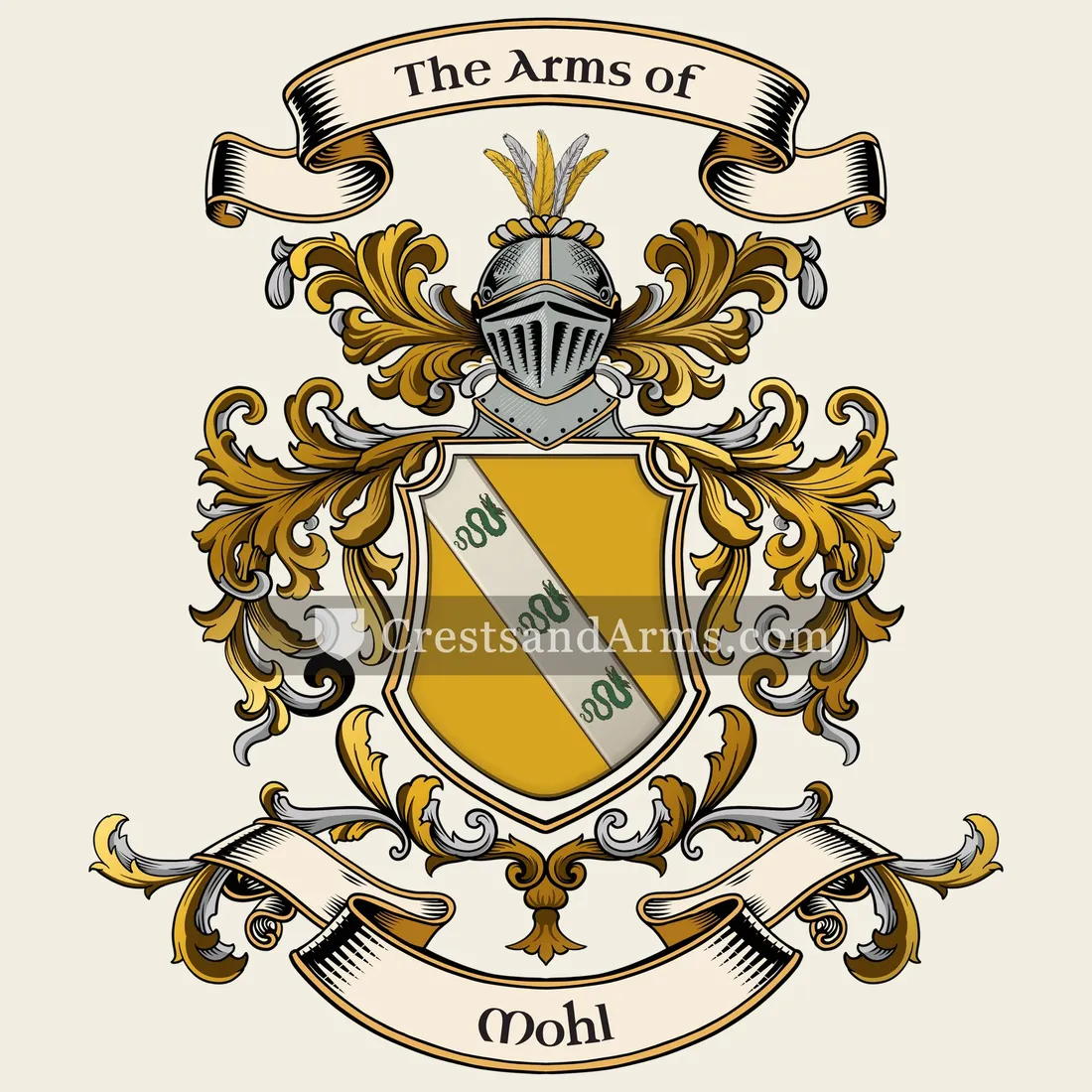
 bendDefence, and the scarf of a commander
 serpentWisdom, healing and prudence
 bendDefence, and the scarf of a commander
 serpentWisdom, healing and prudence