Map of Netherlands showing where the Mol arms are recorded
The Mol arms were recorded in Netherlands, c. 1815.
Arms such as these were typically recorded in Friesland.
Friesland was low, wet country on the northern coast of the Netherlands, farmed by families who had held the same land for centuries. Free landholders were unusually common there, and a free landholder could carry arms.
This is where the arms were entered in the register. Families often moved to other parts of the country, so the same name can turn up in more than one region.
Region
Friesland
First recorded
1815
Granting Authority for the Mol Arms
Hoge Raad van Adel
Photograph made by me · CC BY-SA 3.0
The body that granted and recorded arms in Netherlands in this period.
William I of the Netherlands
Sovereign of the period
William I of the Netherlands
1815–1840
Reigning in Netherlands when the Mol arms are first recorded.
How Arms Worked in Netherlands
In the Netherlands, coats of arms were often used by noble families and those who held specific public offices. These arms were passed down through the generations to legitimate descendants. Younger branches of a family usually kept the original design without needing to add special marks. This system ensured that the family identity remained clear and consistent over many years.
Granting authority
The Hoge Raad van Adel is the official body that regulates and manages noble titles and coats of arms in the Netherlands.
How they got arms
Families typically obtained their coats of arms through official royal grants or by proving their long-standing historical use of the symbols.
Where arms were recorded
Coats of arms are officially recorded in the registers held by the Hoge Raad van Adel, which began its work in 1814.
The family's standing
Recorded among the armigerous families of Netherlands.
Origin & History of the Mol Family in Netherlands
The surname Mol has deep roots in the Dutch landscape, often serving as a descriptive name that reflects the historical connection between families and the land. In the Dutch language, the word "mol" translates to mole, which likely served as a nickname for an ancestor who was known for working the earth or perhaps for having physical traits that reminded neighbors of the small burrowing animal. By the early 19th century, records confirm that families bearing this name were well-established in the northern province of Friesland. During this period, the Napoleonic administration required citizens to formalize their surnames for tax and military purposes. This transition helped solidify the Mol name within official civil registries, marking a shift from local recognition to documented lineage. These early families in Friesland were often part of the rural community, contributing to the agricultural and maritime traditions that defined the region during the 1800s.
Meaning of the Mol family crest colors & symbols
Symbols on this shield
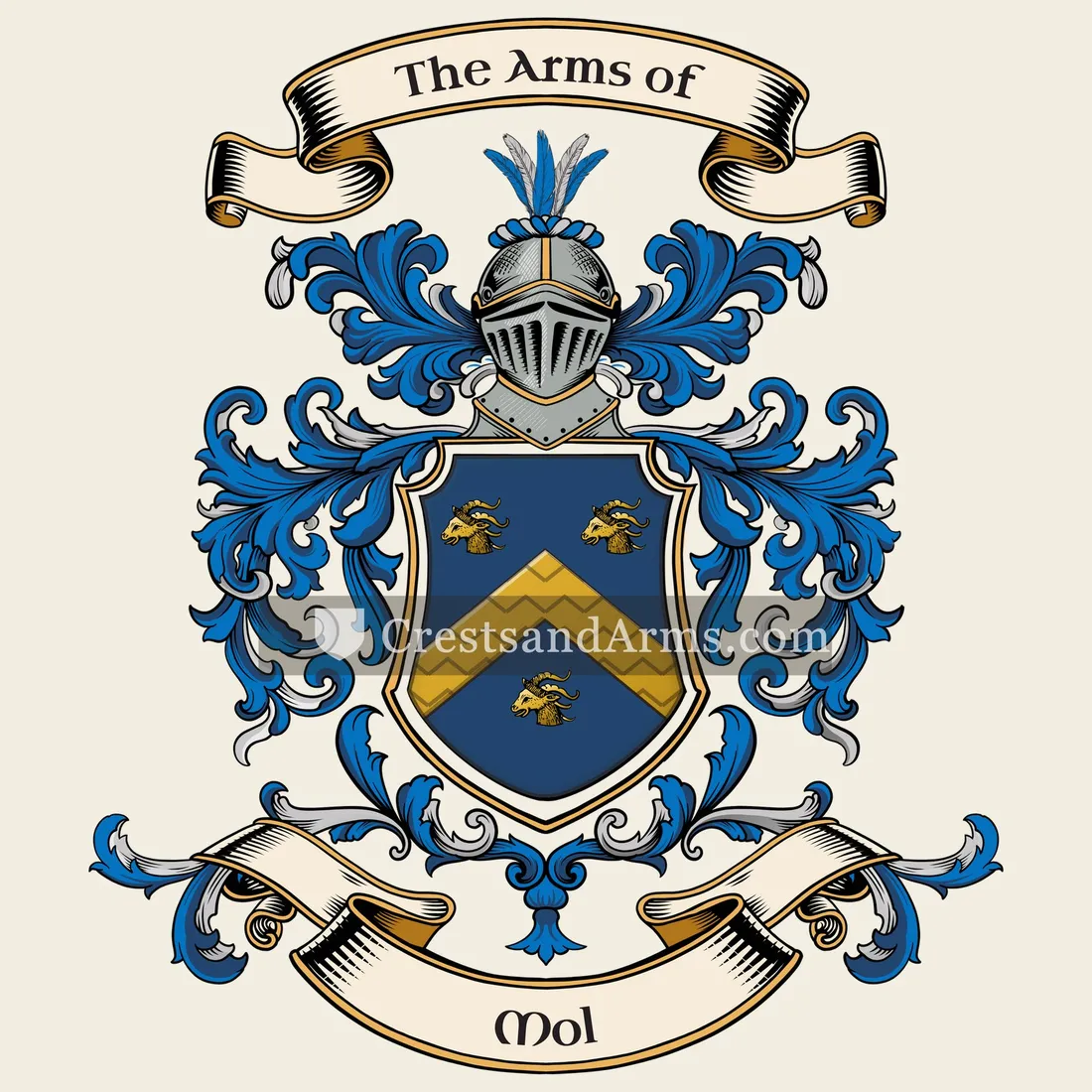
chevronProtection, and faithful service completed
goats headWisdom, and one who wins by policy rather than force
Colours
Blue (Azure)Means: Loyalty and truth
Gold (Or)Means: Generosity
Historical info
Source
J. B. Rietstap, Armorial Général, Gouda: G. B. van Goor Zonen, 1884–87
Blazon (the actual original written record)
“D'azur au chev. d'or, acc. de trois têtes de chèvre du même.”
ArtoisTournaisis · Artois, c. 1663
Digital archive packCoat of arms PNG, gold border print PDF, vector SVG and the certificate of authenticity. Sent to your email in minutes.
Map of France showing where the Mol arms are recorded
The Mol arms were recorded in Artois, c. 1663.
Artois lay on the disputed ground between France and the Low Countries and was fought over for centuries. Families there held their land under arms, and a shield was how a fighting household was known.
This is where the arms were entered in the register. Families often moved to other parts of the country, so the same name can turn up in more than one region.
The body that granted and recorded arms in France in this period.
Louis XIV of France
Sovereign of the period
Louis XIV of France
1643–1715
Reigning in Netherlands when the Mol arms are first recorded.
How Arms Worked in France
In France, a coat of arms was a mark of honor that passed down through the male line to all legitimate descendants. Families often used the same shield without changes to show their shared heritage. If a branch wanted to stand out, they could add a small mark to their shield to show their specific place in the family tree.
Granting authority
The Juge d'armes de France acted as the official authority that regulated and verified coats of arms across the country.
How they got arms
Families typically inherited their arms from ancestors, though they could also receive them through royal grants or by proving their noble status.
Where arms were recorded
Coats of arms were officially recorded in the Armorial Général de France, which began its main collection in the year 1696.
The family's standing
Recorded among the armigerous families of Artois.
Origin & History of the Mol Family in France
The family name Mol has deep roots in the northern region of France known as Artois. By the year 1663, records confirm that members of the family were well established within this area. During the seventeenth century, Artois was a region defined by its strategic importance and its transition between different European powers. Families living there often worked in agriculture or local trade, contributing to the distinct cultural identity of the French borderlands. Because the name is short and phonetic, it likely originated as a descriptive nickname or a reference to a specific location in the local dialect. Over generations, the Mol family became part of the social fabric of the region, living through the complex political shifts that shaped northern France during the reign of King Louis XIV.
Mol Meaning & Related Branches
Root word
moll
Middle Dutch word for a mole animal.
This name
MolA nickname for a person perceived to be blind or burrowing like a mole.
also spelled
Moll
Mollle
Molll
Related arms
Mesmayrecorded with Mol, same area
Nédonchelrecorded with Mol, same area
Pinault des Janmauxrecorded with Mol, same area
Documented Sources
J. B. Rietstap, Armorial Général, Gouda: G. B. van Goor Zonen, 1884–87
Meertens, P.J., Voornamen en familienamen in Nederland, 1959
Van der Schaar, J., Woordenboek van familienamen, 1988
Tresoar (Fries Historisch en Letterkundig Centrum), Burgerlijke Stand van Friesland (Civil Registry of Friesland), 1811–1950
Digital archive packCoat of arms PNG, gold border print PDF, vector SVG and the certificate of authenticity. Sent to your email in minutes.


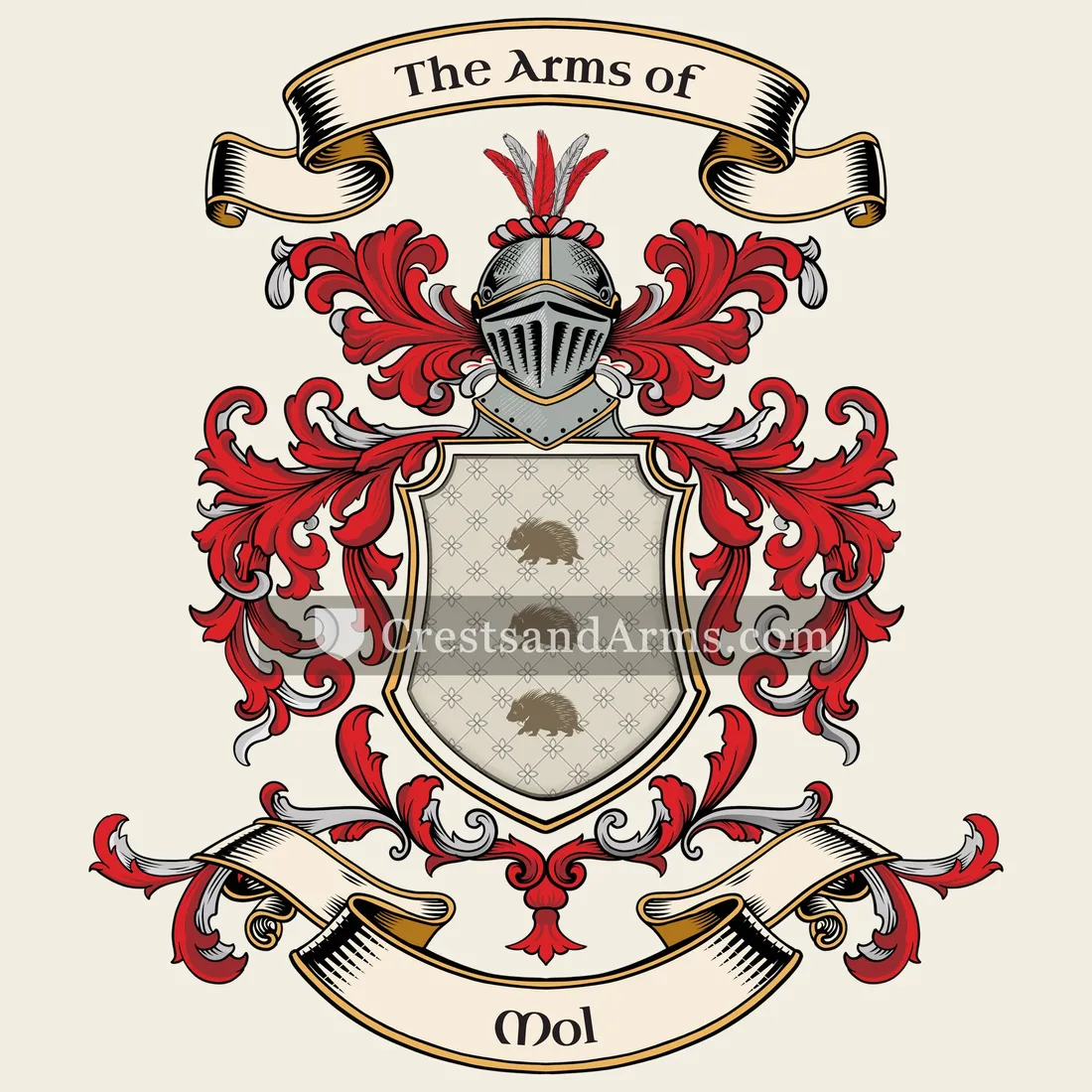
 hedgehogA provident provider
 hedgehogA provident provider


 chevronProtection, and faithful service completed
 goats headWisdom, and one who wins by policy rather than force