Map of France showing where the Molay arms are recorded
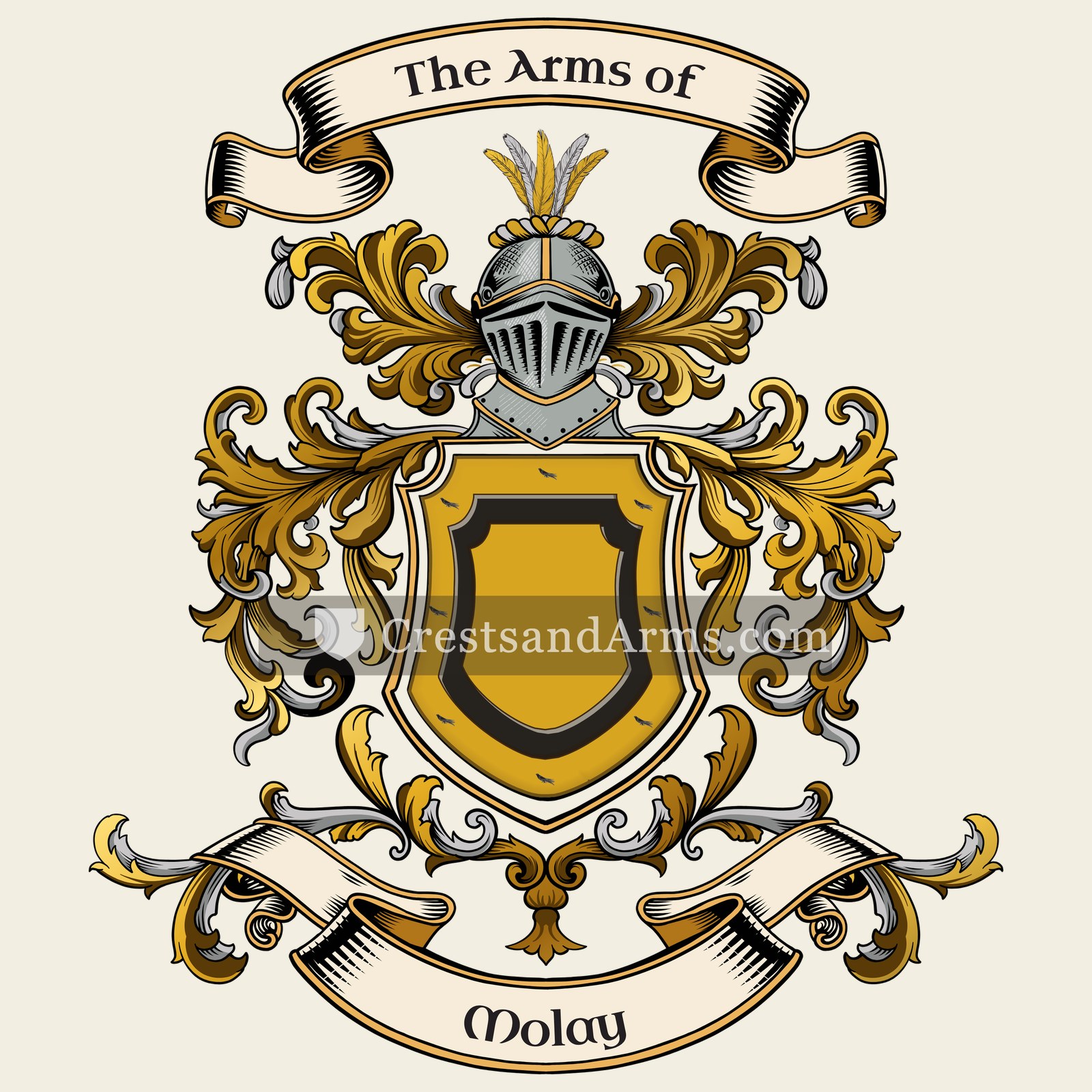
The Molay arms were recorded in Franche-Comte, c. 1663.
Franche-Comte sat between France and the Empire and changed hands more than once. Border families held their land under arms and expected to defend it, so a shield was a practical thing rather than an ornament.
This is where the arms were entered in the register. Families often moved to other parts of the country, so the same name can turn up in more than one region.
The body that granted and recorded arms in France in this period.
Louis XIV of France
Sovereign of the period
Louis XIV of France
1643–1715
Reigning in France when the Molay arms are first recorded.
How Arms Worked in France
In France, a coat of arms was a mark of honor that passed down through the male line to all legitimate descendants. Families often used the same shield without changes to show their shared heritage. If a branch wanted to stand out, they could add a small mark to their shield to show their specific place in the family tree.
Granting authority
The Juge d'armes de France acted as the official authority that regulated and verified coats of arms across the country.
How they got arms
Families typically inherited their arms from ancestors, though they could also receive them through royal grants or by proving their noble status.
Where arms were recorded
Coats of arms were officially recorded in the Armorial Général de France, which began its main collection in the year 1696.
The family's standing
Recorded among the armigerous families of Franche-Comte.
Origin & History of the Molay Family in France
The history of the Molay family is deeply rooted in the rugged landscape of the Franche-Comté region of eastern France. By the mid-seventeenth century, the family was well-established in this area, which served as a vital crossroads between the French kingdom and the Holy Roman Empire. The name itself is thought to be topographical, likely derived from the Old French word "moulay," which referred to a mill or a place where grain was ground. Families living near these essential local structures often adopted the name to identify their home or their trade. Records from 1663 confirm that members of the Molay family were active participants in the social and economic life of their local communities during this period. Life in Franche-Comté at that time was defined by agricultural work and the management of local resources, providing a stable foundation for the family to grow and thrive across generations.
Related Branches & Arms
Root word
mola
Latin term referring to a millstone or ground grain.
This name
MolayA topographical name for someone who lived near a mill or worked as a miller.
also spelled
Mollay
Molai
Documented Sources
J. B. Rietstap, Armorial Général, Gouda: G. B. van Goor Zonen, 1884–87
Benoit, Arthur, Recherches sur les anciennes familles de la Franche-Comté, 1884
Archives Départementales du Doubs, Série B: Cours et juridictions
Dunod de Charnage, François-Ignace, Mémoires pour servir à l'histoire du comté de Bourgogne, 1740
Digital archive packCoat of arms PNG, gold border print PDF, vector SVG and the certificate of authenticity. Sent to your email in minutes.


 orlePreservation, and protection in battle
 martletA younger son, who must win his own land
 orlePreservation, and protection in battle
 martletA younger son, who must win his own land