Map of Spain showing where the Moles arms are recorded
The Moles arms were recorded in Aragon, c. 1722.
Aragon was mountain and river country in north-eastern Spain, with a strong tradition of small independent landholders. A great many families counted as gentry there, and each one needed a shield to be told apart.
This is where the arms were entered in the register. Families often moved to other parts of the country, so the same name can turn up in more than one region.
The body that granted and recorded arms in Spain in this period.
Philip V of Spain
Sovereign of the period
Philip V of Spain
1714–1724
Reigning in Spain when the Moles arms are first recorded.
How Arms Worked in Spain
In Spain, a coat of arms was considered a form of property that belonged to the entire family line. These arms were passed down from a father to all his children equally. Younger branches of the family usually kept the original design without needing to add any special marks to distinguish their specific line.
Granting authority
The Cronista Rey de Armas was the official body that regulated and granted coats of arms throughout Spain.
How they got arms
Families often obtained their arms through royal grants or by proving their noble status to the official heraldic authority.
Where arms were recorded
Coats of arms were officially recorded in the registers of the Cronista Rey de Armas starting in 1496.
The family's standing
Recorded among the armigerous families of Aragon.
Origin & History of the Moles Family in Spain
The family name Moles has deep roots in the northeastern region of Spain, particularly within the Kingdom of Aragon. By the early 18th century, the family was well-established in this area, which was a hub for trade and local governance. The name likely originated as a topographical descriptor, referring to people who lived near a pier, a jetty, or a stone structure, as the word "mole" in various Romance languages relates to massive stone masonry. During the 1700s, families with this name were often integrated into the local social fabric, participating in the agricultural and administrative life of the Aragonese countryside. Because Aragon was a crossroads for movement between the Mediterranean coast and the interior of the Iberian Peninsula, the Moles family likely benefited from the economic stability of the region during this era. Their presence in 1722 suggests they were part of a stable community that valued land ownership and local civic participation.
Coat of Arms & Family Crest Details
Symbols on this shield
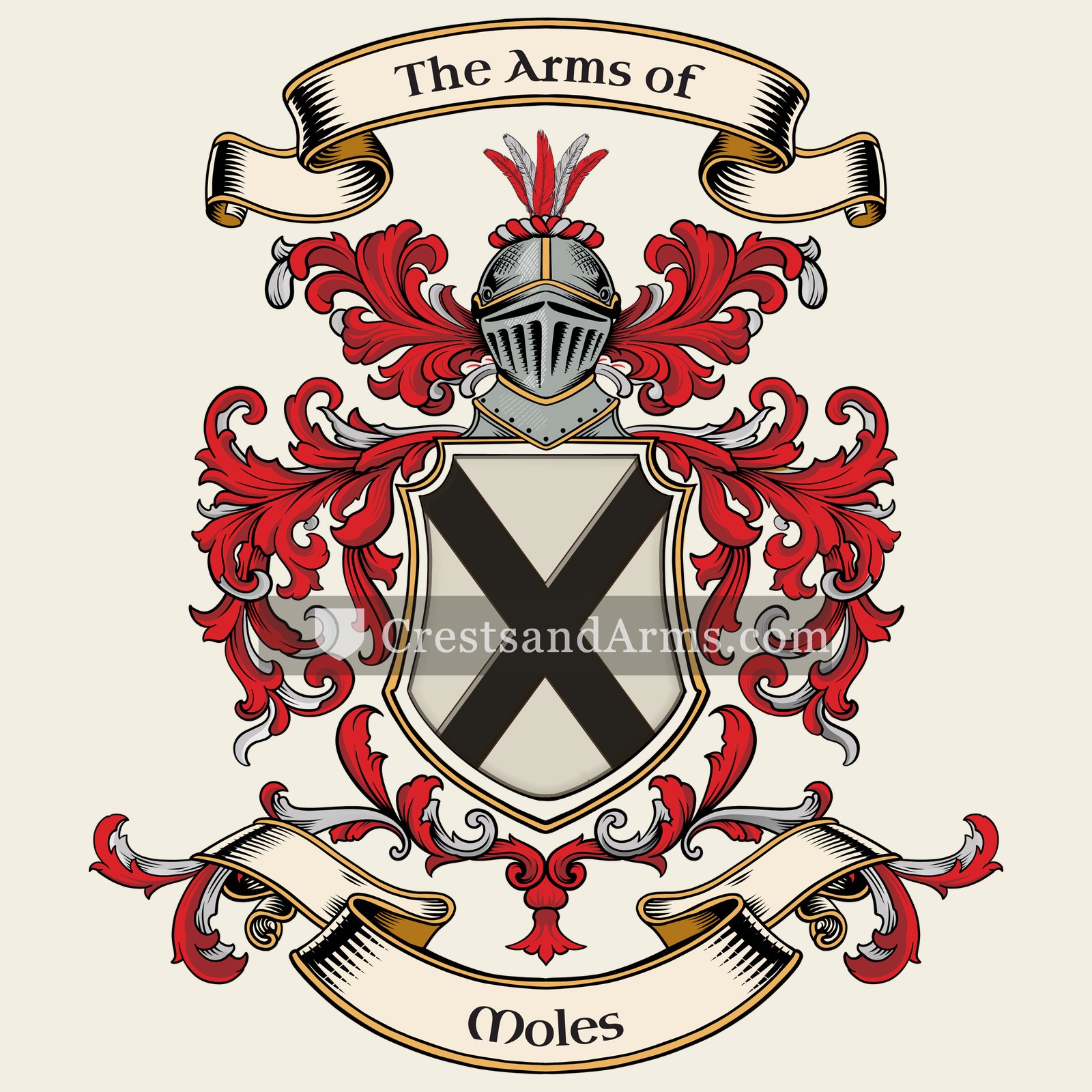
saltireResolution, and St Andrew's cross
Colours
Silver (Argent)Means: Peace and sincerity
Black (Sable)Means: Constancy
Historical info
Source
J. B. Rietstap, Armorial Général, Gouda: G. B. van Goor Zonen, 1884–87
Blazon (the actual original written record)
“D'arg. au saut. de sa.”
LyonnaisLyonnais, c. 1663
Digital archive packCoat of arms PNG, gold border print PDF, vector SVG and the certificate of authenticity. Sent to your email in minutes.
Map of France showing where the Moles arms are recorded
The Moles arms were recorded in Lyonnais, c. 1663.
Lyonnais centred on Lyon, one of the great banking and silk towns of France. Money made in the city bought estates in the countryside around it, and those estates brought arms with them.
This is where the arms were entered in the register. Families often moved to other parts of the country, so the same name can turn up in more than one region.
The body that granted and recorded arms in France in this period.
Louis XIV of France
Sovereign of the period
Louis XIV of France
1643–1715
Reigning in Spain when the Moles arms are first recorded.
How Arms Worked in France
In France, a coat of arms was a mark of honor that passed down through the male line to all legitimate descendants. Families often used the same shield without changes to show their shared heritage. If a branch wanted to stand out, they could add a small mark to their shield to show their specific place in the family tree.
Granting authority
The Juge d'armes de France acted as the official authority that regulated and verified coats of arms across the country.
How they got arms
Families typically inherited their arms from ancestors, though they could also receive them through royal grants or by proving their noble status.
Where arms were recorded
Coats of arms were officially recorded in the Armorial Général de France, which began its main collection in the year 1696.
The family's standing
Recorded among the armigerous families of Lyonnais.
Origin & History of the Moles Family in France
The history of the Moles family in France is deeply rooted in the cultural landscape of the Lyonnais region. By 1663, records confirm that members of the family were firmly established in this area, which was a vital center for trade and silk production during the seventeenth century. The name itself is thought to be topographical, likely originating from a description of the land where early ancestors lived or worked. During this period, families in the Lyonnais often lived in tight-knit communities centered around local parishes and agricultural estates. As the family grew, they became part of the social fabric of southeastern France, navigating the complex political and religious changes that defined the reign of King Louis XIV. Their presence in this region suggests a long-standing connection to the local economy and the traditional way of life that characterized the French countryside before the modern era.
Coat of Arms & Family Crest Details
Symbols on this shield
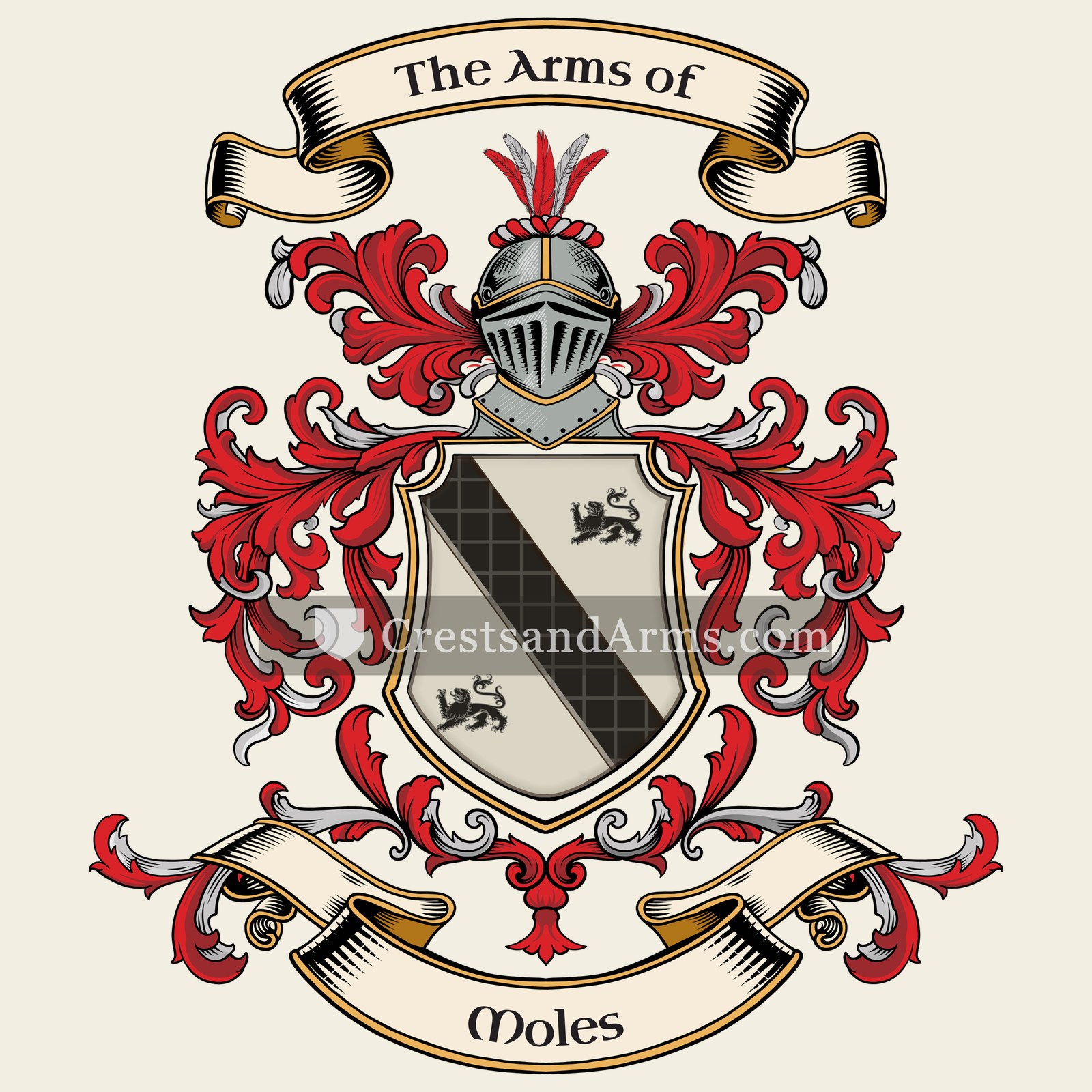
bendDefence, and the scarf of a commander
lionCourage, strength and royalty
Colours
Silver (Argent)Means: Peace and sincerity
Black (Sable)Means: Constancy
Historical info
Source
Sir Bernard Burke, The General Armory of England, Scotland, Ireland and Wales, London: Harrison & Sons, 1884
Blazon (the actual original written record)
“Ar. a bend sa. betw. two lions' heads erased of the last”
Englandc. 1620
Digital archive packCoat of arms PNG, gold border print PDF, vector SVG and the certificate of authenticity. Sent to your email in minutes.
Map of England showing where the Moles arms are recorded
The Moles arms were recorded in England, c. 1620.
Arms such as these were typically recorded in York.
Yorkshire is the largest of the English counties, and it held more gentry families than any other. Land there was split among a great many households rather than a few, so a great many of them carried arms.
This is where the arms were entered in the register. Families often moved to other parts of the country, so the same name can turn up in more than one region.
The body that granted and recorded arms in England in this period.
James VI and I
Sovereign of the period
James VI and I
1603–1625
Reigning in Spain when the Moles arms are first recorded.
How Arms Worked in England
English heraldry allowed arms to be shared by all legitimate descendants of the original owner. These symbols were treated as personal property that moved through the generations to all children. While the eldest son kept the original design, other family members could use the same shield without needing to change it or register their own unique versions.
Granting authority
The College of Arms in London has regulated the use of coats of arms throughout England and Wales since 1484.
How they got arms
Families typically obtained their coats of arms through a formal grant from the Crown or by proving their ancient right to them.
Where arms were recorded
All official coats of arms are recorded in the registers kept at the College of Arms, which date back to the fifteenth century.
The family's standing
Recorded among the armigerous families of England.
Origin & History of the Moles Family in England
The surname Moles has roots that trace back to the social and geographical landscape of medieval England. The name is often classified as a topographic surname, which means it was likely given to people who lived near a specific landmark or a piece of land known as a "mole." In Old English, this term could refer to a sandy bank or a small mound of earth. By the early 17th century, the family had established a presence in the historic city of York. Records from 1620 show members of the family living in this region, which was a major hub for trade and administration in Northern England at the time. During this period, families in York were often deeply integrated into the local parish systems, where their names were recorded in baptismal and marriage registers as they navigated the changing religious and political climate of the Stuart era.
Moles Meaning & Related Branches
Root word
mola
Latin term referring to a millstone or a grinding stone.
This name
MolesOccupational surname for someone who worked at a mill or operated a millstone.
also spelled
Molles
Moels
Moiles
Moyles
Molls
Related arms
Moelsvariant spelling
Moolevariant spelling
Documented Sources
J. B. Rietstap, Armorial Général, Gouda: G. B. van Goor Zonen, 1884–87
Endika de Mogrobejo, Diccionario hispano-heráldico y genealógico de apellidos españoles y de ámbitos hispanos, 1995
Alberto García Carraffa and Arturo García Carraffa, Enciclopedia heráldica y genealógica hispano-americana, 1920
Archivo de la Corona de Aragón, Registro de la Real Audiencia de Aragón
Archivo Histórico Nacional, Sección de Consejos Suprimidos
Digital archive packCoat of arms PNG, gold border print PDF, vector SVG and the certificate of authenticity. Sent to your email in minutes.


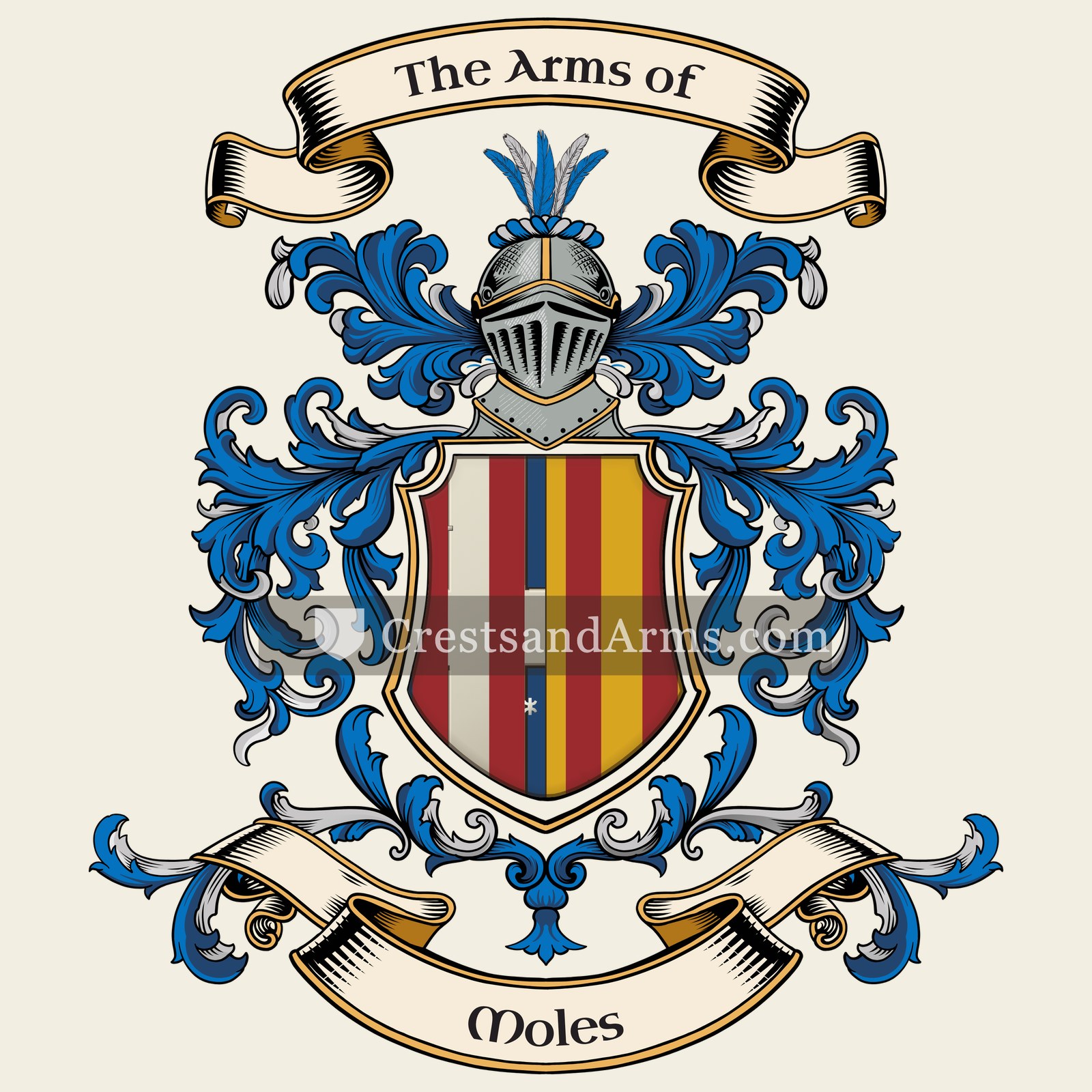
 cross symbolChristian faith and service
 paleMilitary strength, and a fortified defence
 millrind / fer de molineThe mill's iron, and the grinding of grain
 cross symbolChristian faith and service
 paleMilitary strength, and a fortified defence
 millrind / fer de molineThe mill's iron, and the grinding of grain


 saltireResolution, and St Andrew's cross


 bendDefence, and the scarf of a commander
 lionCourage, strength and royalty