A record of documented arms, meaning and origin, researched for the Molitoris family lines. Documented in 3 countries.
Reg. 4449 · French, M–O
Coat of Arms & Family Crest Details
Symbols on this shield
columnFortitude and constancy
swordJustice, and military honour
mulletThe third son, and a divine quality from above
Colours
Red (Gules)Means: Military strength
Gold (Or)Means: Generosity
Silver (Argent)Means: Peace and sincerity
Green (Vert)Means: Hope
Historical info
Source
J. B. Rietstap, Armorial Général, Gouda: G. B. van Goor Zonen, 1884–87
Blazon (the actual original written record)
“De gu. à une colonne d'or, accostée de deux épées d'arg., garnies du sec., surm. chacune de cinq rameaux de laurier de sin., aboutés en forme d'étoile.”
FranceParis, c. 1808
Digital archive packCoat of arms PNG, gold border print PDF, vector SVG and the certificate of authenticity. Sent to your email in minutes.
Map of France showing where the Molitoris arms are recorded
The Molitoris arms were recorded in Paris, c. 1808.
This is where the arms were entered in the register. Families often moved to other parts of the country, so the same name can turn up in more than one region.
The body that granted and recorded arms in France in this period.
Napoleon
Sovereign of the period
Napoleon
1804–1814
Reigning in France when the Molitoris arms are first recorded.
How Arms Worked in France
In France, a coat of arms was a mark of honor that passed down through the male line to all legitimate descendants. Families often used the same shield without changes to show their shared heritage. If a branch wanted to stand out, they could add a small mark to their shield to show their specific place in the family tree.
Granting authority
The Juge d'armes de France acted as the official authority that regulated and verified coats of arms across the country.
How they got arms
Families typically inherited their arms from ancestors, though they could also receive them through royal grants or by proving their noble status.
Where arms were recorded
Coats of arms were officially recorded in the Armorial Général de France, which began its main collection in the year 1696.
The family's standing
Recorded among the armigerous families of France.
Origin & History of the Molitoris Family in France
The surname Molitoris is derived from the Latin word for miller, which suggests that the family’s ancestors originally worked in the grain processing trade. By the early nineteenth century, the family had established a presence in Paris, a city undergoing massive social and political shifts during the Napoleonic era. Records from 1808 confirm that members of the family were living in the capital during a time when Napoleon Bonaparte was reorganizing French society and civil administration. Because the name is rooted in a professional title, it likely emerged as a way to identify individuals by their specific role within their local community. As the family settled into urban life in Paris, they became part of the growing population of skilled workers and professionals who helped define the city’s character during the transition into the modern age.
Coat of Arms & Family Crest Details
Symbols on this shield
lambGentleness, patience and faith
Colours
Red (Gules)Means: Military strength
Silver (Argent)Means: Peace and sincerity
Historical info
Source
J. B. Rietstap, Armorial Général, Gouda: G. B. van Goor Zonen, 1884–87
Blazon (the actual original written record)
“De gu. à un agneau pascal pass. d'arg., portant une banderole. C.: un vol d'arg.”
GermanyFrancfort s, c. 1765
Digital archive packCoat of arms PNG, gold border print PDF, vector SVG and the certificate of authenticity. Sent to your email in minutes.
Map of Germany showing where the Molitoris arms are recorded
The Molitoris arms were recorded in Francfort s, c. 1765.
This is where the arms were entered in the register. Families often moved to other parts of the country, so the same name can turn up in more than one region.
The body that granted and recorded arms in Germany in this period.
Francis I, Holy Roman Emperor
Sovereign of the period
Francis I, Holy Roman Emperor
1745–1765
Reigning in France when the Molitoris arms are first recorded.
How Arms Worked in Germany
In the Holy Roman Empire, coats of arms were often granted to individuals by the Emperor or his representatives. These arms were then passed down through the generations to all legitimate descendants of the original holder. Younger branches of a family usually kept the same shield design without needing to change it, as the arms belonged to the entire lineage.
Granting authority
The Holy Roman Emperor held the sole power to grant new coats of arms throughout his vast imperial territories.
How they got arms
Families typically obtained their coats of arms through a formal imperial grant or by proving their noble status to the authorities.
Where arms were recorded
These grants were officially recorded in the Imperial Chancery registers, which began keeping formal records of such honors during the Middle Ages.
The family's standing
Recorded among the armigerous families of Germany.
Origin & History of the Molitoris Family in Germany
The surname Molitoris is a Latinized form of the word for a miller, reflecting a time when many families adopted names based on their trade or social standing. By the mid-18th century, the name was well-established in the Frankfurt region, a major center for trade and commerce in the Holy Roman Empire. Records confirm that members of the Molitoris family were active in Frankfurt by 1765, living in a city that served as a vital hub for merchants, scholars, and artisans. During this period, families with names like Molitoris often moved between growing urban centers to pursue opportunities in milling, grain production, or local administration. Because the name was rooted in the Latin term for a miller, it suggests that the family’s ancestors likely held a position of economic importance within their local community, managing the essential resources required to feed the expanding population of the German states.
Coat of Arms & Family Crest Details
Symbols on this shield
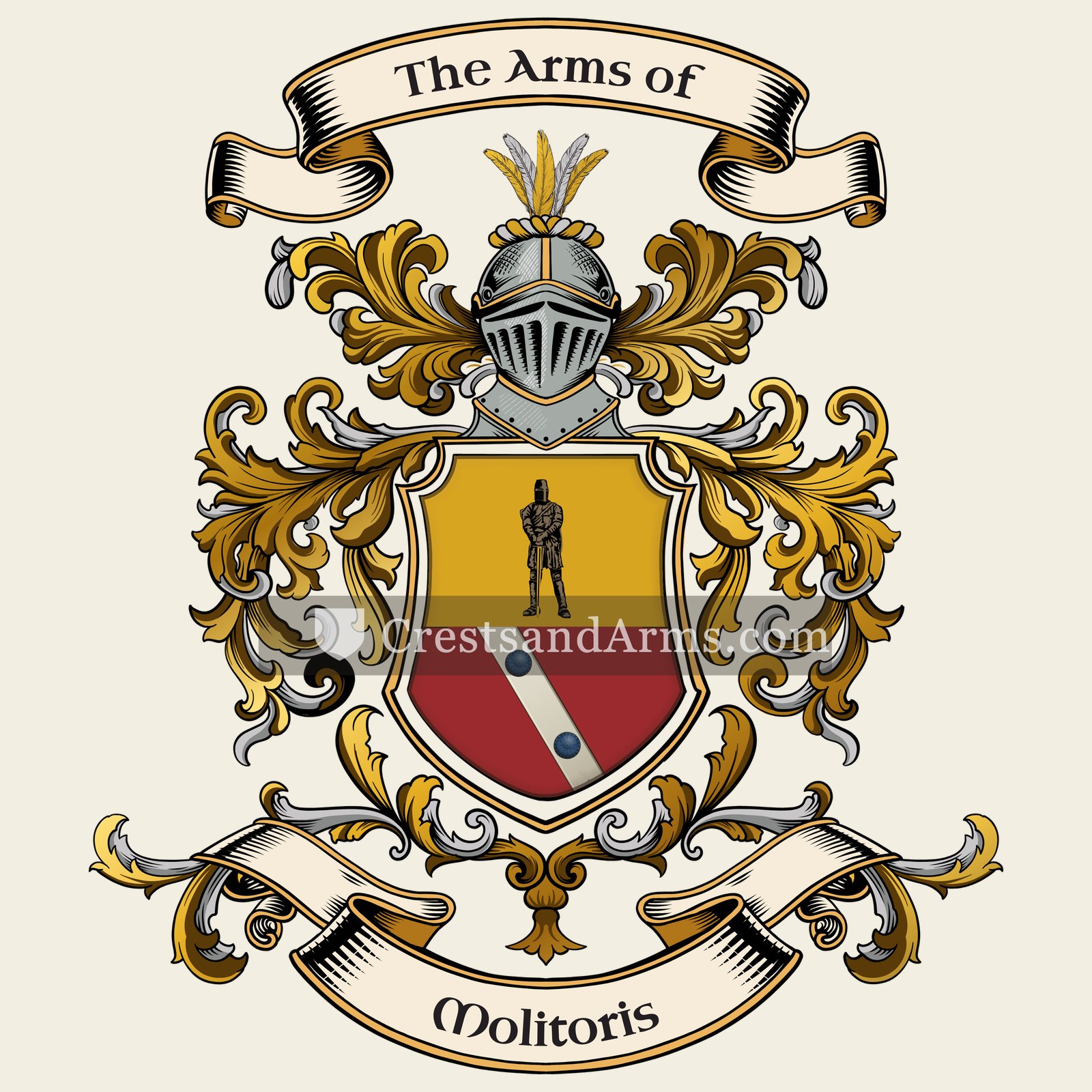
bendDefence, and the scarf of a commander
knightChivalry and service in arms
roundelA coin, and one who has been to the crusades
Colours
Gold (Or)Means: Generosity
Red (Gules)Means: Military strength
Silver (Argent)Means: Peace and sincerity
Blue (Azure)Means: Loyalty and truth
Historical info
Source
J. B. Rietstap, Armorial Général, Gouda: G. B. van Goor Zonen, 1884–87
Blazon (the actual original written record)
“Coupé: au 1 d'or à un chevalier iss., mouv. du coupé, arm. d'arg., au baudrier de gu., le casque panaché de trois pl. d'aut., une d'arg. entre deux de gu., tenant de sa main dextre une lance d'arg., la sen. appuyée sur sa hanche; au 2 de gu. à la bande d'arg., ch. de deux tourt. d'azur. Deux cq. cour. C.: 1° le chevalier iss.; 1. d'or et de sa.; 2° cinq pl. d'aut.: de sa., d'or, d'azur, d'arg. et de gu.; l. d'arg. et de gu.”
Austriac. 1778
Digital archive packCoat of arms PNG, gold border print PDF, vector SVG and the certificate of authenticity. Sent to your email in minutes.
Map of Austria showing where the Molitoris arms are recorded
The Molitoris arms were recorded in Austria, c. 1778.
Arms such as these were typically recorded in Tyrol.
Tyrol was mountain country in western Austria, where the valleys were held by families who had been there a very long time. Old tenure counted for more than money, and old families carried arms.
This is where the arms were entered in the register. Families often moved to other parts of the country, so the same name can turn up in more than one region.
Region
Tyrol
First recorded
1778
Granting Authority for the Molitoris Arms
Imperial and Royal chancery
Sodacan · CC BY-SA 3.0
The body that granted and recorded arms in Austria in this period.
Joseph II, Holy Roman Emperor
Sovereign of the period
Joseph II, Holy Roman Emperor
1765–1790
Reigning in France when the Molitoris arms are first recorded.
How Arms Worked in Austria
Austrian coats of arms were often linked directly to noble titles granted by the Emperor. These symbols belonged to the entire family line rather than just one individual. When a family grew, new branches kept the original design without needing to change it. This system allowed all members of a noble house to share the same identity across many generations.
Granting authority
The Imperial and Royal chancery managed all heraldic matters and controlled the official granting of arms throughout the Austrian lands.
How they got arms
Families typically received their arms through a formal imperial decree that often accompanied the elevation of a person to noble status.
Where arms were recorded
Official records of these grants were kept in the Imperial Register of Nobility which began its formal documentation process in 1453.
The family's standing
Recorded among the armigerous families of Austria.
Origin & History of the Molitoris Family in Austria
The surname Molitoris is a Latinized variation of the word for a miller, which suggests that the family’s ancestors were likely tradespeople who played a vital role in the agrarian economy of the Alpine regions. By 1778, records confirm that members of the family were established in the Tyrol region of Austria. During this era, the mountainous landscape of Tyrol shaped the daily lives of families like the Molitoris, who often lived in small, tight-knit village communities. Because milling was an essential service for processing grain, those who held the name were often respected figures within their local parishes. As the family moved through the valleys of western Austria, they integrated into the regional culture, eventually spreading into neighboring areas while maintaining their connection to the history of the Austrian lands.
Related Branches & Arms
Root word
molitor
A person who operates a mill or grinds grain.
This name
MolitorisDerived from the Latin term for a miller, indicating an ancestral occupation.
also spelled
Mollitor
Moliter
Documented Sources
J. B. Rietstap, Armorial Général, Gouda: G. B. van Goor Zonen, 1884–87
Archives nationales, Fichier des actes de l'état civil reconstitué
Dauzat, Albert, Dictionnaire étymologique des noms et prénoms de France, 1951
Digital archive packCoat of arms PNG, gold border print PDF, vector SVG and the certificate of authenticity. Sent to your email in minutes.


 columnFortitude and constancy
 swordJustice, and military honour
 mulletThe third son, and a divine quality from above
 columnFortitude and constancy
 swordJustice, and military honour
 mulletThe third son, and a divine quality from above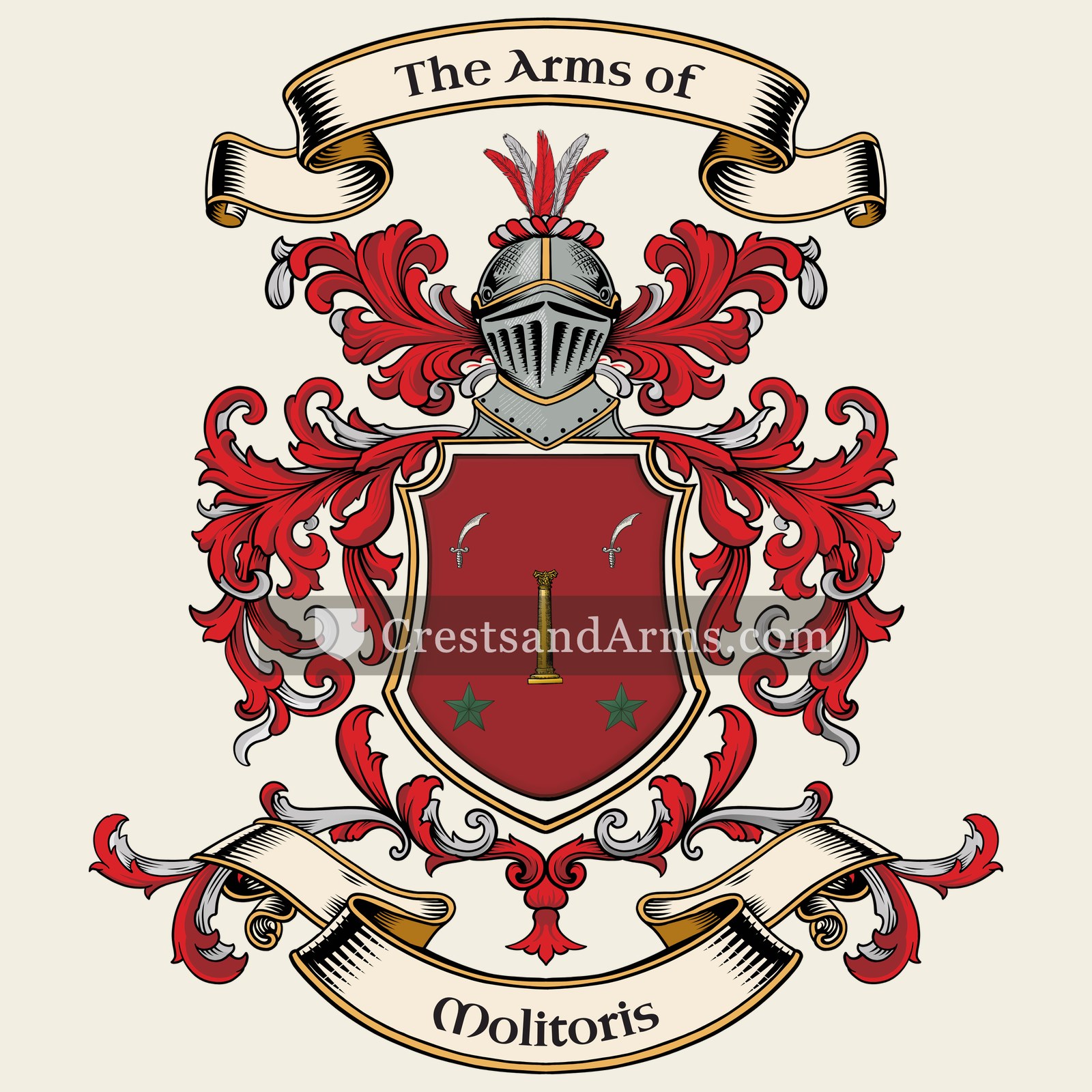


 lambGentleness, patience and faith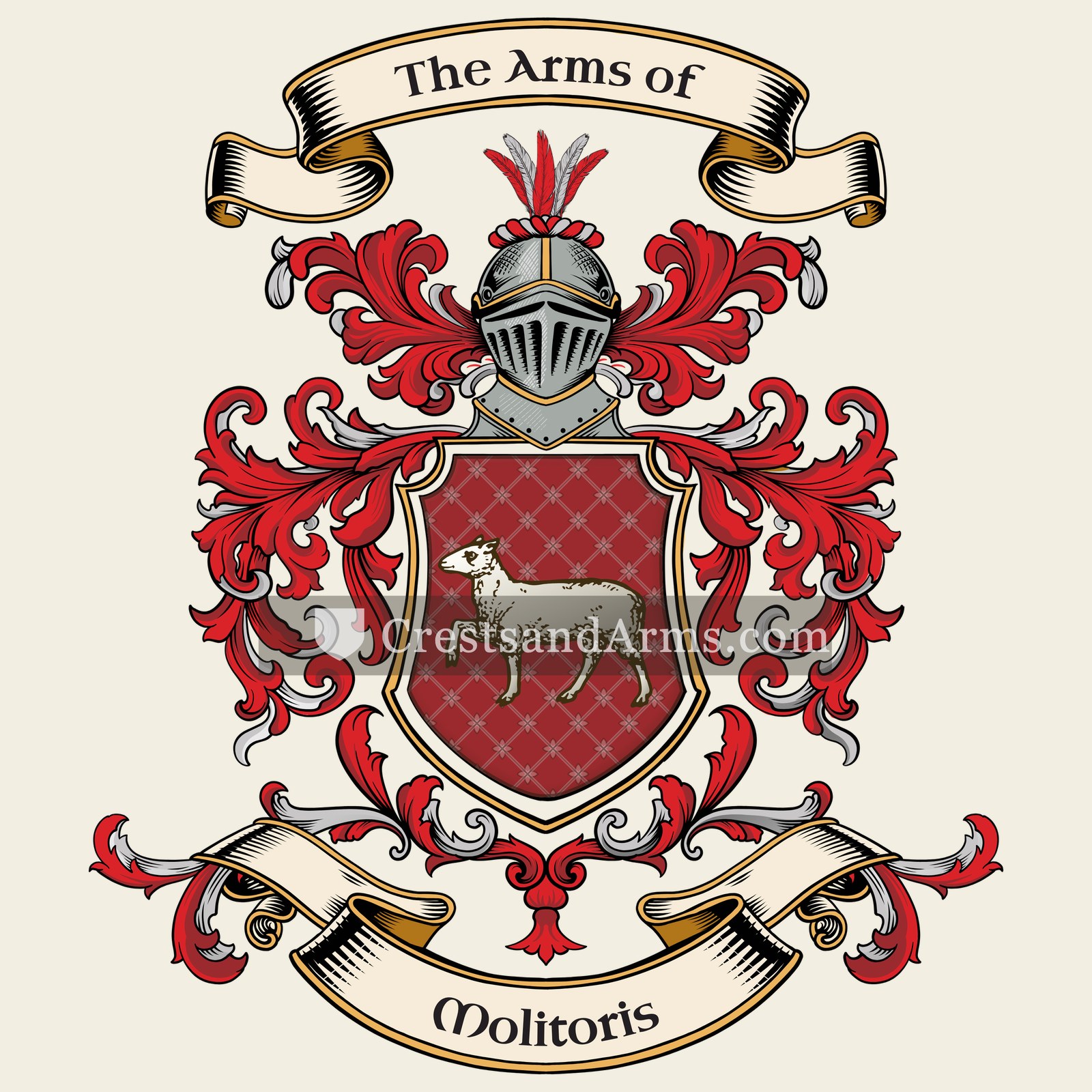


 bendDefence, and the scarf of a commander
 knightChivalry and service in arms
 roundelA coin, and one who has been to the crusades