Map of Britain showing where the Monaghan arms are recorded
The Monaghan arms were recorded in Britain, c. 1708.
Arms such as these were typically recorded in Kent.
Kent sits between London and the short crossing to Europe, and the trade passing through made it wealthy. Merchant families bought land with that money, and it was landowners who took coats of arms.
This is where the arms were entered in the register. Families often moved to other parts of the country, so the same name can turn up in more than one region.
The body that granted and recorded arms in Britain in this period.
Anne of Great Britain
Sovereign of the period
Anne of Great Britain
1707–1714
Reigning in Britain when the Monaghan arms are first recorded.
How Arms Worked in Britain
English heraldry allowed arms to be shared by all legitimate descendants of the original owner. These symbols were treated as personal property that moved through the generations to all children. While the eldest son kept the original design, other family members could use the same shield without needing to change it or register their own unique versions.
Granting authority
The College of Arms in London has regulated the use of coats of arms throughout England and Wales since 1484.
How they got arms
Families typically obtained their coats of arms through a formal grant from the Crown or by proving their ancient right to them.
Where arms were recorded
All official coats of arms are recorded in the registers kept at the College of Arms, which date back to the fifteenth century.
The family's standing
Recorded among the armigerous families of Britain.
Origin & History of the Monaghan Family in Britain
The surname Monaghan originates from the Irish Gaelic name Ó Manacháin, which translates to descendant of the monk. This name likely began as a descriptive nickname for a person who lived near a monastery or served as a lay brother within a religious order. While the name is deeply rooted in the history of County Monaghan in Ireland, family members eventually migrated across the Irish Sea to England. By 1708, records confirm that members of the family had established a presence in Kent. This movement was common during the eighteenth century as individuals sought new opportunities in trade and agriculture within the growing British economy. Over time, the family name evolved from its original Gaelic spelling to the modern version used today as it integrated into English communities.
Monaghan Meaning & Related Branches
Root word
O Manachain
Derived from the Gaelic word for a monk or religious devotee.
This name
MonaghanDescendant of the little monk, referring to a follower of a religious order.
also spelled
Cairnes
Monaghan
Kairnz de Monahan
Documented Sources
J. B. Rietstap, Armorial Général, Gouda: G. B. van Goor Zonen, 1884–87
MacLysaght, Edward. The Surnames of Ireland. 1985
Woulfe, Patrick. Sloinnte Gaedheal is Gall: Irish Names and Surnames. 1923
The National Archives (UK). Parish registers of Kent, series RG 4
Digital archive packCoat of arms PNG, gold border print PDF, vector SVG and the certificate of authenticity. Sent to your email in minutes.


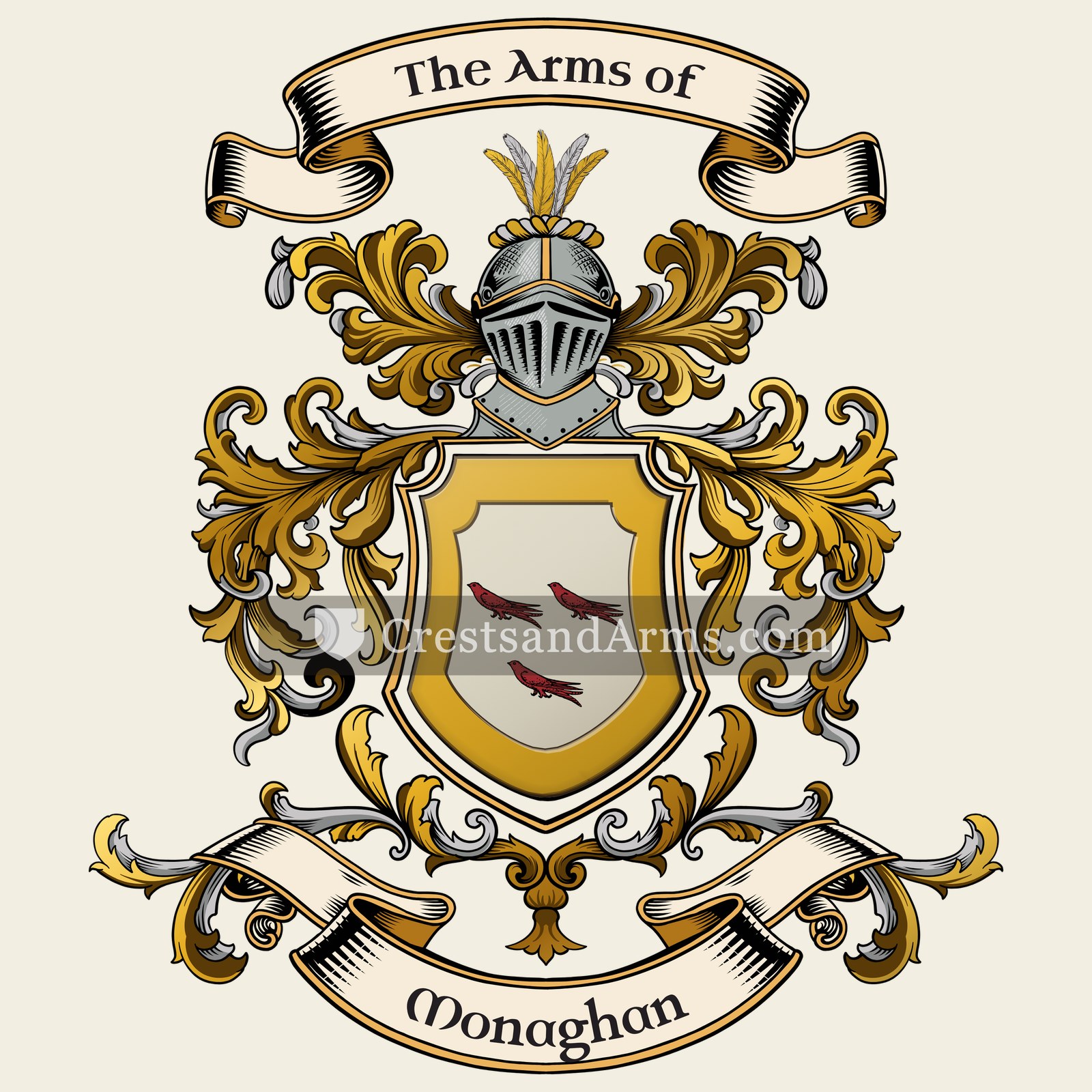
 martletA younger son, who must win his own land
 martletA younger son, who must win his own land