Map of Belgium showing where the Mondragon arms are recorded
The Mondragon arms were recorded in Brabant, c. 1737.
Brabant lay at the heart of the Low Countries, where the trade routes met. Its towns were wealthy and its landowners many, and both kinds of family kept arms, which is why the region is so heavily represented.
This is where the arms were entered in the register. Families often moved to other parts of the country, so the same name can turn up in more than one region.
The body that granted and recorded arms in Belgium in this period.
Charles VI, Holy Roman Emperor
Sovereign of the period
Charles VI, Holy Roman Emperor
1711–1740
Reigning in Belgium when the Mondragon arms are first recorded.
How Arms Worked in Belgium
In Belgium, a coat of arms is considered personal property that is passed down through the male line to legitimate descendants. Families often use the same shield design across generations to show their shared heritage. If a branch of the family wants to change the design, they must apply for an official update to their specific version of the arms.
Granting authority
The Conseil héraldique is the official body that regulates and approves all coats of arms in Belgium.
How they got arms
Families obtain their coats of arms through formal royal grants or by confirming their historical right to use existing designs.
Where arms were recorded
All approved coats of arms are officially recorded in the public registers of the Conseil héraldique since 1844.
The family's standing
Recorded among the armigerous families of Brabant.
Origin & History of the Mondragon Family in Belgium
The history of the Mondragon name in Belgium is deeply connected to the region of Brabant, where records confirm the family was established by at least 1737. While the name originates from the Basque region of Spain, its presence in the Low Countries likely stems from the movement of military personnel and administrators during the period of Spanish rule. By the eighteenth century, members of the family had integrated into the local social fabric of Brabant, transitioning from their initial roles as outsiders to becoming part of the regional community. This period marked a shift where the family name became associated with the local population rather than its foreign military roots. As they settled into the towns and villages of the area, they participated in the typical life of the region, leaving behind traces in parish registers and civil documents that track their growth and influence over several generations.
Coat of Arms & Family Crest Details
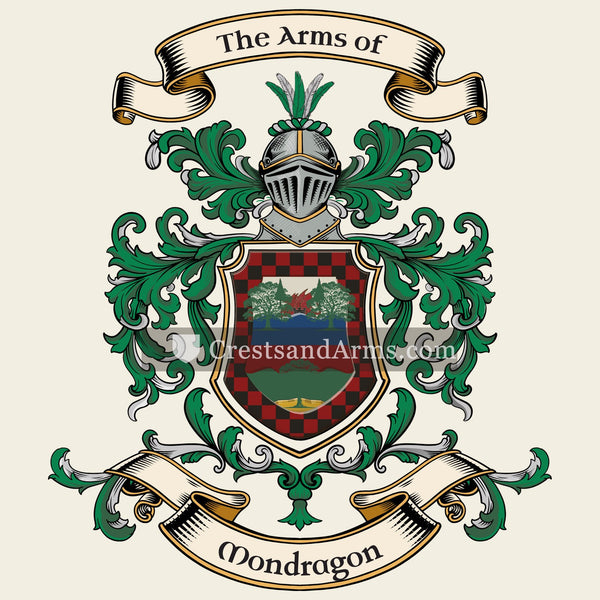
Symbols on this shield
fessThe military belt, and readiness to serve
treeLife, endurance and deep roots
dragonA most valiant defender of treasure
towerGrandeur and solidity, and a stronghold defended
pine treeSteadfastness through every season
Colours
Silver (Argent)Means: Peace and sincerity
Green (Vert)Means: Hope
Blue (Azure)Means: Loyalty and truth
Black (Sable)Means: Constancy
Gold (Or)Means: Generosity
Red (Gules)Means: Military strength
Historical info
Source
J. B. Rietstap, Armorial Général, Gouda: G. B. van Goor Zonen, 1884–87
Blazon (the actual original written record)
“Coupé: au 1 parti: a. d'arg. à une tour de gu., sommée de trois tourelles du même, portant chacune une bannière d'arg. flottant à sen.; la tour accostée de deux pins de sin. et soutenue de deux fasces ondées d'azur, et acc. d'un dragon ailé de gu., devant la porte, br. sur les fasces; à une chaine de sa. en orle carré, br. sur le tout; b. de sin. à neuf canons sur leurs affûts d'or, 3, 3 et 3; au 2 d'arg. à trois arbres rangés de sin., l'espace entre les arbres rempli d'herbes du même, le tout soutenu d'un fascé ondé d'azur et d'arg. de quatre pièces.”
SpainBiscaye, c. 1722
Digital archive packCoat of arms PNG, gold border print PDF, vector SVG and the certificate of authenticity. Sent to your email in minutes.
Map of Spain showing where the Mondragon arms are recorded
The Mondragon arms were recorded in Biscaye, c. 1722.
This is where the arms were entered in the register. Families often moved to other parts of the country, so the same name can turn up in more than one region.
The body that granted and recorded arms in Spain in this period.
Philip V of Spain
Sovereign of the period
Philip V of Spain
1714–1724
Reigning in Belgium when the Mondragon arms are first recorded.
How Arms Worked in Spain
In Spain, a coat of arms was considered a form of property that belonged to the entire family line. These arms were passed down from a father to all his children equally. Younger branches of the family usually kept the original design without needing to add any special marks to distinguish their specific line.
Granting authority
The Cronista Rey de Armas was the official body that regulated and granted coats of arms throughout Spain.
How they got arms
Families often obtained their arms through royal grants or by proving their noble status to the official heraldic authority.
Where arms were recorded
Coats of arms were officially recorded in the registers of the Cronista Rey de Armas starting in 1496.
The family's standing
Recorded among the armigerous families of Spain.
Origin & History of the Mondragon Family in Spain
The name Mondragon originates from the Basque Country in northern Spain, specifically linked to the town of Arrasate, which is also known as Mondragón. The name itself is derived from the Latin words for mountain and dragon, reflecting the rugged and legendary landscape of the region. By the early 18th century, families carrying this name were well-established in the province of Biscay. During this period, the Basque people maintained a strong sense of local identity and autonomy, often documenting their family lineages through parish records to prove their status as free citizens. These early Mondragon families were typically involved in the local agricultural and iron-working traditions that defined the economy of the Basque mountains. As they moved through the 1700s, members of the family played roles in the social and administrative life of their local communities, helping to preserve the unique cultural heritage of the Biscayan region.
Mondragon Meaning & Related Branches
Root word
Mons Draconis
Latin for mountain of the dragon.
This name
MondragonRefers to a person originating from a place associated with a dragon-shaped mountain or hill.
also spelled
Mondragonn
Mondragone
Mondragonne
Related arms
Montdragonvariant spelling
Documented Sources
J. B. Rietstap, Armorial Général, Gouda: G. B. van Goor Zonen, 1884–87
Archives: Algemeen Rijksarchief (General State Archives), Parochieregisters van Brabant (Parish Registers of Brabant)
Books: De Smet, Antoine, Les relations entre les Pays-Bas et l'Espagne, 1955
Books: Verhulst, Adriaan, Précis d'histoire rurale de la Belgique, 1990
Digital archive packCoat of arms PNG, gold border print PDF, vector SVG and the certificate of authenticity. Sent to your email in minutes.


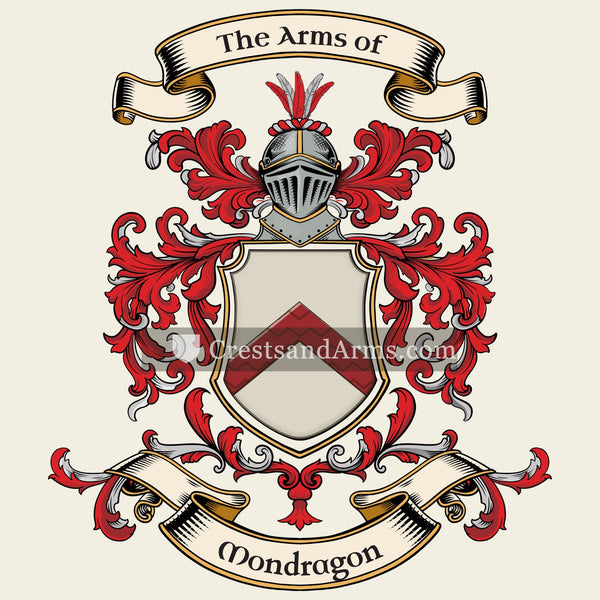
 chevronProtection, and faithful service completed
 chevronProtection, and faithful service completed


 fessThe military belt, and readiness to serve
 treeLife, endurance and deep roots
 dragonA most valiant defender of treasure
 towerGrandeur and solidity, and a stronghold defended
 pine treeSteadfastness through every season