Map of Denmark showing where the Mone arms are recorded
The Mone arms were recorded in Denmark, c. 1722.
Arms such as these were typically recorded in Sjaælland.
Zealand held the Danish court, the crown's offices and Copenhagen itself. Families who served the king kept estates within reach of it, and royal service was the ordinary route to a coat of arms.
This is where the arms were entered in the register. Families often moved to other parts of the country, so the same name can turn up in more than one region.
The body that granted and recorded arms in Denmark in this period.
Frederik IV of Denmark
Sovereign of the period
Frederik IV of Denmark
1699–1730
Reigning in Denmark when the Mone arms are first recorded.
How Arms Worked in Denmark
Danish heraldry during this period was closely tied to noble status and royal favor rather than being open to all citizens. Arms were typically granted by the monarch to individuals, and these symbols were then shared by all members of the noble house. If a family line died out, the right to use those specific arms ended with them.
Granting authority
The Danish royal chancery held the power to issue and regulate official coats of arms for the kingdom.
How they got arms
Families usually received their arms through a formal royal grant that confirmed their noble status and rights.
Where arms were recorded
These grants were officially recorded in the Danish Royal Chancery records starting in the sixteenth century.
The family's standing
Recorded among the armigerous families of Denmark.
Origin & History of the Mone Family in Denmark
The history of the Mone family in Denmark centers on the island of Sjælland, where records confirm their presence as early as 1722. During the eighteenth century, the name was closely tied to the rural social structures of the Danish countryside, where families often lived and worked within the same parish for generations. At this time, Denmark was transitioning through significant agricultural reforms, and the Mone family likely participated in the traditional farming life that defined the region. Because the name is relatively rare, it suggests that the family likely originated from a specific local community or a small cluster of villages in Sjælland. Over the decades, the family members integrated into the local economy, contributing to the development of the island’s agricultural landscape while maintaining their presence in the historical records of the Danish church and local administrative offices.
Meaning of the Mone family crest colors & symbols
Symbols on this shield
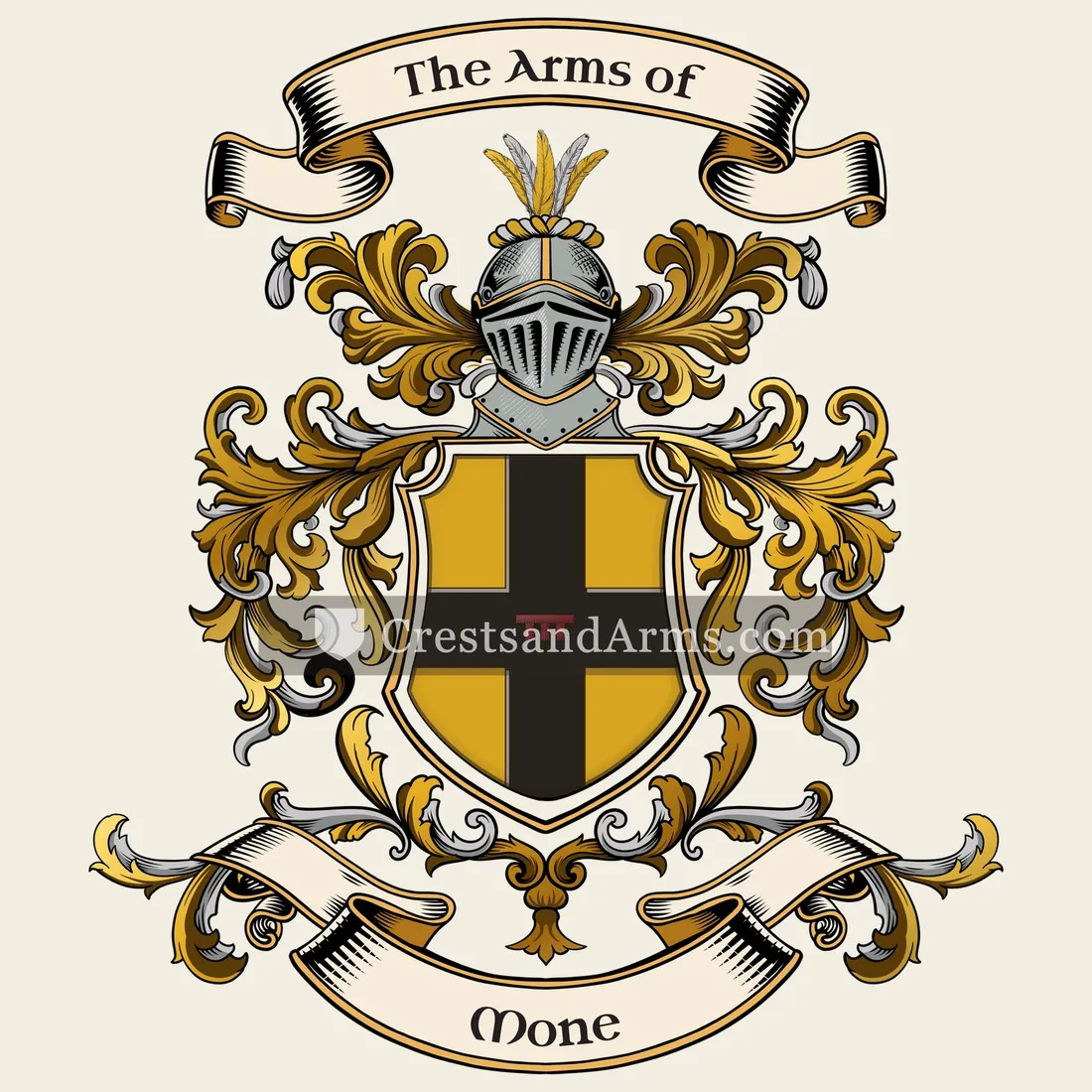
cross symbolChristian faith and service
labelThe eldest son, during his father's life
Colours
Gold (Or)Means: Generosity
Black (Sable)Means: Constancy
Red (Gules)Means: Military strength
Historical info
Source
Sir Bernard Burke, The General Armory of England, Scotland, Ireland and Wales, London: Harrison & Sons, 1884
Blazon (the actual original written record)
“Or, a cross engr. sa. a label of three points gu. each charged with as many bezants”
CornwallCornwall, c. 1620
Digital archive packCoat of arms PNG, gold border print PDF, vector SVG and the certificate of authenticity. Sent to your email in minutes.
Map of England showing where the Mone arms are recorded
The Mone arms were recorded in Cornwall, c. 1620.
Cornwall was a county apart, with its own language and its own tight-knit gentry. Tin and the sea made money there, and families who made it bought land, which is what brought arms with it.
This is where the arms were entered in the register. Families often moved to other parts of the country, so the same name can turn up in more than one region.
The body that granted and recorded arms in England in this period.
James VI and I
Sovereign of the period
James VI and I
1603–1625
Reigning in Denmark when the Mone arms are first recorded.
How Arms Worked in England
English heraldry allowed arms to be shared by all legitimate descendants of the original owner. These symbols were treated as personal property that moved through the generations to all children. While the eldest son kept the original design, other family members could use the same shield without needing to change it or register their own unique versions.
Granting authority
The College of Arms in London has regulated the use of coats of arms throughout England and Wales since 1484.
How they got arms
Families typically obtained their coats of arms through a formal grant from the Crown or by proving their ancient right to them.
Where arms were recorded
All official coats of arms are recorded in the registers kept at the College of Arms, which date back to the fifteenth century.
The family's standing
Recorded among the armigerous families of Cornwall.
Origin & History of the Mone Family in England
The surname Mone has deep roots in the rugged landscape of Cornwall, where records confirm the family was well established by the early 17th century. During this period, Cornwall was a hub of mining and maritime trade, and families like the Mones often lived in small, tight-knit coastal communities. The name itself likely evolved from older regional dialects or descriptive nicknames used to identify people in local parish registers. Because Cornwall was somewhat isolated from the rest of England by geography and its own unique language, families in the area often maintained distinct traditions and naming patterns that persisted for generations. By 1620, the presence of the Mone family in these records suggests they were settled members of the community who contributed to the local economy and social life of the Cornish peninsula.
Mone Meaning & Related Branches
Root word
Mon
Derived from the Old Norse word for a neck or ridge.
This name
MoneA topographical surname referring to someone who lived near a prominent ridge or neck of land.
also spelled
Monne
Mony
Mo-nay
Monney
Moyne
Related arms
Moignevariant spelling
Moonvariant spelling
Moynevariant spelling
Documented Sources
J. B. Rietstap, Armorial Général, Gouda: G. B. van Goor Zonen, 1884–87
Rigsarkivet (Danish National Archives), Kirkebøger (Parish Registers), Sjælland Stift


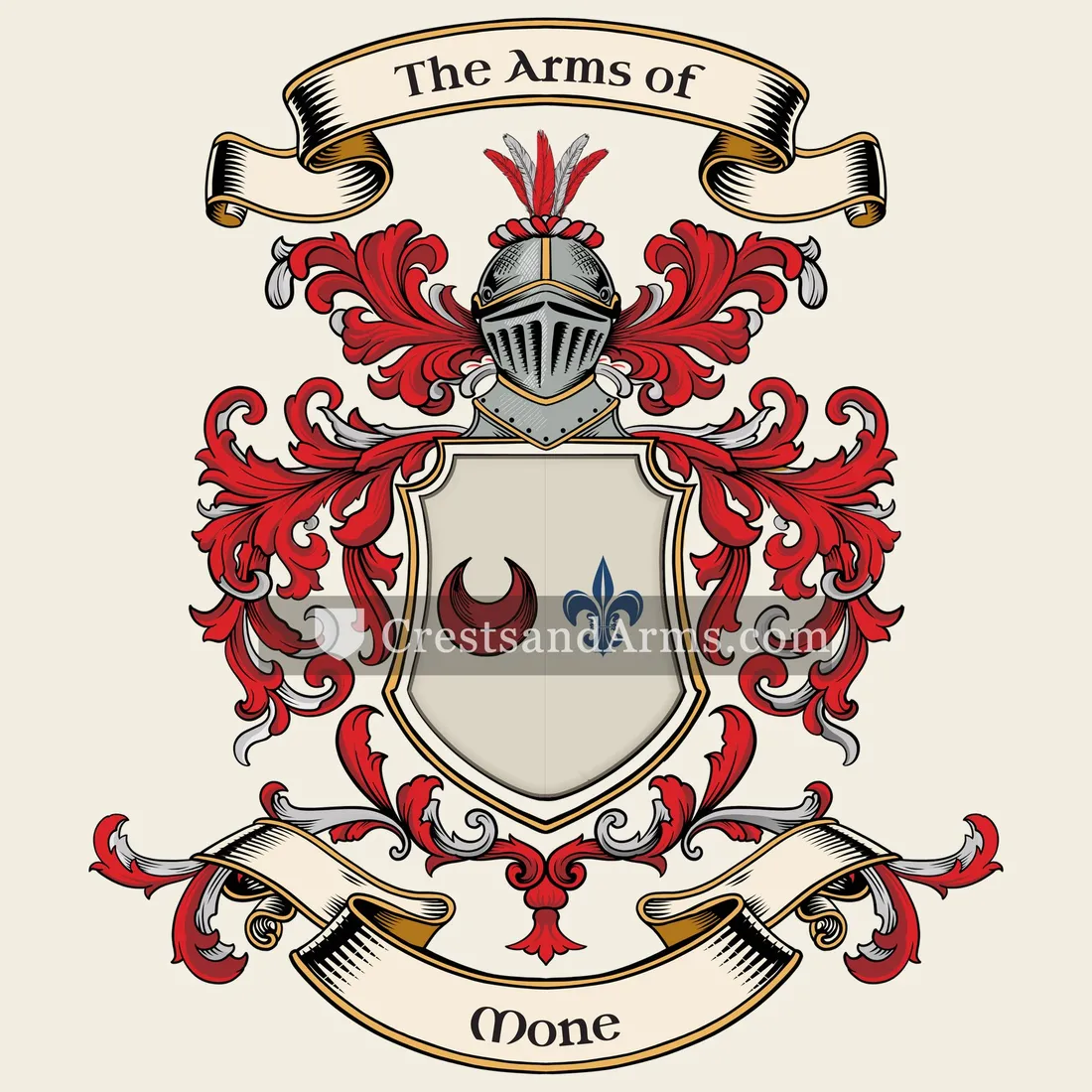
 crescentHonour by the sovereign, and the second son
 fleur de lisPurity, light, and the sixth son
 crescentHonour by the sovereign, and the second son
 fleur de lisPurity, light, and the sixth son


 cross symbolChristian faith and service
 labelThe eldest son, during his father's life