A record of documented arms, meaning and origin, researched for the Monnier family lines. Documented in 2 countries.
Reg. 6193 · French, M–O
Meaning of the Monnier family crest colors & symbols
Symbols on this shield
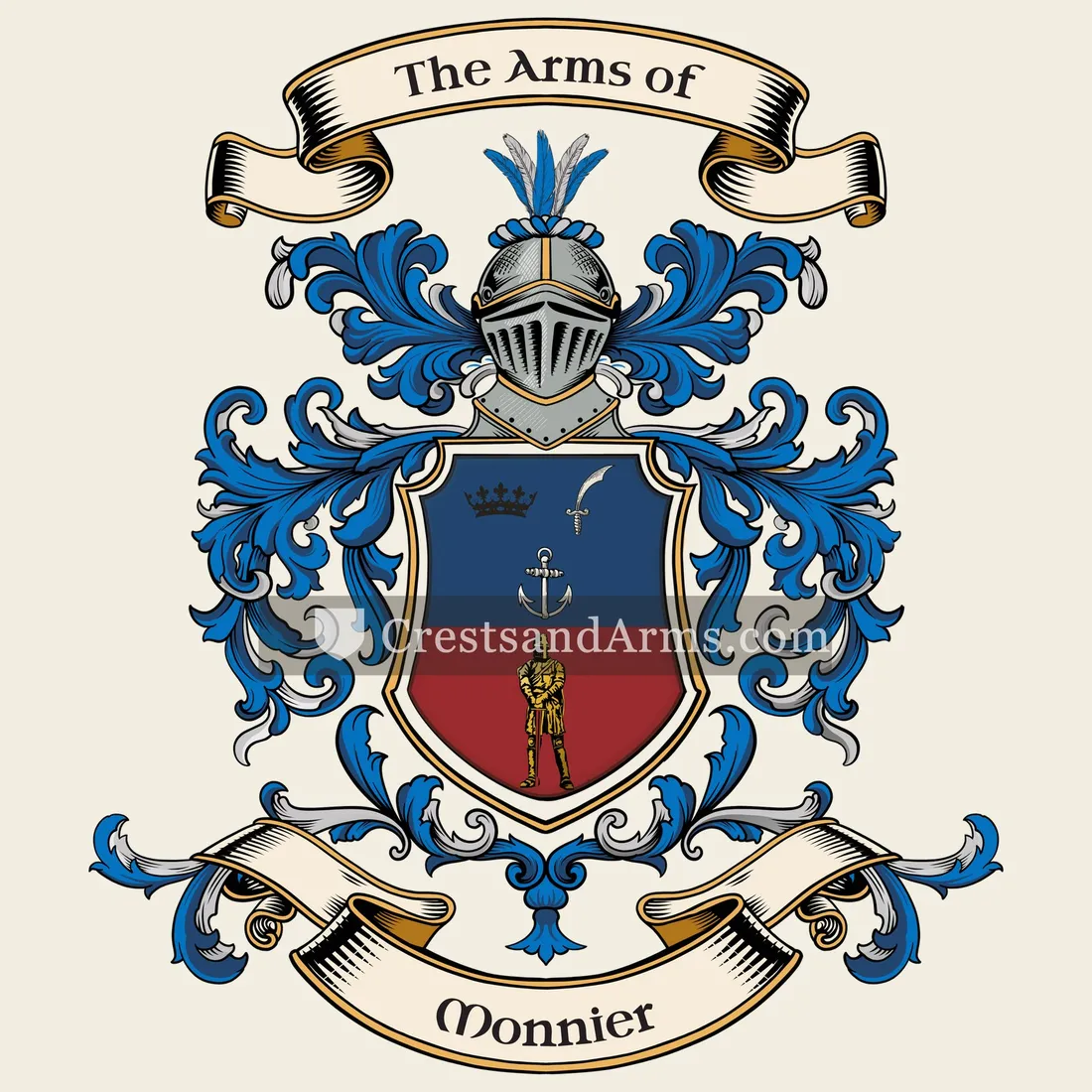
crownSovereignty, authority and just reward
swordJustice, and military honour
anchorHope, and steadfastness in trouble
knightChivalry and service in arms
Colours
Blue (Azure)Means: Loyalty and truth
Red (Gules)Means: Military strength
Black (Sable)Means: Constancy
Silver (Argent)Means: Peace and sincerity
Gold (Or)Means: Generosity
Historical info
Source
J. B. Rietstap, Armorial Général, Gouda: G. B. van Goor Zonen, 1884–87
Blazon (the actual original written record)
“Coupé: au 1 d'azur à une couronne murale de sa., adextrée d'une épée d'arg. et senestrée d'une ancre du même; au 2 de gu. à un chevalier, arm. de toutes pièces d'or, l'épée en arrêt.”
Francec. 1663
Digital archive packCoat of arms PNG, gold border print PDF, vector SVG and the certificate of authenticity. Sent to your email in minutes.
Map of France showing where the Monnier arms are recorded
The Monnier arms were recorded in France, c. 1663.
Arms such as these were typically recorded in Bretagne.
More families held coats of arms in Bretagne than anywhere else in France. The land was divided into many small estates rather than a few large ones, so far more households counted as gentry, and each needed a shield of its own to be told apart.
This is where the arms were entered in the register. Families often moved to other parts of the country, so the same name can turn up in more than one region.
The body that granted and recorded arms in France in this period.
Louis XIV of France
Sovereign of the period
Louis XIV of France
1643–1715
Reigning in France when the Monnier arms are first recorded.
How Arms Worked in France
In France, a coat of arms was a mark of honor that passed down through the male line to all legitimate descendants. Families often used the same shield without changes to show their shared heritage. If a branch wanted to stand out, they could add a small mark to their shield to show their specific place in the family tree.
Granting authority
The Juge d'armes de France acted as the official authority that regulated and verified coats of arms across the country.
How they got arms
Families typically inherited their arms from ancestors, though they could also receive them through royal grants or by proving their noble status.
Where arms were recorded
Coats of arms were officially recorded in the Armorial Général de France, which began its main collection in the year 1696.
The family's standing
Recorded among the armigerous families of France.
Origin & History of the Monnier Family in France
The name Monnier originates from the medieval French word *monnier*, which was a professional title for a person who worked at a mint or operated a grain mill. During the Middle Ages, surnames often developed from the specific trade a person practiced, and this name became common across many regions of France as people moved between towns. By the middle of the seventeenth century, the family had established a firm presence in the province of Bretagne. Records from 1663 confirm that members of the Monnier family were living in this coastal region, where they likely integrated into the local agricultural or maritime economy. Over time, the name evolved alongside the French language, shifting from a simple job description into a permanent family identifier passed down through generations. This transition reflects the broader history of how French families began to anchor themselves to specific provinces and communities during the early modern period.
Meaning of the Monnier family crest colors & symbols
Symbols on this shield
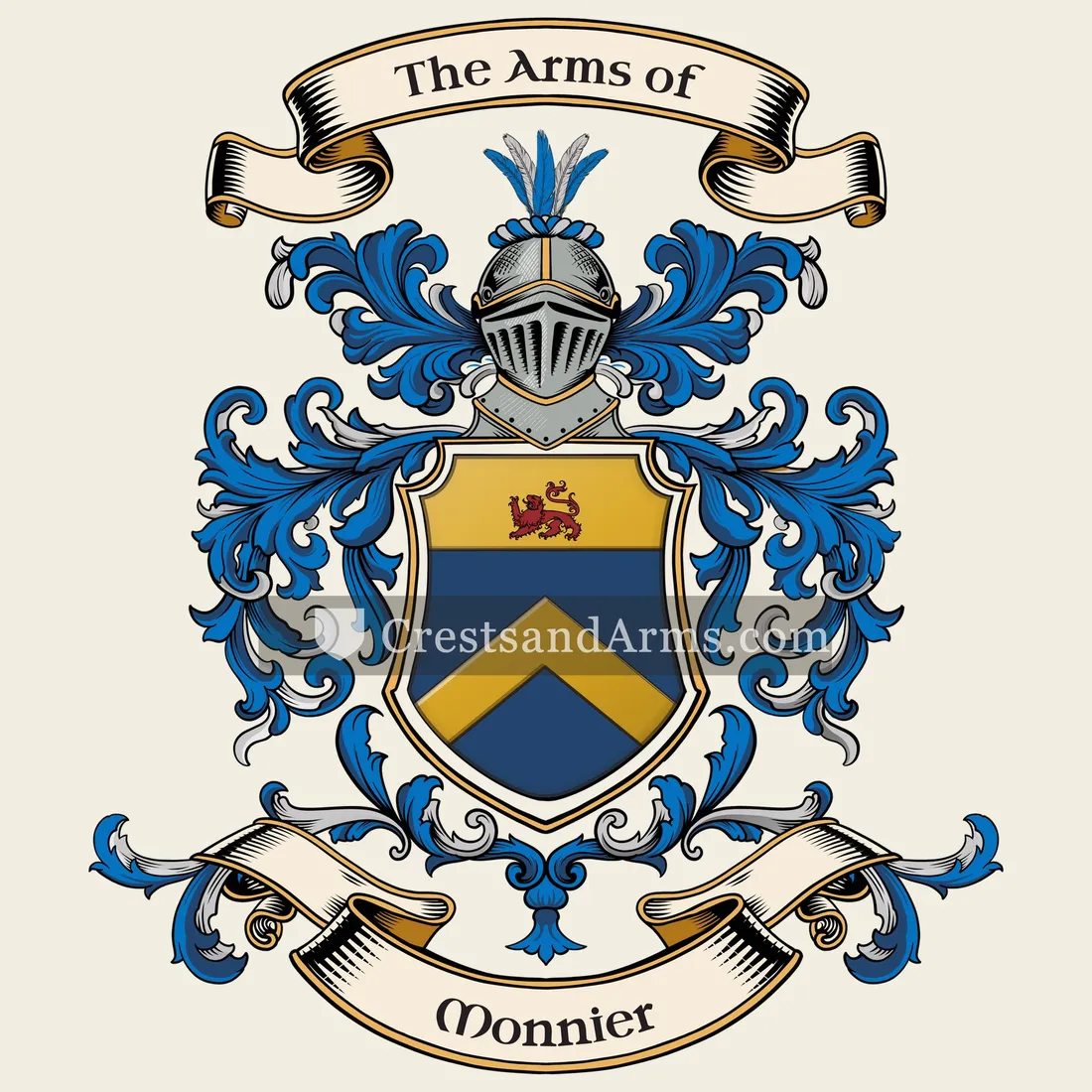
chevronProtection, and faithful service completed
chiefAuthority, wisdom and dominion
lionCourage, strength and royalty
Colours
Blue (Azure)Means: Loyalty and truth
Gold (Or)Means: Generosity
Red (Gules)Means: Military strength
Historical info
Source
J. B. Rietstap, Armorial Général, Gouda: G. B. van Goor Zonen, 1884–87
Blazon (the actual original written record)
“D'azur au chev. d'or; au chef du même, ch. d'un lion iss. de gu.”
SwitzerlandBerne, c. 1745
Digital archive packCoat of arms PNG, gold border print PDF, vector SVG and the certificate of authenticity. Sent to your email in minutes.
Map of Switzerland showing where the Monnier arms are recorded
The Monnier arms were recorded in Berne, c. 1745.
This is where the arms were entered in the register. Families often moved to other parts of the country, so the same name can turn up in more than one region.
The body that granted and recorded arms in Switzerland in this period.
How Arms Worked in Switzerland
In Switzerland, coats of arms were not restricted to the nobility and were often adopted by common citizens and families. These symbols were passed down through generations to show family identity. When branches of a family grew, they often changed small details of the design to distinguish their own line from the original group.
Granting authority
Cantonal and civic authorities managed the use of coats of arms within their specific regions and local jurisdictions.
How they got arms
Families typically assumed their own coats of arms based on local custom rather than receiving them from a central monarch.
Where arms were recorded
Arms were recorded in various cantonal and civic registers starting from the fourteenth century throughout the Swiss region.
The family's standing
Recorded among the armigerous families of Switzerland.
Origin & History of the Monnier Family in Switzerland
The surname Monnier is deeply rooted in the history of French-speaking regions, and its presence in Switzerland reflects the movement of families across borders during the eighteenth century. The name itself is derived from the Old French word *monier*, which historically referred to a person who worked as a miller or a mint master. By the time members of the family were documented in Berne in 1745, the name had already established itself as a common occupational identifier in Western Europe. Settling in a city like Berne during this period often meant that families were part of the growing urban middle class, contributing to the local economy through trade or specialized craftsmanship. These early Swiss Monniers were likely part of a broader migration pattern where skilled workers moved into Swiss cantons to seek new opportunities in the heart of the Alps. Their presence in the official city records of 1745 serves as a clear marker of their integration into the social and administrative fabric of the region.
Monnier Meaning & Related Branches
Root word
Monier
Derived from the Latin moneta meaning mint or money.
This name
MonnierAn occupational surname for a person who worked as a mint master or money changer.
also spelled
Monier
Monnyer
Monyay
Related arms
Moniervariant spelling
Documented Sources
J. B. Rietstap, Armorial Général, Gouda: G. B. van Goor Zonen, 1884–87
Dauzat, Albert. Dictionnaire étymologique des noms et prénoms de France. 1951
Morlet, Marie-Thérèse. Dictionnaire étymologique des noms de famille. 1991
Digital archive packCoat of arms PNG, gold border print PDF, vector SVG and the certificate of authenticity. Sent to your email in minutes.


 crownSovereignty, authority and just reward
 swordJustice, and military honour
 anchorHope, and steadfastness in trouble
 knightChivalry and service in arms
 crownSovereignty, authority and just reward
 swordJustice, and military honour
 anchorHope, and steadfastness in trouble
 knightChivalry and service in arms


 chevronProtection, and faithful service completed
 chiefAuthority, wisdom and dominion
 lionCourage, strength and royalty