Map of France showing where the Monnin arms are recorded
The Monnin arms were recorded in Dauphine, c. 1663.
Dauphine lay in the mountains of south-eastern France, a country of small estates and scattered valleys. Its gentry were many and mostly modest, and even a small landholding was enough to justify arms.
This is where the arms were entered in the register. Families often moved to other parts of the country, so the same name can turn up in more than one region.
The body that granted and recorded arms in France in this period.
Louis XIV of France
Sovereign of the period
Louis XIV of France
1643–1715
Reigning in France when the Monnin arms are first recorded.
How Arms Worked in France
In France, a coat of arms was a mark of honor that passed down through the male line to all legitimate descendants. Families often used the same shield without changes to show their shared heritage. If a branch wanted to stand out, they could add a small mark to their shield to show their specific place in the family tree.
Granting authority
The Juge d'armes de France acted as the official authority that regulated and verified coats of arms across the country.
How they got arms
Families typically inherited their arms from ancestors, though they could also receive them through royal grants or by proving their noble status.
Where arms were recorded
Coats of arms were officially recorded in the Armorial Général de France, which began its main collection in the year 1696.
The family's standing
Recorded among the armigerous families of Dauphine.
Origin & History of the Monnin Family in France
The surname Monnin traces its roots to the mountainous regions of eastern France, with a significant presence established in the province of Dauphiné by the mid-seventeenth century. During the 1600s, this area was a rugged landscape defined by its proximity to the Alps and a complex social structure that relied heavily on local agriculture and trade. Families like the Monnins often lived in tight-knit rural communities where they were deeply connected to the land and the local parish. As the name spread through the region, it became synonymous with the hardworking populations of the foothills who navigated the challenges of life under the French monarchy. By 1663, the family was already well-integrated into the social fabric of the territory, participating in the daily life and administrative record-keeping that defined the era. This early history reflects a lineage rooted in the resilience and stability of provincial French life.
Meaning of the Monnin family crest colors & symbols
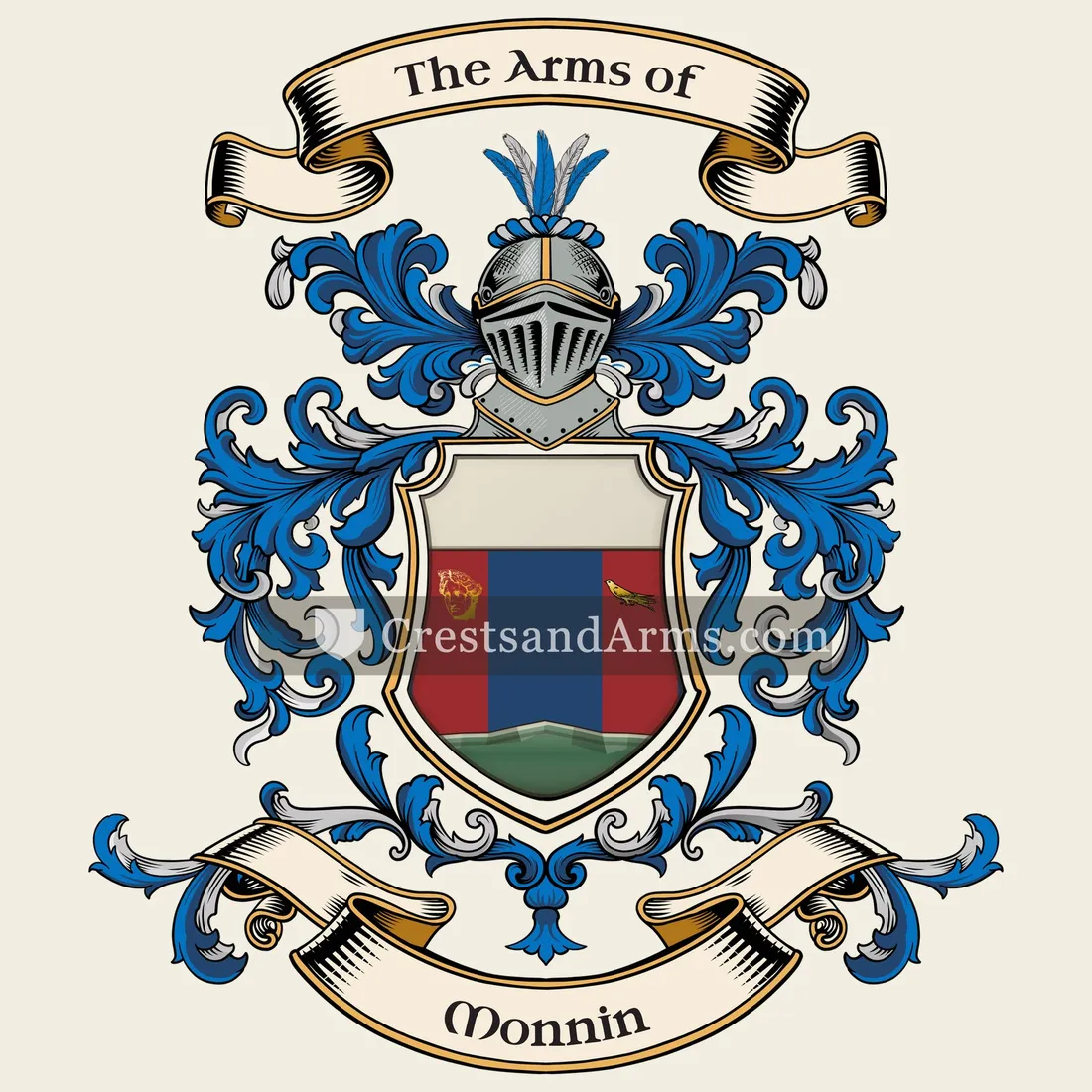
Symbols on this shield
mountThe ground held, and steadfastness upon it
chiefAuthority, wisdom and dominion
paleMilitary strength, and a fortified defence
womanGrace, and the founding of a house
martletA younger son, who must win his own land
Colours
Blue (Azure)Means: Loyalty and truth
Red (Gules)Means: Military strength
Silver (Argent)Means: Peace and sincerity
Green (Vert)Means: Hope
Gold (Or)Means: Generosity
Historical info
Source
J. B. Rietstap, Armorial Général, Gouda: G. B. van Goor Zonen, 1884–87
Blazon (the actual original written record)
“D'azur à une femme d'or, supp. de sa main levée un oiseau du même et couchée sur le flanc sen. d'un tertre de sin.; au chef d'arg., ch. de deux pals de gu.”
SwitzerlandNeufchâtel, c. 1745
Digital archive packCoat of arms PNG, gold border print PDF, vector SVG and the certificate of authenticity. Sent to your email in minutes.
Map of Switzerland showing where the Monnin arms are recorded
The Monnin arms were recorded in Neufchâtel, c. 1745.
This is where the arms were entered in the register. Families often moved to other parts of the country, so the same name can turn up in more than one region.
The body that granted and recorded arms in Switzerland in this period.
How Arms Worked in Switzerland
In Switzerland, coats of arms were not restricted to the nobility and were often adopted by common citizens and families. These symbols were passed down through generations to show family identity. When branches of a family grew, they often changed small details of the design to distinguish their own line from the original group.
Granting authority
Cantonal and civic authorities managed the use of coats of arms within their specific regions and local jurisdictions.
How they got arms
Families typically assumed their own coats of arms based on local custom rather than receiving them from a central monarch.
Where arms were recorded
Arms were recorded in various cantonal and civic registers starting from the fourteenth century throughout the Swiss region.
The family's standing
Recorded among the armigerous families of Switzerland.
Origin & History of the Monnin Family in Switzerland
The Monnin family name is deeply rooted in the Jura region of Switzerland, particularly within the canton of Neuchâtel. By the mid-18th century, the family had established a firm presence in this area, which was known for its rugged landscape and industrious communities. During this period, the people of the Jura were often involved in agriculture, forestry, and the early stages of watchmaking. The name Monnin likely evolved from local dialects and naming customs that were common in the French-speaking parts of the Swiss mountains. Families like the Monnins often lived in small, tight-knit village clusters where they contributed to the local economy and social structure. Their presence in Neuchâtel by 1745 reflects a long history of settlement in a region that served as a crossroads for trade and cultural exchange between Switzerland and France.
Monnin Meaning & Related Branches
Root word
Simon
Derived from the Hebrew name Shimon meaning he has heard.
This name
MonninA diminutive form originating from the given name Simon, common in the Franche-Comté region.
also spelled
Monine
Moninn
Monint
Monan
Documented Sources
J. B. Rietstap, Armorial Général, Gouda: G. B. van Goor Zonen, 1884–87
Borel d'Hauterive, André, Annuaire de la noblesse de France et des maisons souveraines de l'Europe, 1855
Chorier, Nicolas, Histoire générale de Dauphiné, 1661
Archives départementales de l'Isère, Série E (Familles et seigneuries)
Archives départementales de la Drôme, Série 5E (Notaires et minutes notariales)
Digital archive packCoat of arms PNG, gold border print PDF, vector SVG and the certificate of authenticity. Sent to your email in minutes.


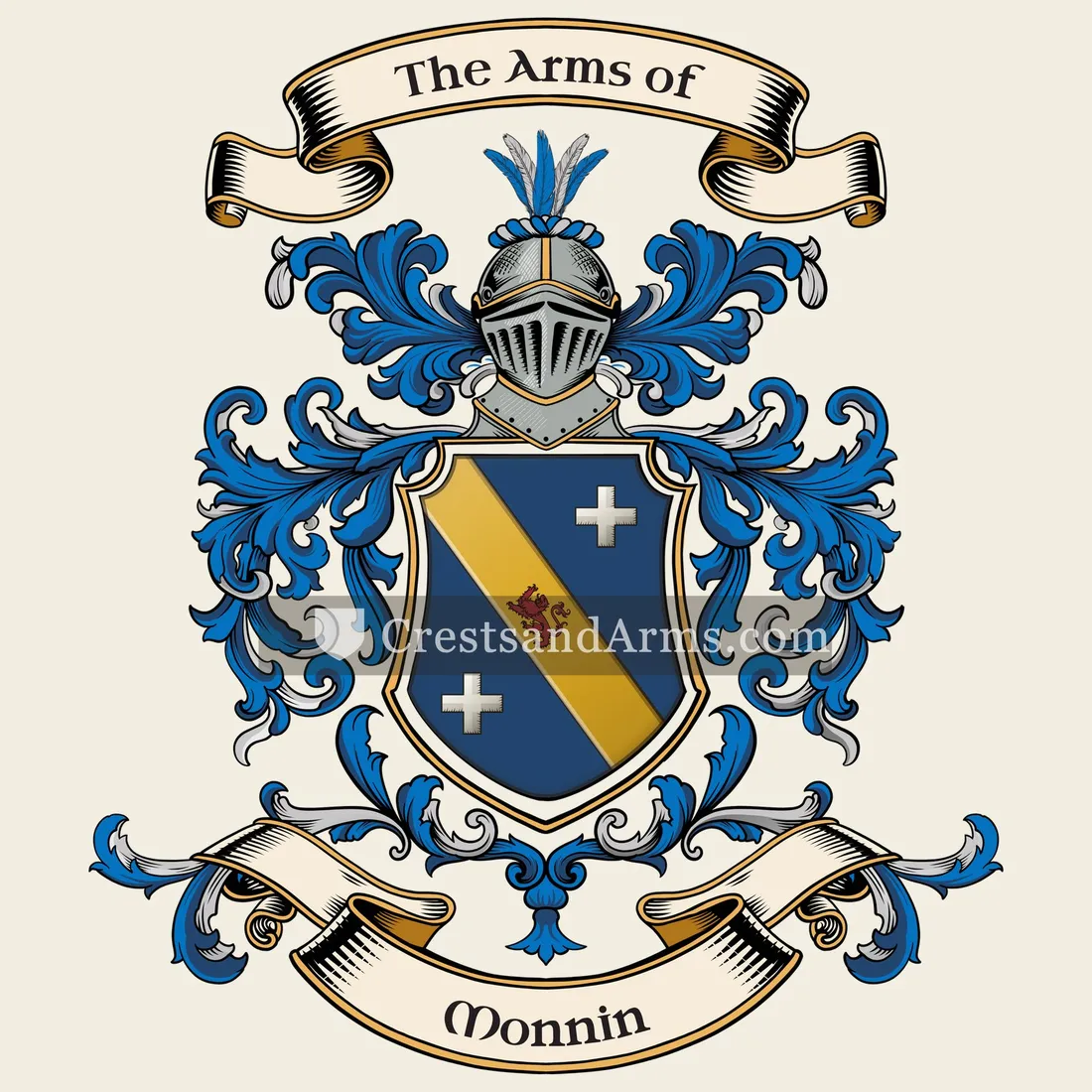
 bendDefence, and the scarf of a commander
 cross symbolChristian faith and service
 lionCourage, strength and royalty
 bendDefence, and the scarf of a commander
 cross symbolChristian faith and service
 lionCourage, strength and royalty


 mountThe ground held, and steadfastness upon it
 chiefAuthority, wisdom and dominion
 paleMilitary strength, and a fortified defence
 womanGrace, and the founding of a house
 martletA younger son, who must win his own land