Map of France showing where the Monrad arms are recorded
The Monrad arms were recorded in Marche, c. 1663.
Marche was poor upland country in central France, thinly settled and rarely rich. Its gentry held small estates for a very long time, and long tenure counted for more than money.
This is where the arms were entered in the register. Families often moved to other parts of the country, so the same name can turn up in more than one region.
The body that granted and recorded arms in France in this period.
Louis XIV of France
Sovereign of the period
Louis XIV of France
1643–1715
Reigning in France when the Monrad arms are first recorded.
How Arms Worked in France
In France, a coat of arms was a mark of honor that passed down through the male line to all legitimate descendants. Families often used the same shield without changes to show their shared heritage. If a branch wanted to stand out, they could add a small mark to their shield to show their specific place in the family tree.
Granting authority
The Juge d'armes de France acted as the official authority that regulated and verified coats of arms across the country.
How they got arms
Families typically inherited their arms from ancestors, though they could also receive them through royal grants or by proving their noble status.
Where arms were recorded
Coats of arms were officially recorded in the Armorial Général de France, which began its main collection in the year 1696.
The family's standing
Recorded among the armigerous families of Marche.
Origin & History of the Monrad Family in France
The Monrad family name is deeply rooted in the history of the Marche region in Italy, where records confirm their presence as early as 1663. During this period, the family established themselves within the local social structure, likely engaging in the agricultural or administrative life that defined the central Italian landscape. The name itself reflects the linguistic traditions of the era, serving as a distinct identifier for a lineage that maintained a consistent presence in the region for generations. As the family grew, they became part of the fabric of local society, participating in the religious and civic customs that shaped the towns of Marche. By tracing their history back to the mid-seventeenth century, we gain a clear picture of a family that played a steady role in the development of their community long before the modern era.
Monrad Meaning & Related Branches
Root word
Mund-rad
Old Germanic elements meaning protection and counsel or advice.
This name
MonradA name signifying a person who provides wise protection or serves as a counselor.
also spelled
Monart
Documented Sources
J. B. Rietstap, Armorial Général, Gouda: G. B. van Goor Zonen, 1884–87
Archivio di Stato di Ancona, Stato civile della Restaurazione
Colucci, Giuseppe, Delle antichità picene, 1790
Tozzi, Pierluigi, La storia delle Marche, 1984
Digital archive packCoat of arms PNG, gold border print PDF, vector SVG and the certificate of authenticity. Sent to your email in minutes.


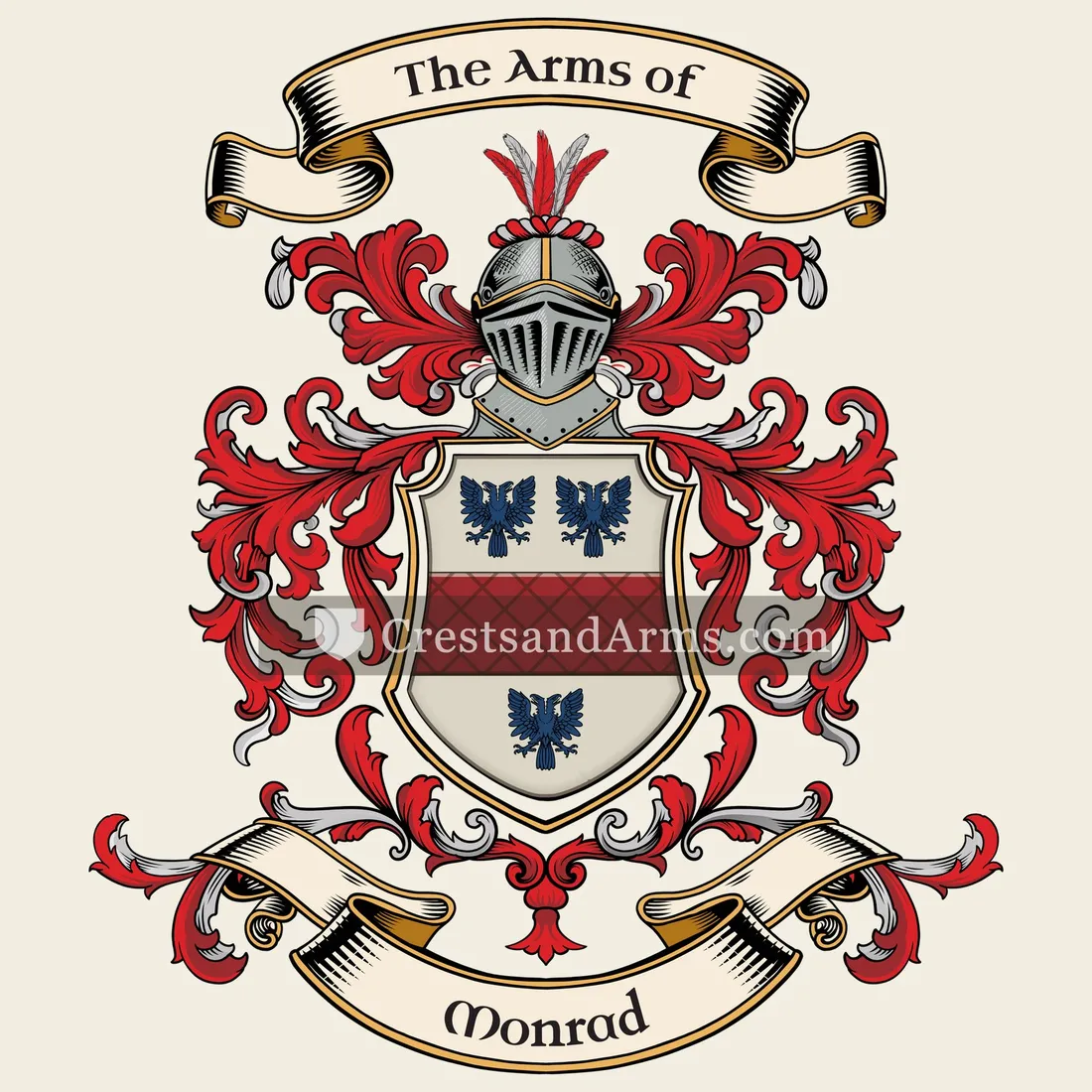
 fessThe military belt, and readiness to serve
 eagleNobility, strength and a keen mind
 fessThe military belt, and readiness to serve
 eagleNobility, strength and a keen mind