Map of Italy showing where the Montana arms are recorded
The Montana arms were recorded in Piedmont, c. 1775.
Piedmont was Alpine and river country in north-western Italy, ruled from Turin. Its noble houses were listed formally by the state, and a name on that list carried arms as a matter of record.
This is where the arms were entered in the register. Families often moved to other parts of the country, so the same name can turn up in more than one region.
The body that granted and recorded arms in Italy in this period.
Alvise Giovanni Mocenigo
Sovereign of the period
Alvise Giovanni Mocenigo
1763–1778
Reigning in Italy when the Montana arms are first recorded.
How Arms Worked in Italy
In the Italian states, coats of arms were often used by noble families to show their status and history. These symbols were passed down through the generations to all legitimate male descendants. Younger branches of a family usually kept the original design but sometimes added small changes to distinguish their specific line from the main branch.
Granting authority
Various local rulers and city governments controlled the use of coats of arms across the different Italian states.
How they got arms
Families often assumed their own arms or received them as official grants from local lords, popes, or city councils.
Where arms were recorded
Arms were recorded in local city archives or private family books rather than in one single national register.
The family's standing
Recorded among the armigerous families of Piedmont.
Origin & History of the Montana Family in Italy
The family name Montana finds its roots in the rugged landscape of northern Italy, specifically within the Piedmont region. The name is descriptive in nature, derived from the Italian word "montagna," which translates to mountain. In the eighteenth century, families often adopted surnames based on their geographic surroundings or the specific terrain they inhabited. By 1775, records confirm that members of the Montana family were well-established in Piedmont, likely living among the foothills of the Alps. Life in this area required resilience, as the mountainous environment shaped both the daily work and the social structure of the local population. Because the name identifies a connection to high-altitude land, it suggests that the earliest ancestors were likely farmers, shepherds, or traders who navigated the difficult mountain passes to sustain their livelihoods. This deep connection to the Piedmontese landscape remains the defining element of the family's early historical identity.
Coat of Arms & Family Crest Details
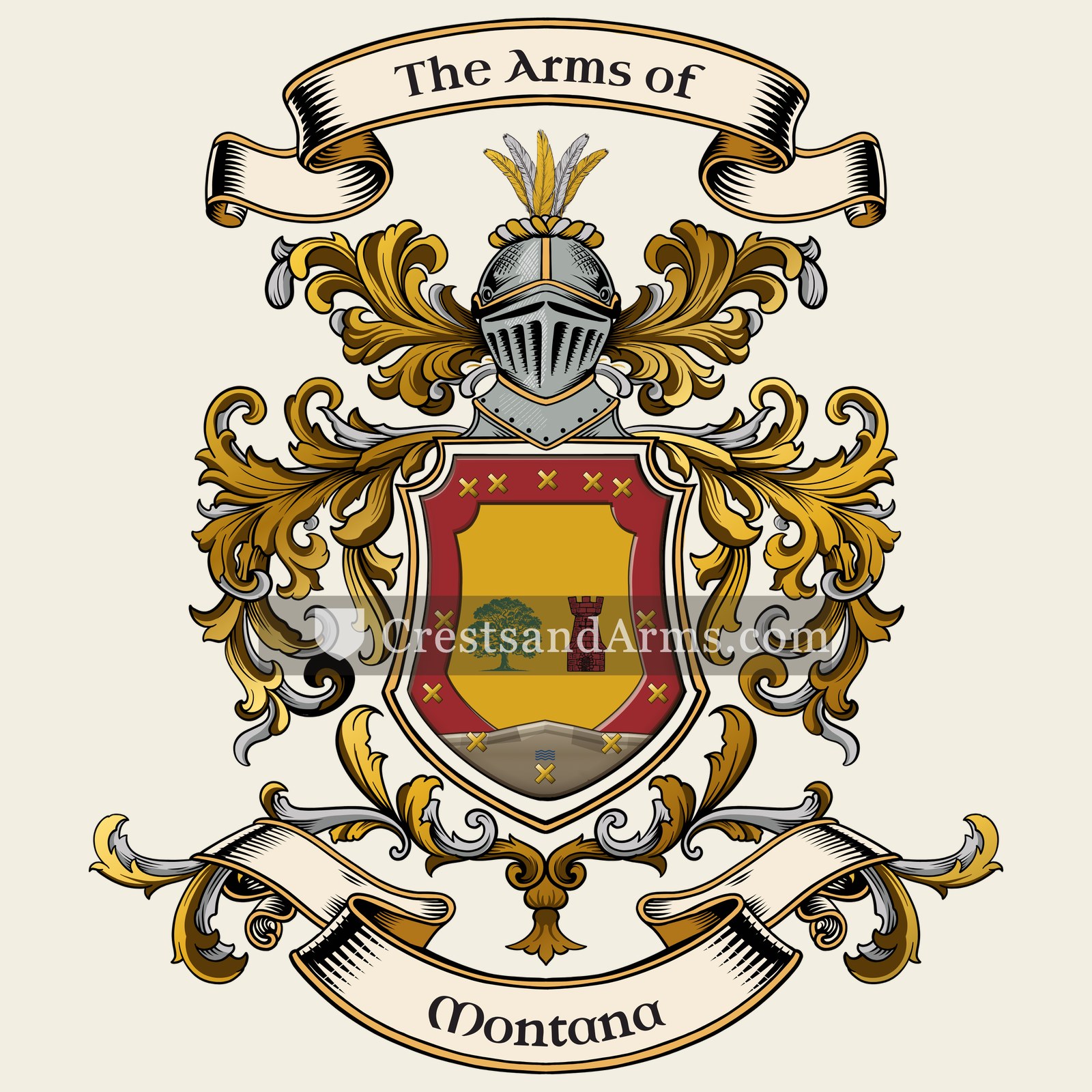
Symbols on this shield
mountThe ground held, and steadfastness upon it
treeLife, endurance and deep roots
towerGrandeur and solidity, and a stronghold defended
riverThe bounds of a land, and life carried through it
saltire coupedResolution, and the cross of St Andrew
Colours
Gold (Or)Means: Generosity
Red (Gules)Means: Military strength
Green (Vert)Means: Hope
Blue (Azure)Means: Loyalty and truth
Historical info
Source
J. B. Rietstap, Armorial Général, Gouda: G. B. van Goor Zonen, 1884–87
Blazon (the actual original written record)
“D'or à un mont au nat., mouv. du flanc sen., portant sur sa pente un chêne de sin., fruité d'or; ledit mont adextré d'une tour sommée d'une tourelle de gu.; le tout mouv. d'une eau d'azur en p., agitée d'arg.; à la bord. de gu., ch. de treize flanchis d'or, 4 en chef, 5 en p. et 2 à chaque flanc l'un sur l'autre.”
CataloniaCatalonia, c. 1722
Digital archive packCoat of arms PNG, gold border print PDF, vector SVG and the certificate of authenticity. Sent to your email in minutes.
Map of Spain showing where the Montana arms are recorded
The Montana arms were recorded in Catalonia, c. 1722.
Catalonia lived by sea trade, and its merchant houses were as powerful as its landowners. Both sorts of family took arms, and Barcelona kept records of the houses entitled to bear them.
This is where the arms were entered in the register. Families often moved to other parts of the country, so the same name can turn up in more than one region.
The body that granted and recorded arms in Spain in this period.
Philip V of Spain
Sovereign of the period
Philip V of Spain
1714–1724
Reigning in Italy when the Montana arms are first recorded.
How Arms Worked in Spain
In Spain, a coat of arms was considered a form of property that belonged to the entire family line. These arms were passed down from a father to all his children equally. Younger branches of the family usually kept the original design without needing to add any special marks to distinguish their specific line.
Granting authority
The Cronista Rey de Armas was the official body that regulated and granted coats of arms throughout Spain.
How they got arms
Families often obtained their arms through royal grants or by proving their noble status to the official heraldic authority.
Where arms were recorded
Coats of arms were officially recorded in the registers of the Cronista Rey de Armas starting in 1496.
The family's standing
Recorded among the armigerous families of Catalonia.
Origin & History of the Montana Family in Spain
The surname Montana finds its roots in the rugged landscape of the Iberian Peninsula, where it functioned as a topographic descriptor for families living in or near mountainous terrain. By the early 18th century, the name was well-established in the Catalonia region of northeastern Spain. Records from 1722 confirm that members of the Montana family were active participants in the social and economic life of this area during a time of significant transition following the War of the Spanish Succession. Because Catalonia served as a vital crossroads for trade and cultural exchange between the Mediterranean and the rest of Europe, those bearing the name were often integrated into the local agricultural or mercantile communities that defined the Catalan countryside. The name reflects a deep connection to the geography of the region, marking the family as people who were defined by the distinct hills and high elevations of their ancestral home.
Montana Meaning & Related Branches
Root word
Montanus
Latin term derived from mons meaning mountain or mountainous region.
This name
MontanaRefers to someone who lived in or originated from a mountainous area.
also spelled
Montanna
Montane
Montanya
Documented Sources
J. B. Rietstap, Armorial Général, Gouda: G. B. van Goor Zonen, 1884–87
De Felice, Emidio. Dizionario dei cognomi italiani. 1978
Toselli, Ottavio. Dizionario etimologico dei cognomi italiani. 1980
Archivio di Stato di Torino, Stato Civile della Restaurazione
Digital archive packCoat of arms PNG, gold border print PDF, vector SVG and the certificate of authenticity. Sent to your email in minutes.


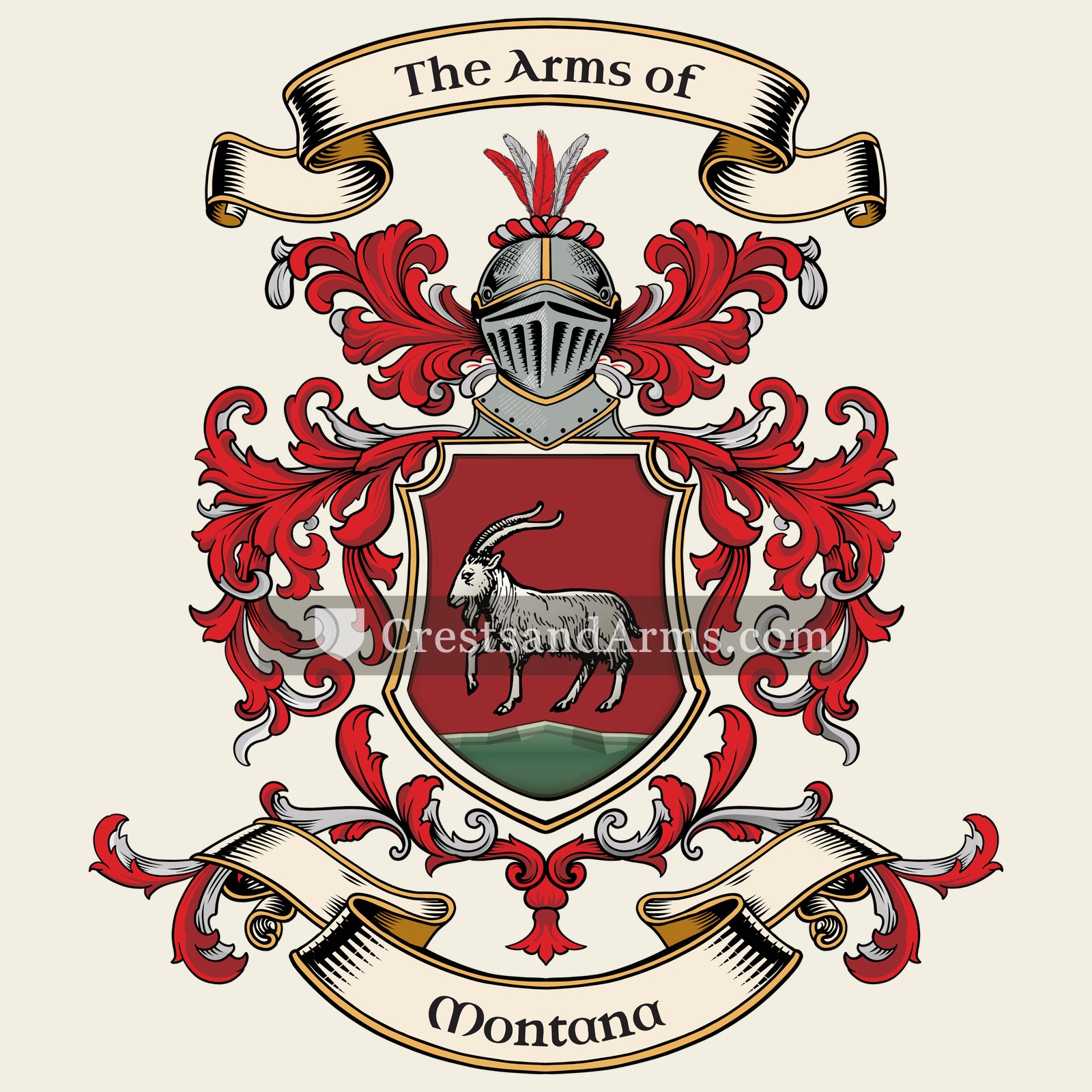
 mountThe ground held, and steadfastness upon it
 goatOne who wins by diplomacy rather than force
 mountThe ground held, and steadfastness upon it
 goatOne who wins by diplomacy rather than force


 treeLife, endurance and deep roots
 towerGrandeur and solidity, and a stronghold defended
 riverThe bounds of a land, and life carried through it
 saltire coupedResolution, and the cross of St Andrew