Map of Spain showing where the Montanez arms are recorded
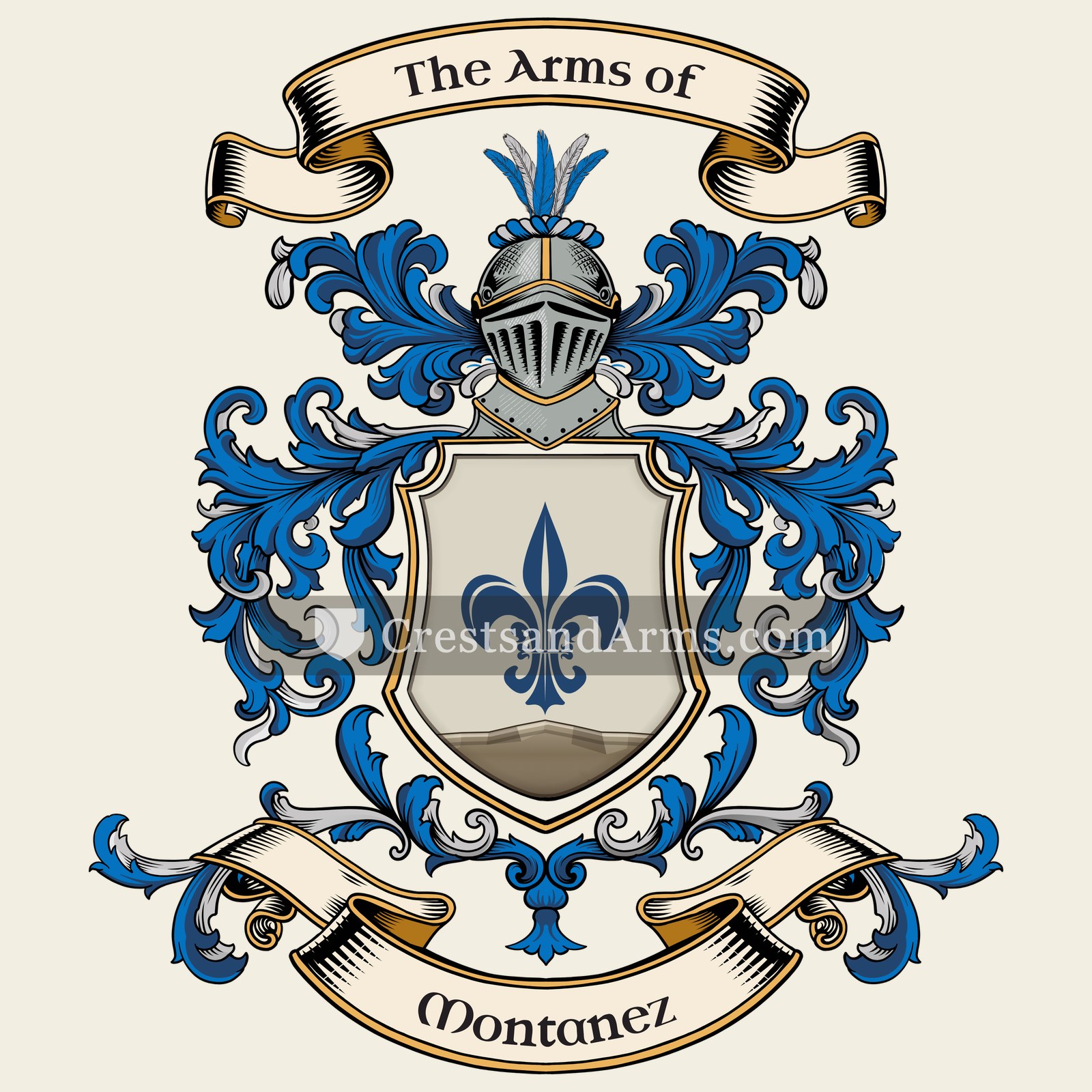
The Montanez arms were recorded in Catalonia, c. 1722.
Catalonia lived by sea trade, and its merchant houses were as powerful as its landowners. Both sorts of family took arms, and Barcelona kept records of the houses entitled to bear them.
This is where the arms were entered in the register. Families often moved to other parts of the country, so the same name can turn up in more than one region.
The body that granted and recorded arms in Spain in this period.
Philip V of Spain
Sovereign of the period
Philip V of Spain
1714–1724
Reigning in Spain when the Montanez arms are first recorded.
How Arms Worked in Spain
In Spain, a coat of arms was considered a form of property that belonged to the entire family line. These arms were passed down from a father to all his children equally. Younger branches of the family usually kept the original design without needing to add any special marks to distinguish their specific line.
Granting authority
The Cronista Rey de Armas was the official body that regulated and granted coats of arms throughout Spain.
How they got arms
Families often obtained their arms through royal grants or by proving their noble status to the official heraldic authority.
Where arms were recorded
Coats of arms were officially recorded in the registers of the Cronista Rey de Armas starting in 1496.
The family's standing
Recorded among the armigerous families of Catalonia.
Origin & History of the Montanez Family in Spain
The surname Montañez is a topographic name that originated in the Iberian Peninsula. It was traditionally used to describe people who lived in or came from mountainous regions. By the early 18th century, records confirm that members of the family were well-established in the Catalonia region of Spain. During this period, families in Catalonia were often deeply connected to the local agricultural economy and the social structures of their specific mountain villages. As the family grew, they moved through various parts of the region, carrying the name as a reflection of their ancestral ties to the rugged landscape. This history highlights how the name served as a simple way to identify a person by their home environment long before modern census records existed.
Related Branches & Arms
Root word
Montanus
Derived from the Latin word for mountain or mountainous region.
This name
MontanezRefers to someone who lived in or originated from a mountainous area.
also spelled
Montanere
Montanerr
Documented Sources
J. B. Rietstap, Armorial Général, Gouda: G. B. van Goor Zonen, 1884–87
Moll, Francesc de Borja, Els llinatges catalans, 1959
Alcover, Antoni Maria, Diccionari català-valencià-balear, 1962
Arxiu de la Corona d'Aragó, Registres de la Reial Cancelleria
Digital archive packCoat of arms PNG, gold border print PDF, vector SVG and the certificate of authenticity. Sent to your email in minutes.


 mountThe ground held, and steadfastness upon it
 fleur de lisPurity, light, and the sixth son
 mountThe ground held, and steadfastness upon it
 fleur de lisPurity, light, and the sixth son