Map of France showing where the Montesano arms are recorded
The Montesano arms were recorded in Gascogne, c. 1725.
Gascogne was south-western country of small estates and stubborn independence, long fought over by France and England. Its gentry were numerous and poor, and even a small holding was enough for a shield of one's own.
This is where the arms were entered in the register. Families often moved to other parts of the country, so the same name can turn up in more than one region.
The body that granted and recorded arms in France in this period.
Louis XV of France
Sovereign of the period
Louis XV of France
1715–1774
Reigning in France when the Montesano arms are first recorded.
How Arms Worked in France
In France, a coat of arms was a mark of honor that passed down through the male line to all legitimate descendants. Families often used the same shield without changes to show their shared heritage. If a branch wanted to stand out, they could add a small mark to their shield to show their specific place in the family tree.
Granting authority
The Juge d'armes de France acted as the official authority that regulated and verified coats of arms across the country.
How they got arms
Families typically inherited their arms from ancestors, though they could also receive them through royal grants or by proving their noble status.
Where arms were recorded
Coats of arms were officially recorded in the Armorial Général de France, which began its main collection in the year 1696.
The family's standing
Recorded among the armigerous families of Gascogne.
Origin & History of the Montesano Family in France
The family name Montesano originates from the Italian language and translates to mean mountain of health or healthy mountain. While the name is deeply rooted in Italian geography, historical records confirm that members of the family were established in the Gascogne region of France by 1725. During this period, Gascogne was a vibrant area known for its agricultural wealth and its strategic position near the Pyrenees mountains. Families moving from the Italian peninsula to southern France often sought new opportunities in trade or land management during the eighteenth century. The presence of the Montesano name in this specific French province suggests that early ancestors were part of a broader movement of families crossing borders to integrate into new local economies. By settling in Gascogne, these early family members became part of the unique cultural landscape that blended Mediterranean influences with the traditions of southwestern France.
Montesano Meaning & Related Branches
Root word
Mons
Latin term referring to a mountain or a prominent hill.
This name
MontesanoDerived from a locative habitational name indicating someone who lived on a healthy mountain.
also spelled
Montespane
Montespann
Montespant
Documented Sources
J. B. Rietstap, Armorial Général, Gouda: G. B. van Goor Zonen, 1884–87
Archives départementales des Landes, Registres paroissiaux et d'état civil
Dauzat, Albert, Dictionnaire étymologique des noms de famille et prénoms de France, 1951


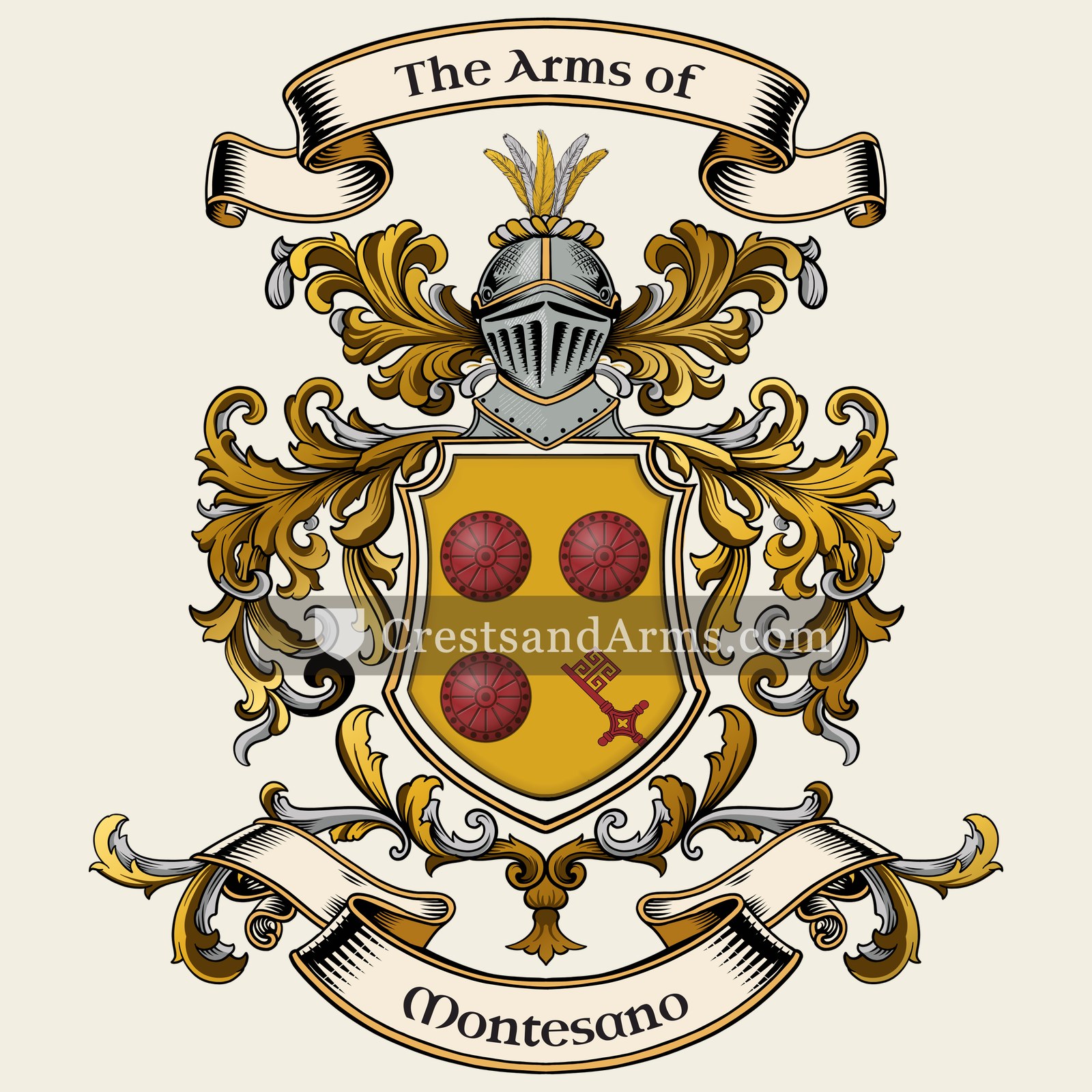
 roundelA coin, and one who has been to the crusades
 keyGuardianship, and the office of a steward
 roundelA coin, and one who has been to the crusades
 keyGuardianship, and the office of a steward