A record of documented arms, meaning and origin, researched for the Montgomery family lines. Documented in 3 countries.
Reg. 4979 · Scottish, M–O
Coat of Arms & Family Crest Details
Symbols on this shield
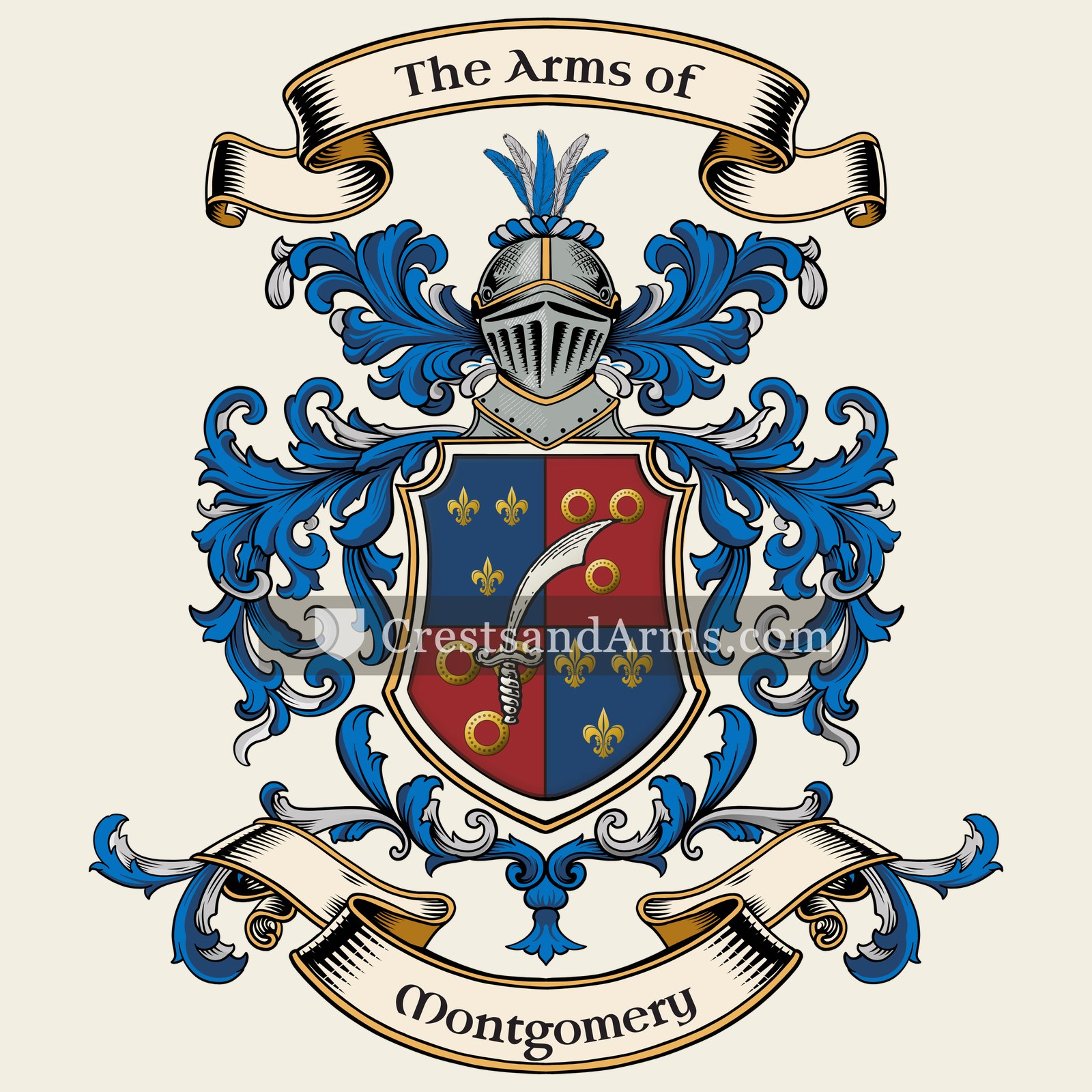
swordJustice, and military honour
fleur de lisPurity, light, and the sixth son
ringFidelity, and a promise kept
Colours
Blue (Azure)Means: Loyalty and truth
Red (Gules)Means: Military strength
Gold (Or)Means: Generosity
Historical info
Source
Sir Bernard Burke, The General Armory of England, Scotland, Ireland and Wales, London: Harrison & Sons, 1884
Blazon (the actual original written record)
“Quarterly, 1st and 4th, az. three fleurs-de-lis or, for Montgomery; 2nd and 3rd, gu. three rings or, gemmed az., for Eglinton; over all in the centre a two-handed sword in pale ppr”
AyrSkelmorlie · Ayr, c. 1748
Digital archive packCoat of arms PNG, gold border print PDF, vector SVG and the certificate of authenticity. Sent to your email in minutes.
Map of Scotland showing where the Montgomery arms are recorded
The Montgomery arms were recorded in Ayr, c. 1748.
Ayrshire was farming country along Scotland's south-west coast, held in a great many small estates. Its lairds were numerous rather than rich, and each holding brought its own claim to arms.
This is where the arms were entered in the register. Families often moved to other parts of the country, so the same name can turn up in more than one region.
The body that granted and recorded arms in Scotland in this period.
George II of Great Britain
Sovereign of the period
George II of Great Britain
1727–1760
Reigning in Scotland when the Montgomery arms are first recorded.
How Arms Worked in Scotland
Scottish heraldry is unique because it treats a coat of arms as a piece of personal property protected by law. Only one person can own a specific design at any given time. When a family grows, the head keeps the original shield while other relatives must apply for their own distinct version with slight changes to prove their specific identity.
Granting authority
The Court of the Lord Lyon acts as the official body that regulates and controls all heraldic matters throughout Scotland.
How they got arms
Individuals obtain a legal right to their arms through a formal petition process that confirms their identity and family connection.
Where arms were recorded
All valid coats of arms are officially entered into the Public Register of All Arms and Bearings starting from 1672.
The family's standing
Recorded among the armigerous families of Ayr.
Origin & History of the Montgomery Family in Scotland
The Montgomery family name has deep roots in Scotland that stretch back long before the mid-eighteenth century. The family originally arrived in the country during the twelfth century when a Norman knight named Roger de Montgomery was granted land in Renfrewshire by the Scottish crown. Over the following generations, the family expanded their influence across the lowlands and became prominent landowners in the region of Ayrshire. By the time the family was firmly established in Ayr in 1748, they had already spent hundreds of years integrating into Scottish society through marriage, politics, and local administration. Their history is closely tied to the development of the Scottish landscape, as they played an active role in the agricultural and social growth of the western shires. This long presence in the region allowed the family to become a recognized part of the local community, transitioning from their origins as medieval settlers into a well-established Scottish family.
Coat of Arms & Family Crest Details
Symbols on this shield
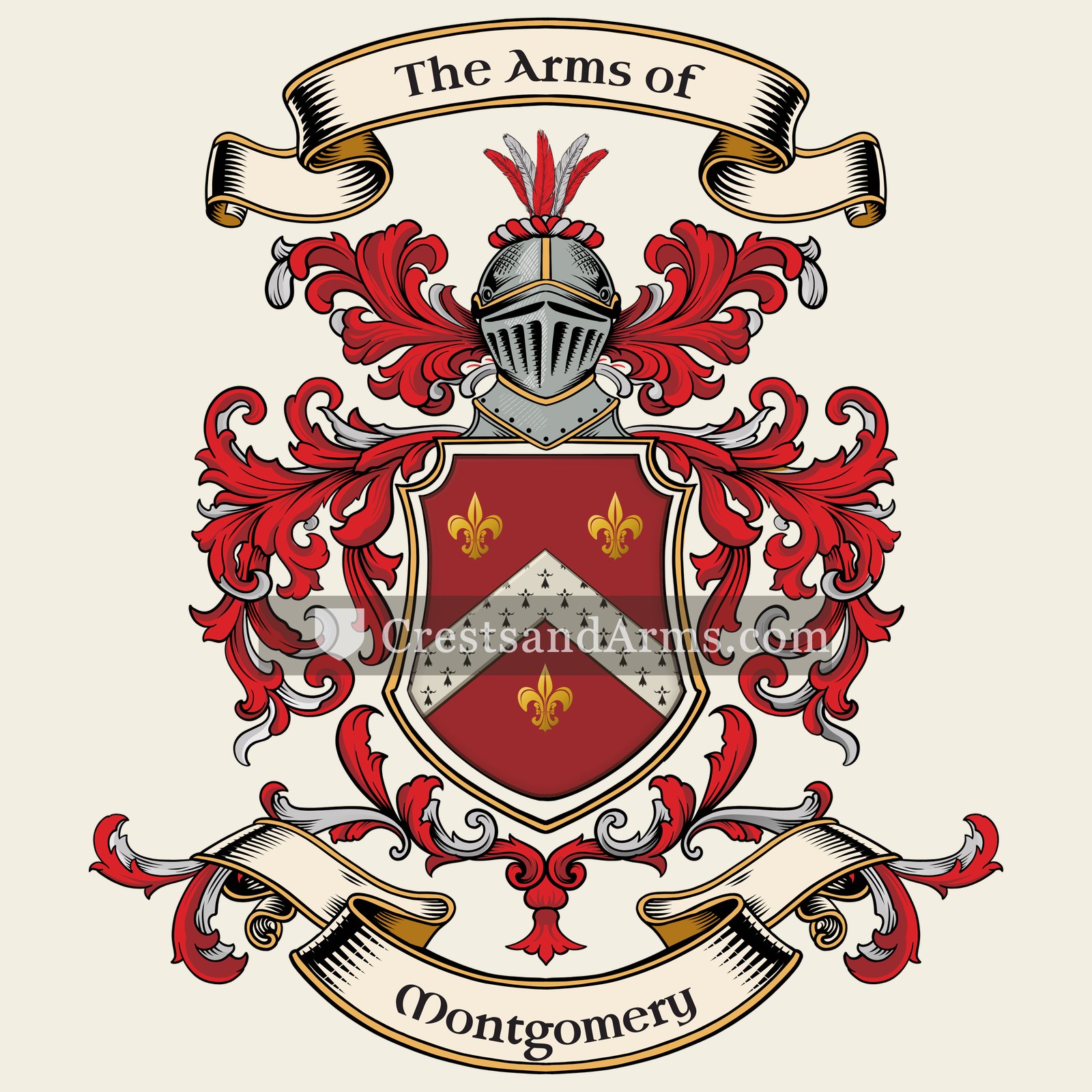
chevronProtection, and faithful service completed
fleur de lisPurity, light, and the sixth son
Colours
Red (Gules)Means: Military strength
ErmineMeans: Dignity
Gold (Or)Means: Generosity
Historical info
Source
Sir Bernard Burke, The General Armory of England, Scotland, Ireland and Wales, London: Harrison & Sons, 1884
Blazon (the actual original written record)
“Gu. a chev. erm. betw. three fleurs-de-lis or”
Walesc. 1476
Digital archive packCoat of arms PNG, gold border print PDF, vector SVG and the certificate of authenticity. Sent to your email in minutes.
Map of Wales showing where the Montgomery arms are recorded
The Montgomery arms were recorded in Wales, c. 1476.
Arms such as these were typically recorded in Denbigh.
Denbighshire was north Welsh country of hills and small estates. Land was held by a great many families rather than a few, and each holding brought its own claim to a coat of arms.
This is where the arms were entered in the register. Families often moved to other parts of the country, so the same name can turn up in more than one region.
The body that granted and recorded arms in Wales in this period.
Edward IV of England
Sovereign of the period
Edward IV of England
1471–1483
Reigning in Scotland when the Montgomery arms are first recorded.
How Arms Worked in Wales
English heraldry allowed arms to be shared by all legitimate descendants of the original owner. These symbols were treated as personal property that moved through the generations to all children. While the eldest son kept the original design, other family members could use the same shield without needing to change it or register their own unique versions.
Granting authority
The College of Arms in London has regulated the use of coats of arms throughout England and Wales since 1484.
How they got arms
Families typically obtained their coats of arms through a formal grant from the Crown or by proving their ancient right to them.
Where arms were recorded
All official coats of arms are recorded in the registers kept at the College of Arms, which date back to the fifteenth century.
The family's standing
Recorded among the armigerous families of Wales.
Origin & History of the Montgomery Family in Wales
The Montgomery family name in Wales is deeply connected to the shifting political landscape of the late medieval period. While the name originated from Norman roots, by the time records place the family in Denbigh in 1476, they had become firmly integrated into the local Welsh social structure. During this era, Denbigh was a significant administrative center where English influence and Welsh traditions frequently overlapped. Families like the Montgomerys often served as local officials or landowners who bridged the gap between the crown and the local population. Their presence in the region suggests they were part of a rising class of gentry who managed estates and participated in the legal life of the town. Over time, these families adopted the local customs and language, ensuring that the name became a permanent part of the regional history of North Wales.
Coat of Arms & Family Crest Details
Symbols on this shield
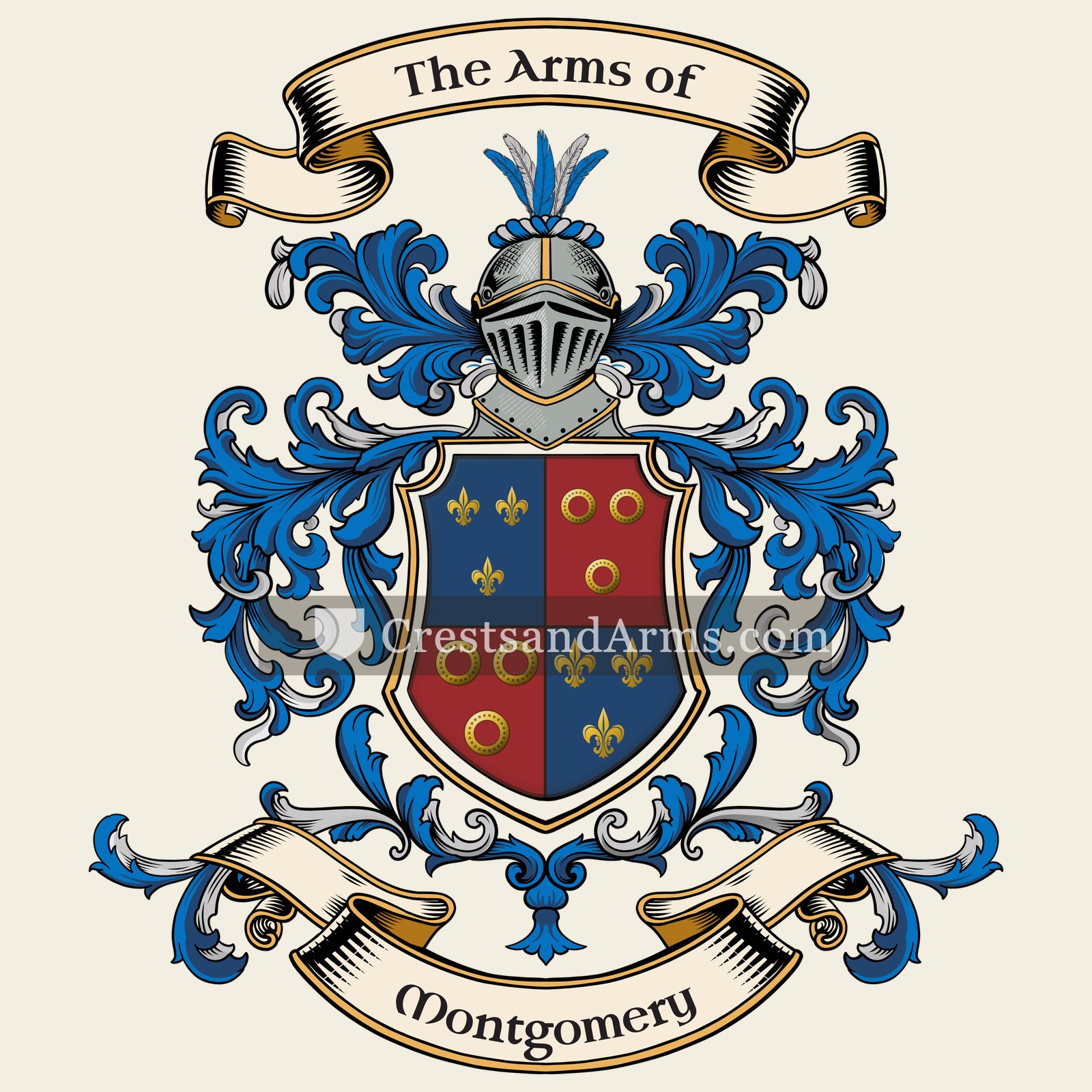
fleur de lisPurity, light, and the sixth son
ringFidelity, and a promise kept
Colours
Blue (Azure)Means: Loyalty and truth
Red (Gules)Means: Military strength
Gold (Or)Means: Generosity
Historical info
Source
Sir Bernard Burke, The General Armory of England, Scotland, Ireland and Wales, London: Harrison & Sons, 1884
Blazon (the actual original written record)
“Quarterly, 1st and 4th, az. three fleurs-de-lis or, for MONTGOMERY; 2nd and 3rd, gu. three annulets or, gemmed az., for EGLINTON”
DonegalConvoy House · Donegal, c. 1645
Digital archive packCoat of arms PNG, gold border print PDF, vector SVG and the certificate of authenticity. Sent to your email in minutes.
Map of Ireland showing where the Montgomery arms are recorded
The Montgomery arms were recorded in Donegal, c. 1645.
Donegal was remote north-western Irish country of mountain and coast. Its land was poor and its families few, but those who held ground held it for a very long time.
This is where the arms were entered in the register. Families often moved to other parts of the country, so the same name can turn up in more than one region.
The body that granted and recorded arms in Ireland in this period.
Charles I of England
Sovereign of the period
Charles I of England
1625–1649
Reigning in Scotland when the Montgomery arms are first recorded.
How Arms Worked in Ireland
The Ulster King of Arms granted coats of arms to individuals who proved their social standing and good character. These symbols were typically inherited by all legitimate descendants of the original holder. If a family branch wanted a unique look, they could apply for a specific change to their design through the office to ensure their identity remained distinct.
Granting authority
The Ulster King of Arms acted as the official body that regulated and issued all coats of arms throughout Ireland.
How they got arms
Families obtained their arms through formal grants issued by the office after proving their eligibility and paying the required fees.
Where arms were recorded
All official grants were recorded in the registers held by the Ulster King of Arms starting from the year 1552.
The family's standing
Recorded among the armigerous families of Donegal.
Origin & History of the Montgomery Family in Ireland
The Montgomery family name in Ireland is deeply connected to the period of the Ulster Plantation during the seventeenth century. While the name has roots in Normandy and Scotland, its presence in County Donegal became firmly established by 1645 as part of a broader movement of settlers from the Scottish Lowlands. These families were often granted land as part of official efforts to stabilize the region, and they quickly integrated into the local economy and social structure of the north. Over time, the Montgomerys became significant landowners and community leaders in Donegal, helping to shape the cultural and agricultural landscape of the area. Their history reflects the complex migration patterns of the era, as they adapted to life in a new country while maintaining links to their ancestral heritage.
Montgomery Meaning & Related Branches
Root word
Gumont
A Germanic name composed of elements meaning man and protector.
This name
MontgomeryDerived from a place name in Normandy meaning man's hill or mountain.
also spelled
Montgomerie
Montgommery
Mountgomery
Gomery
Related arms
Bentincksimilar arms
Campbell-McIversimilar arms
Elliotsimilar arms
* **Montgommeryvariant spelling
Documented Sources
Sir Bernard Burke, The General Armory of England, Scotland, Ireland and Wales, London: Harrison & Sons, 1884
Anderson, William, The Scottish Nation; or, The Surnames, Families, Literature, Honours, and Biographical History of the People of Scotland, 1863
Fraser, William, Memorials of the Montgomeries, Earls of Eglinton, 1859
National Records of Scotland, Ayr Burgh Records, B6/18
Digital archive packCoat of arms PNG, gold border print PDF, vector SVG and the certificate of authenticity. Sent to your email in minutes.


 swordJustice, and military honour
 fleur de lisPurity, light, and the sixth son
 ringFidelity, and a promise kept
 swordJustice, and military honour
 fleur de lisPurity, light, and the sixth son
 ringFidelity, and a promise kept


 chevronProtection, and faithful service completed