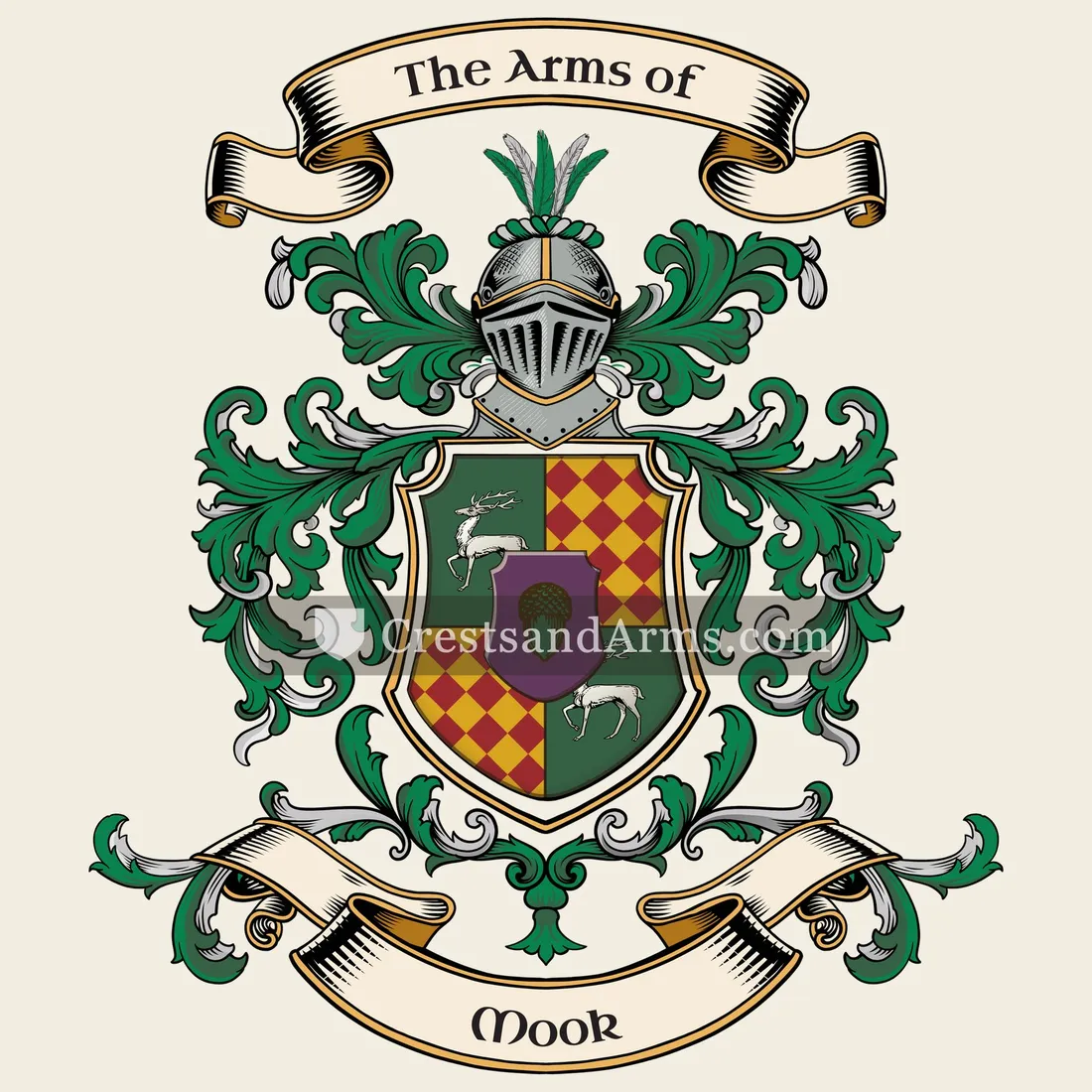
A record of documented arms, meaning and origin, researched for the Mook family of Germany.
Reg. 8333 · German, M–O
Meaning of the Mook family crest colors & symbols
Symbols on this shield
oakGreat age, strength and steadfastness
stagPeace and harmony, and one who will not fight unprovoked
Colours
Green (Vert)Means: Hope
Gold (Or)Means: Generosity
Purple (Purpure)Means: Royal majesty
Silver (Argent)Means: Peace and sincerity
Historical info
Source
J. B. Rietstap, Armorial Général, Gouda: G. B. van Goor Zonen, 1884–87
Blazon (the actual original written record)
“Ec.: aux 1 et 4 de sin. à une ramure de cerf d'arg.; aux 2 et 3 losangé en fasce d'or et de gu. Sur le tout de pourpre à une branche de chêne de sin. Cq. cour. C.: la branche, entre la ramure. L.: à dextre d'arg. et de sin., à sen. d'or et de gu.”
GermanySchwarzbourg-Sondershausen, c. 1817
Digital archive packCoat of arms PNG, gold border print PDF, vector SVG and the certificate of authenticity. Sent to your email in minutes.
Map of Germany showing where the Mook arms are recorded
The Mook arms were recorded in Schwarzbourg-Sondershausen, c. 1817.
This is where the arms were entered in the register. Families often moved to other parts of the country, so the same name can turn up in more than one region.
The body that granted and recorded arms in Germany in this period.
Frederick William III of Prussia
Sovereign of the period
Frederick William III of Prussia
1797–1840
Reigning in Germany when the Mook arms are first recorded.
How Arms Worked in Germany
Prussian heraldry was strictly tied to social rank and noble status rather than being a free choice for every citizen. These symbols were treated as permanent family property that moved through the generations to all legitimate heirs. If a family branch wanted to change their design to stand out, they had to apply for official permission to alter their specific version of the shield.
Granting authority
The Prussian Heroldsamt acted as the central state office that managed and strictly controlled all noble titles and coats of arms.
How they got arms
Families usually obtained their arms through formal royal grants or by proving their long-standing noble status to the state authorities.
Where arms were recorded
All official coats of arms were kept in the rolls of the Prussian Heroldsamt, which functioned from 1706 until 1918.
The family's standing
Recorded among the armigerous families of Germany.
Origin & History of the Mook Family in Germany
The family name Mook has deep roots in the region of Schwarzburg-Sondershausen, a former principality located in present-day Thuringia, Germany. By 1817, records confirm that members of the Mook family were well-established residents within this area. The name itself likely originated as a descriptive term or a nickname in the local German dialect, which was common for surnames developing in rural communities during that era. Families in this region often lived in small agricultural villages where they worked as farmers, craftsmen, or laborers. Because the principality was a sovereign state with its own administration, the Mook family would have been subject to the local laws and record-keeping practices of the Schwarzburg rulers. Over time, these early ancestors helped shape the local culture and community life of the region before some eventually migrated to other parts of the world.
Mook Meaning & Related Branches
Root word
Mok
A Middle Low German term for a female hare or rabbit.
This name
MookA nickname for a person with characteristics resembling a hare or rabbit.
also spelled
Mutch
Mook
Documented Sources
J. B. Rietstap, Armorial Général, Gouda: G. B. van Goor Zonen, 1884–87


 oakGreat age, strength and steadfastness
 stagPeace and harmony, and one who will not fight unprovoked
 oakGreat age, strength and steadfastness
 stagPeace and harmony, and one who will not fight unprovoked