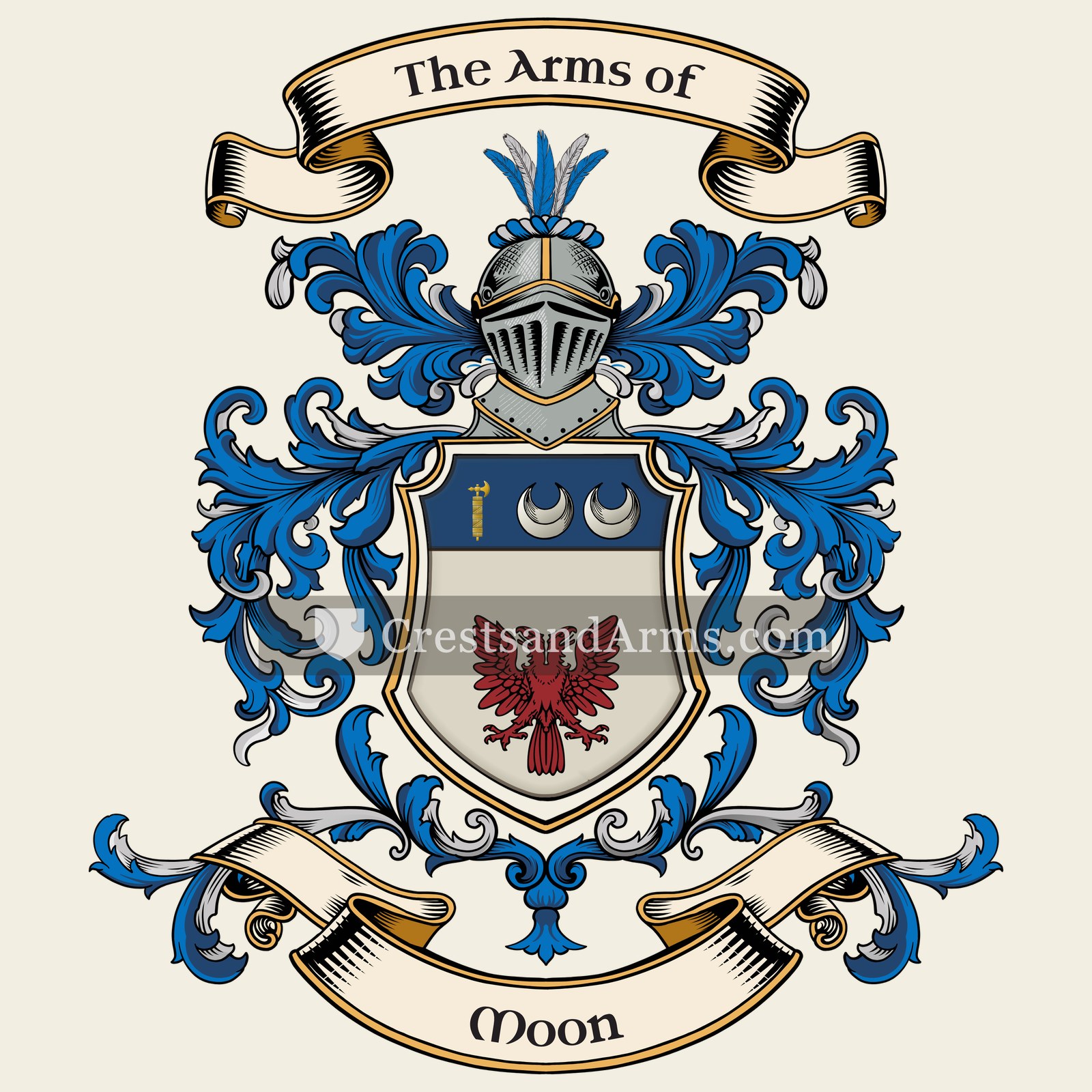
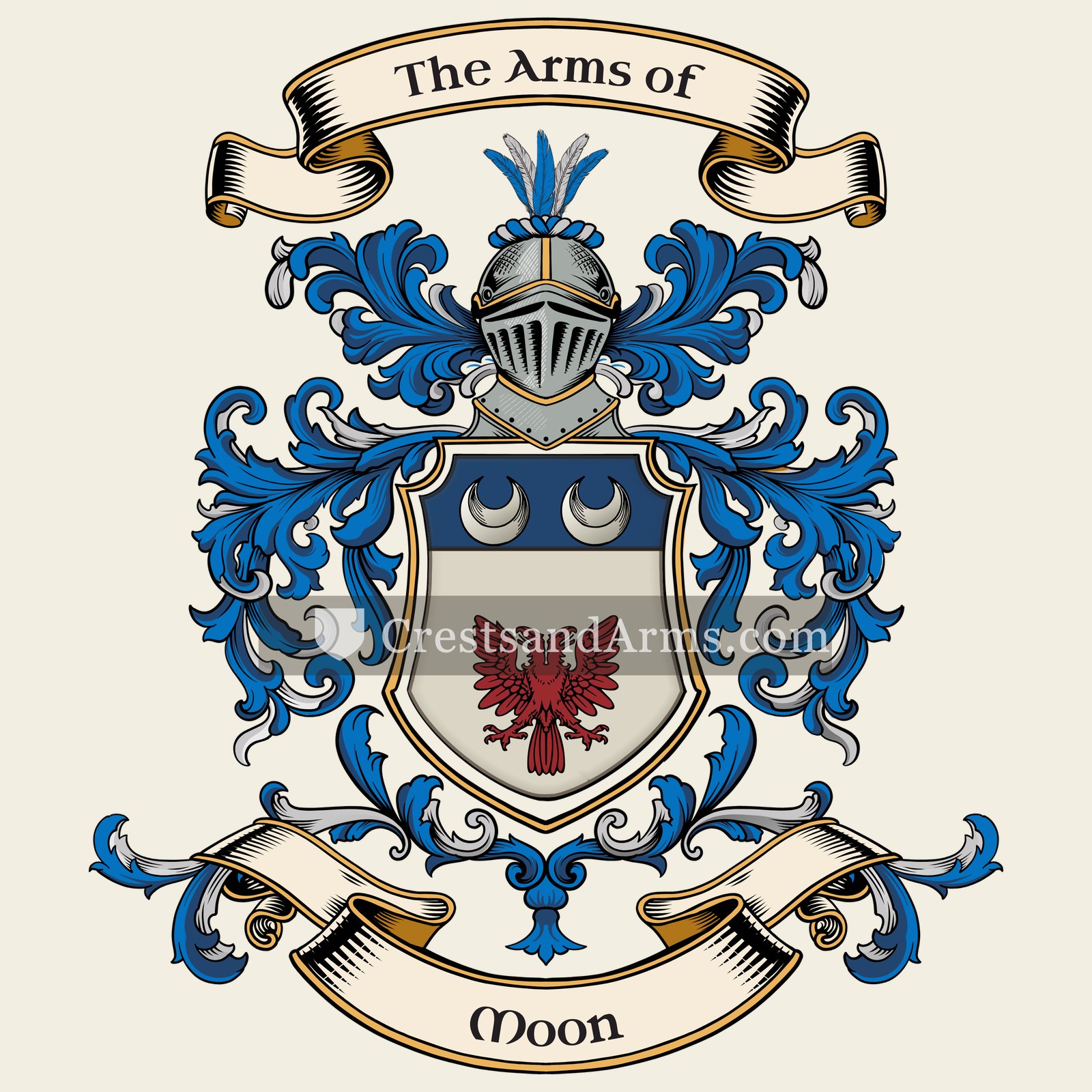
A record of documented arms, meaning and origin, researched for the Moon family lines. Documented in 2 countries.
Reg. 3747 · Britain, M–O
Coat of Arms & Family Crest Details
Symbols on this shield
chiefAuthority, wisdom and dominion
eagleNobility, strength and a keen mind
fascesAuthority joined to unity
crescentHonour by the sovereign, and the second son
Colours
Silver (Argent)Means: Peace and sincerity
Blue (Azure)Means: Loyalty and truth
Red (Gules)Means: Military strength
Gold (Or)Means: Generosity
Historical info
Source
J. B. Rietstap, Armorial Général, Gouda: G. B. van Goor Zonen, 1884–87
Blazon (the actual original written record)
“D'arg. à l'aigle de gu., ch. sur sa poitrine de deux épées d'arg., passées en saut.; au chef nébulé d'azur, ch. d'un faisceau des licteurs d'or, accosté de deux croiss. d'arg. C.: un croiss. d'arg., br. sur le faisceau des licteurs en bande, et une épée d'arg. en barre, passés en saut. D.: ÆQUAM SERVARE MENTEM.”
BritainLondres, c. 1700
Digital archive packCoat of arms PNG, gold border print PDF, vector SVG and the certificate of authenticity. Sent to your email in minutes.
Map of Britain showing where the Moon arms are recorded
The Moon arms were recorded in Londres, c. 1700.
Arms such as these were typically recorded in Kent.
Kent sits between London and the short crossing to Europe, and the trade passing through made it wealthy. Merchant families bought land with that money, and it was landowners who took coats of arms.
This is where the arms were entered in the register. Families often moved to other parts of the country, so the same name can turn up in more than one region.
The body that granted and recorded arms in Britain in this period.
William III of England
Sovereign of the period
William III of England
1694–1702
Reigning in Britain when the Moon arms are first recorded.
How Arms Worked in Britain
English heraldry allowed arms to be shared by all legitimate descendants of the original owner. These symbols were treated as personal property that moved through the generations to all children. While the eldest son kept the original design, other family members could use the same shield without needing to change it or register their own unique versions.
Granting authority
The College of Arms in London has regulated the use of coats of arms throughout England and Wales since 1484.
How they got arms
Families typically obtained their coats of arms through a formal grant from the Crown or by proving their ancient right to them.
Where arms were recorded
All official coats of arms are recorded in the registers kept at the College of Arms, which date back to the fifteenth century.
The family's standing
Recorded among the armigerous families of Britain.
Origin & History of the Moon Family in Britain
The family name Moon has deep roots in the English county of Kent, where records confirm the presence of the family by the early 18th century. The name itself is likely a topographic surname, which was a common way for people to identify themselves based on the land where they lived or worked. In Middle English, the word *mone* was sometimes used as a nickname for a person who had a calm or gentle temperament, or it may have been given to someone who lived near a landmark associated with the moon. By the 1700s, families bearing this name were well-established in the rural parishes of Kent, often working as farmers or skilled tradespeople who contributed to the local economy. These early generations were part of a stable community that relied on the fertile soil of the "Garden of England" to build their livelihoods. Over time, the name became a permanent fixture in the region, reflecting the steady growth and migration of families across the British countryside during the transition into the modern era.
Coat of Arms & Family Crest Details
Symbols on this shield
chiefAuthority, wisdom and dominion
eagleNobility, strength and a keen mind
crescentHonour by the sovereign, and the second son
Colours
Silver (Argent)Means: Peace and sincerity
Blue (Azure)Means: Loyalty and truth
Red (Gules)Means: Military strength
Historical info
Source
Sir Bernard Burke, The General Armory of England, Scotland, Ireland and Wales, London: Harrison & Sons, 1884
Blazon (the actual original written record)
“Ar. an eagle displ. gu. charged on the breast with two swords in saltire ppr. on a chief nebuly az. a fasces erect or, betw. two crescents ar”
EnglandPortman Square, c. 1620
Digital archive packCoat of arms PNG, gold border print PDF, vector SVG and the certificate of authenticity. Sent to your email in minutes.
Map of England showing where the Moon arms are recorded
The Moon arms were recorded in Portman Square, c. 1620.
Arms such as these were typically recorded in York.
Yorkshire is the largest of the English counties, and it held more gentry families than any other. Land there was split among a great many households rather than a few, so a great many of them carried arms.
This is where the arms were entered in the register. Families often moved to other parts of the country, so the same name can turn up in more than one region.
The body that granted and recorded arms in England in this period.
James VI and I
Sovereign of the period
James VI and I
1603–1625
Reigning in Britain when the Moon arms are first recorded.
How Arms Worked in England
English heraldry allowed arms to be shared by all legitimate descendants of the original owner. These symbols were treated as personal property that moved through the generations to all children. While the eldest son kept the original design, other family members could use the same shield without needing to change it or register their own unique versions.
Granting authority
The College of Arms in London has regulated the use of coats of arms throughout England and Wales since 1484.
How they got arms
Families typically obtained their coats of arms through a formal grant from the Crown or by proving their ancient right to them.
Where arms were recorded
All official coats of arms are recorded in the registers kept at the College of Arms, which date back to the fifteenth century.
The family's standing
Recorded among the armigerous families of England.
Origin & History of the Moon Family in England
The family name Moon has deep roots in the northern regions of England, particularly within the historic city of York. By the year 1620, records indicate that members of the Moon family were already established residents in this area. The name itself is often classified as a topographic surname, which means it was likely given to people who lived near a specific landmark or a house marked by a sign depicting the moon. During the seventeenth century, families in York were often involved in the city’s thriving trade guilds and local governance. As the family grew, they became part of the social fabric of northern England, participating in the daily life and economic development of the region. Their presence in York during this period suggests that they were settled members of the community who contributed to the local history of the city long before the modern era.
Moon Meaning & Related Branches
Root word
Mune
Old French word for a person from the town of Meung-sur-Loire.
This name
MoonA locational surname derived from a place in France, later associated with lunar imagery.
also spelled
Mone
Moun
Related arms
Mohunvariant spelling
Monevariant spelling
Helbertrecorded with Moon, same area
Richardsonrecorded with Moon, same area
Documented Sources
J. B. Rietstap, Armorial Général, Gouda: G. B. van Goor Zonen, 1884–87
Reaney, P.H., A Dictionary of English Surnames, 1997
Cottle, Basil, The Penguin Dictionary of Surnames, 1967
Kent History and Library Centre, Parish Registers of Kent, 1700–1750
The National Archives, The Hearth Tax Returns for Kent, 1664
Digital archive packCoat of arms PNG, gold border print PDF, vector SVG and the certificate of authenticity. Sent to your email in minutes.


 chiefAuthority, wisdom and dominion
 eagleNobility, strength and a keen mind
 fascesAuthority joined to unity
 crescentHonour by the sovereign, and the second son
 chiefAuthority, wisdom and dominion
 eagleNobility, strength and a keen mind
 fascesAuthority joined to unity
 crescentHonour by the sovereign, and the second son