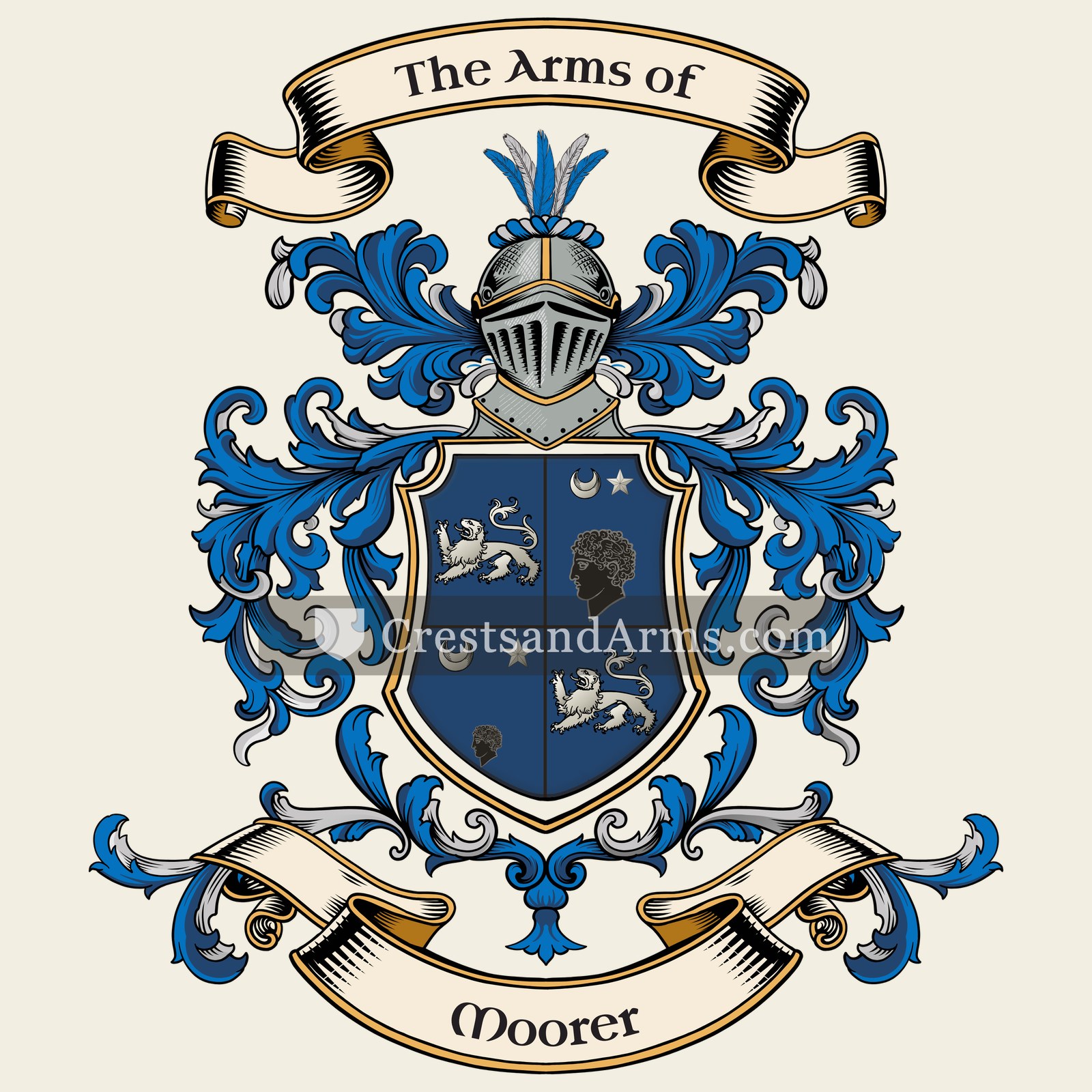
A record of documented arms, meaning and origin, researched for the Moorer family of Switzerland.
Reg. 6397 · Swiss, M–O
Coat of Arms & Family Crest Details
Symbols on this shield
lionCourage, strength and royalty
savages head affrontyAn enemy overcome
crescentHonour by the sovereign, and the second son
mulletThe third son, and a divine quality from above
Colours
Blue (Azure)Means: Loyalty and truth
Silver (Argent)Means: Peace and sincerity
Black (Sable)Means: Constancy
Historical info
Source
J. B. Rietstap, Armorial Général, Gouda: G. B. van Goor Zonen, 1884–87
Blazon (the actual original written record)
“Ec.: aux 1 et 4 d'azur au lion naiss. d'arg.; aux 2 et 3 d'azur à une tête de More, acc. en chef à dextre d'un croiss. d'arg. et à sen. d'une étoile du même.”
Switzerlandc. 1745
Digital archive packCoat of arms PNG, gold border print PDF, vector SVG and the certificate of authenticity. Sent to your email in minutes.
Map of Switzerland showing where the Moorer arms are recorded
The Moorer arms were recorded in Switzerland, c. 1745.
Arms such as these were typically recorded in Bern.
Bern was the largest of the Swiss cantons and ran itself, with its own council and its own courts. Its governing families held office for generations, and office of that kind carried a shield with it.
This is where the arms were entered in the register. Families often moved to other parts of the country, so the same name can turn up in more than one region.
The body that granted and recorded arms in Switzerland in this period.
How Arms Worked in Switzerland
In Switzerland, coats of arms were not restricted to the nobility and were often adopted by common citizens and families. These symbols were passed down through generations to show family identity. When branches of a family grew, they often changed small details of the design to distinguish their own line from the original group.
Granting authority
Cantonal and civic authorities managed the use of coats of arms within their specific regions and local jurisdictions.
How they got arms
Families typically assumed their own coats of arms based on local custom rather than receiving them from a central monarch.
Where arms were recorded
Arms were recorded in various cantonal and civic registers starting from the fourteenth century throughout the Swiss region.
The family's standing
Recorded among the armigerous families of Switzerland.
Origin & History of the Moorer Family in Switzerland
The family name Moorer finds its roots in the Germanic regions of Europe, where it functioned as a descriptive surname for people who lived near a moor or a marshy area. By the mid-eighteenth century, historical records confirm that members of the Moorer family were well-established residents of Bern, Switzerland. During this period, Bern served as a major center for trade and political influence within the Swiss Confederacy. Families living in the city at that time often participated in the local craft guilds or agricultural management of the surrounding countryside. As the family moved across borders and eventually toward the Americas, the name evolved in spelling while maintaining its connection to the landscape of its origins. This transition from a regional descriptor to a recognized family name reflects the broader patterns of migration and social organization seen in central Europe during the 1700s.
Moorer Meaning & Related Branches
Root word
Moor
A person of dark complexion or an inhabitant of the moorlands.
This name
MoorerA topographic name for someone who lived near a moor or a swampy wasteland.
also spelled
Morrier
Moriere
Morriar
Documented Sources
J. B. Rietstap, Armorial Général, Gouda: G. B. van Goor Zonen, 1884–87
Historisches Lexikon der Schweiz, Historisches Lexikon der Schweiz, 2002
Staatsarchiv des Kantons Bern, Kirchenbücher der Stadt Bern, 1745
Brechenmacher, Josef Karlmann, Etymologisches Wörterbuch der deutschen Familiennamen, 1957
Digital archive packCoat of arms PNG, gold border print PDF, vector SVG and the certificate of authenticity. Sent to your email in minutes.


 lionCourage, strength and royalty
 savages head affrontyAn enemy overcome
 crescentHonour by the sovereign, and the second son
 mulletThe third son, and a divine quality from above
 lionCourage, strength and royalty
 savages head affrontyAn enemy overcome
 crescentHonour by the sovereign, and the second son
 mulletThe third son, and a divine quality from above