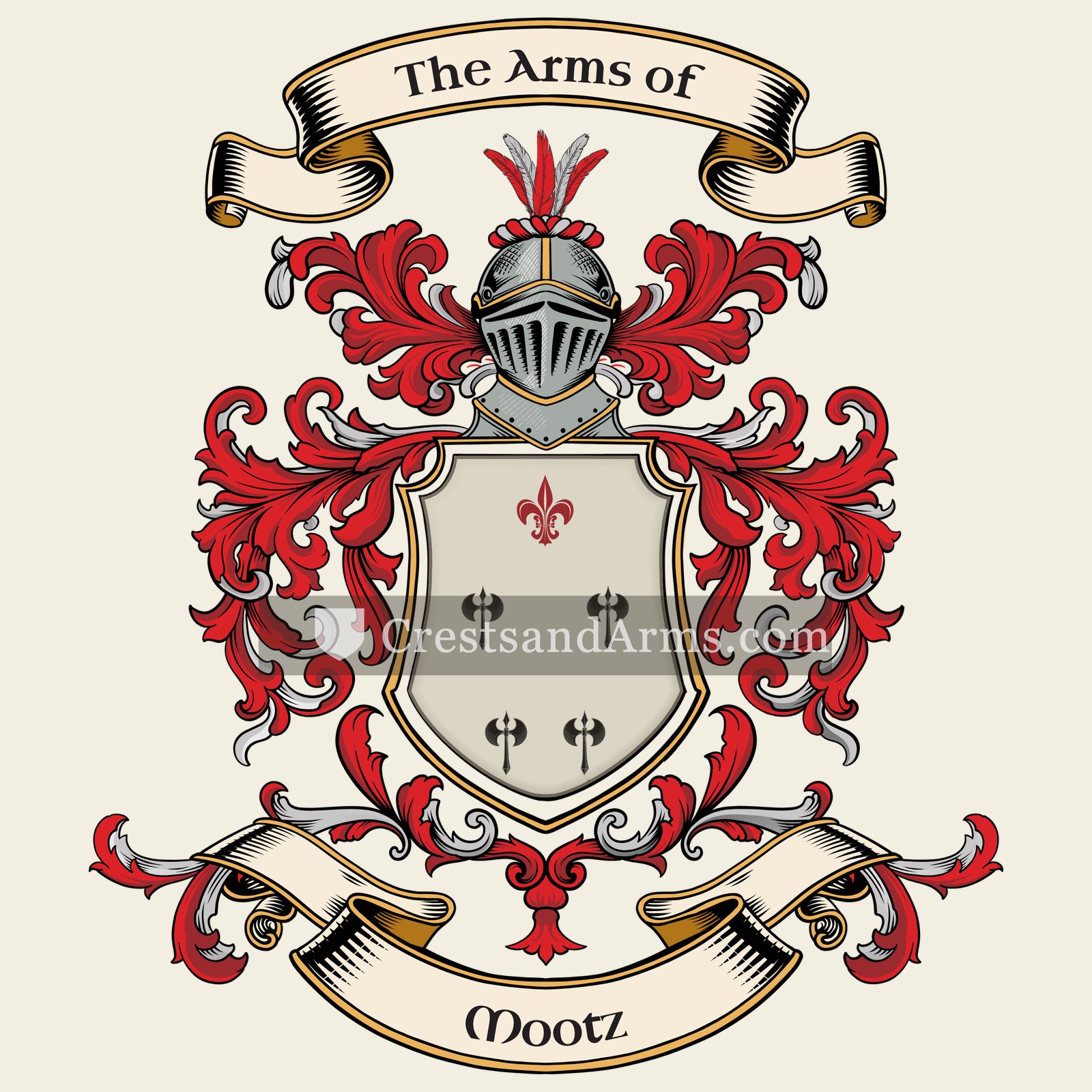
A record of documented arms, meaning and origin, researched for the Mootz family of Germany.
Reg. 2592 · German, M–O
Coat of Arms & Family Crest Details
Symbols on this shield
axeThe execution of military duty
fleur de lisPurity, light, and the sixth son
Colours
Silver (Argent)Means: Peace and sincerity
Black (Sable)Means: Constancy
Red (Gules)Means: Military strength
Historical info
Source
J. B. Rietstap, Armorial Général, Gouda: G. B. van Goor Zonen, 1884–87
Blazon (the actual original written record)
“D'arg. à quatre haches d'armes de sa., emm. d'or, disposées en saut., le bout des manches dirigé vers le coeur de l'écu; le tout acc. en chef d'une fleur-de-lis de gu. Cq. cour. C.: un loup iss. d'or, accosté de deux pennons adossés, d'arg. et d'or, attachés à des lances d'or. L.: à dextre d'or et de sa., à sen. d'arg. et de gu.”
HesseHesse, c. 1780
Digital archive packCoat of arms PNG, gold border print PDF, vector SVG and the certificate of authenticity. Sent to your email in minutes.
Map of Germany showing where the Mootz arms are recorded
The Mootz arms were recorded in Hesse, c. 1780.
Hesse was central German country, divided among a large number of small landowners and prosperous towns. So many separate households held ground there that the region produced an unusual number of coats of arms.
This is where the arms were entered in the register. Families often moved to other parts of the country, so the same name can turn up in more than one region.
The body that granted and recorded arms in Germany in this period.
Joseph II, Holy Roman Emperor
Sovereign of the period
Joseph II, Holy Roman Emperor
1765–1790
Reigning in Germany when the Mootz arms are first recorded.
How Arms Worked in Germany
In the Holy Roman Empire, coats of arms were often granted to individuals by the Emperor or his representatives. These arms were then passed down through the generations to all legitimate descendants of the original holder. Younger branches of a family usually kept the same shield design without needing to change it, as the arms belonged to the entire lineage.
Granting authority
The Holy Roman Emperor held the sole power to grant new coats of arms throughout his vast imperial territories.
How they got arms
Families typically obtained their coats of arms through a formal imperial grant or by proving their noble status to the authorities.
Where arms were recorded
These grants were officially recorded in the Imperial Chancery registers, which began keeping formal records of such honors during the Middle Ages.
The family's standing
Recorded among the armigerous families of Hesse.
Origin & History of the Mootz Family in Germany
The family name Mootz is deeply rooted in the historical region of Hesse, Germany, where records confirm the presence of family members by the year 1780. The name likely originated as a variant of older Germanic names or descriptive terms used to identify individuals in rural communities. During the late 18th century, the people of Hesse lived in a landscape defined by small farming villages and local trade networks. Families like the Mootz clan were often tied to the land, working as skilled craftsmen or agricultural laborers who helped sustain the local economy. As the region underwent shifts in governance and social structure, the family name became a permanent marker of their heritage in the central German highlands. Over time, the name traveled through these local communities, reflecting the quiet but steady history of families who built their lives in the heart of the Holy Roman Empire.
Mootz Meaning & Related Branches
Root word
Matthaeus
Derived from the Hebrew name Matityahu meaning gift of God.
This name
MootzA German diminutive form of Matthew, historically used as a nickname for someone named Matthias.
also spelled
Moetz
Mots
Documented Sources
J. B. Rietstap, Armorial Général, Gouda: G. B. van Goor Zonen, 1884–87
Hessisches Staatsarchiv Marburg, Kirchenbücher der Pfarrei (Parish registers of the parish), 1780
Bahlow, Hans, Deutsches Namenlexikon: Familien- und Vornamen nach Ursprung und Sinn erklärt, 1967
Gottschald, Max, Deutsche Namenkunde: Unsere Familiennamen nach ihrer Entstehung und Bedeutung, 1954
Digital archive packCoat of arms PNG, gold border print PDF, vector SVG and the certificate of authenticity. Sent to your email in minutes.


 axeThe execution of military duty
 fleur de lisPurity, light, and the sixth son
 axeThe execution of military duty
 fleur de lisPurity, light, and the sixth son