Map of Portugal showing where the Mora arms are recorded
The Mora arms were recorded in Portugal, c. 1706.
Arms such as these were typically recorded in Lisboa.
Lisbon was the seat of the Portuguese crown and the port its wealth came through. Families made rich by trade and by service to the king took arms, and the crown's heralds recorded them there.
This is where the arms were entered in the register. Families often moved to other parts of the country, so the same name can turn up in more than one region.
The body that granted and recorded arms in Portugal in this period.
Peter II of Portugal
Sovereign of the period
Peter II of Portugal
1683–1706
Reigning in Portugal when the Mora arms are first recorded.
How Arms Worked in Portugal
In Portugal, a coat of arms was a family possession that passed from a father to his children. Every legitimate descendant had the right to use the family shield without needing to change it. Younger branches of the family kept the original design, though they sometimes added small symbols to distinguish their specific line from the main branch.
Granting authority
The Cartório da Nobreza acted as the official body that managed and regulated noble titles and coats of arms in Portugal.
How they got arms
Families typically inherited their arms through bloodline, though they could also receive new grants from the crown for distinguished service.
Where arms were recorded
Coats of arms were officially recorded in the books of the Cartório da Nobreza starting in the year 1512.
The family's standing
Recorded among the armigerous families of Portugal.
Origin & History of the Mora Family in Portugal
The surname Mora has deep roots in the Iberian Peninsula, where it often functioned as a topographic name for families living near a moor or a dark, wooded area. By the early 18th century, the family had established a clear presence in the bustling capital of Lisboa. During this era, the city was a major center for trade and colonial administration, placing the Mora family at the heart of the Portuguese Empire’s social and economic life. Records from 1706 indicate that members of the family were integrated into the urban fabric of the capital, likely participating in the merchant guilds or the administrative offices that defined life in the city after the restoration of the Portuguese throne. Their residency in Lisboa suggests a family that was well-positioned to navigate the complex social hierarchies of the time, moving through the city’s parishes and contributing to the growth of a nation that was then looking toward its vast overseas territories.
Coat of Arms & Family Crest Details
Symbols on this shield
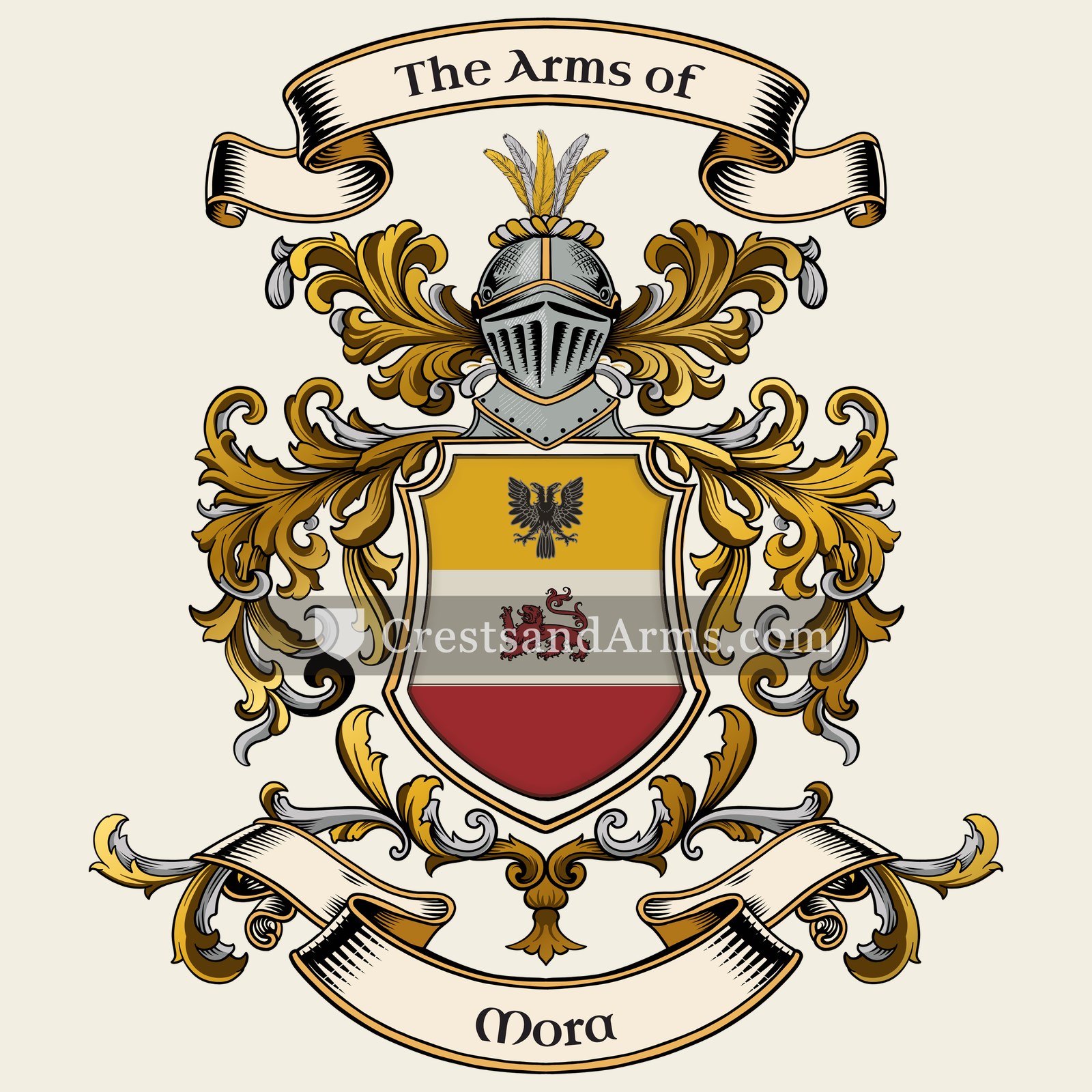
bendDefence, and the scarf of a commander
eagleNobility, strength and a keen mind
lionCourage, strength and royalty
Colours
Gold (Or)Means: Generosity
Silver (Argent)Means: Peace and sincerity
Red (Gules)Means: Military strength
Black (Sable)Means: Constancy
Historical info
Source
J. B. Rietstap, Armorial Général, Gouda: G. B. van Goor Zonen, 1884–87
Blazon (the actual original written record)
“Tiercé en fasce: au 1 d'or à l'aigle ép. de sa., chaque tête cour. du champ; au 2 d'arg. au lion léopardé de gu., tenant de sa patte dextre trois roses du même; au 3 bandé de gu. et d'arg.”
VeniceVenice, c. 1775
Digital archive packCoat of arms PNG, gold border print PDF, vector SVG and the certificate of authenticity. Sent to your email in minutes.
Map of Italy showing where the Mora arms are recorded
The Mora arms were recorded in Venice, c. 1775.
Venice ran on trade, and its great families were merchants before they were anything else. The city kept a formal list of its noble houses, and a name on that list carried arms as a matter of record.
This is where the arms were entered in the register. Families often moved to other parts of the country, so the same name can turn up in more than one region.
The body that granted and recorded arms in Italy in this period.
Alvise Giovanni Mocenigo
Sovereign of the period
Alvise Giovanni Mocenigo
1763–1778
Reigning in Portugal when the Mora arms are first recorded.
How Arms Worked in Italy
In the Italian states, coats of arms were often used by noble families to show their status and history. These symbols were passed down through the generations to all legitimate male descendants. Younger branches of a family usually kept the original design but sometimes added small changes to distinguish their specific line from the main branch.
Granting authority
Various local rulers and city governments controlled the use of coats of arms across the different Italian states.
How they got arms
Families often assumed their own arms or received them as official grants from local lords, popes, or city councils.
Where arms were recorded
Arms were recorded in local city archives or private family books rather than in one single national register.
The family's standing
Recorded among the armigerous families of Venice.
Origin & History of the Mora Family in Italy
The name Mora has deep roots in the Italian peninsula, where it evolved as a descriptive term often linked to the physical appearance or the origin of early ancestors. In the context of Venice, where the family was documented as early as 1775, the name frequently appeared in records detailing the lives of merchants and artisans who helped define the city’s maritime economy. During this period, Venice served as a bustling crossroads for trade and cultural exchange, and families like the Mora were often integrated into the complex social fabric of the Venetian Republic. These early family members likely navigated the unique challenges of living in a city built on water, contributing to the local industries that sustained the region. By examining the historical presence of the name in Venetian archives, we gain a clearer picture of a family that was well-established in one of Europe’s most influential centers of commerce and art during the late eighteenth century.
Coat of Arms & Family Crest Details
Symbols on this shield
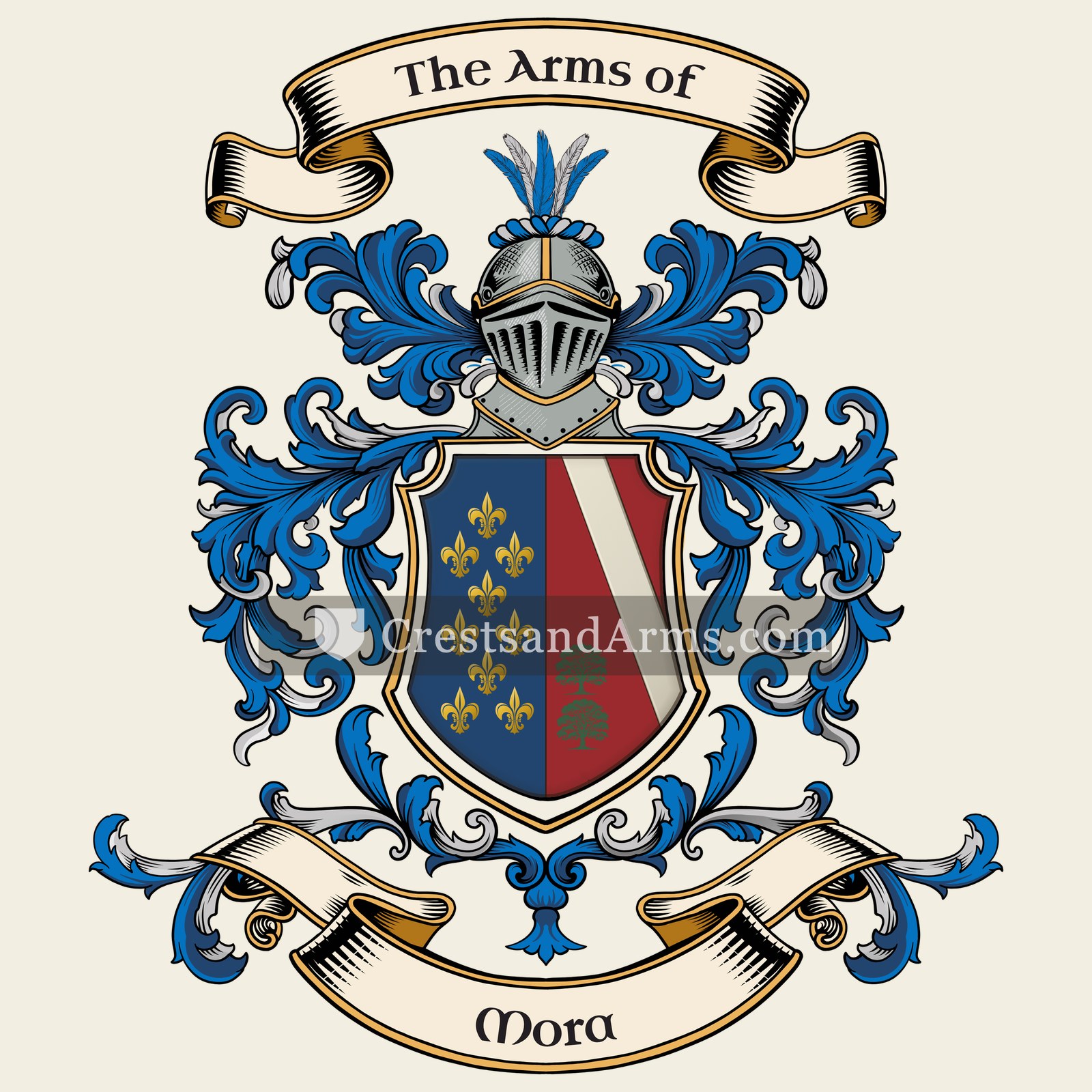
bendDefence, and the scarf of a commander
treeLife, endurance and deep roots
fleur de lisPurity, light, and the sixth son
Colours
Blue (Azure)Means: Loyalty and truth
Red (Gules)Means: Military strength
Silver (Argent)Means: Peace and sincerity
Green (Vert)Means: Hope
Gold (Or)Means: Generosity
Historical info
Source
J. B. Rietstap, Armorial Général, Gouda: G. B. van Goor Zonen, 1884–87
Blazon (the actual original written record)
“Parti: au 1 d'azur à neuf fleurs-de-lis d'or, 1, 2, 1, 2, 1 et 2; au 2 éc.: a. et d. de gu. à la bande d'arg., ch. de trois panelles de sa., posées dans le sens de la bande, les tiges en haut; b. et c. d'or à un arbre arr. de sin.”
SpainAsturies, c. 1722
Digital archive packCoat of arms PNG, gold border print PDF, vector SVG and the certificate of authenticity. Sent to your email in minutes.
Map of Spain showing where the Mora arms are recorded
The Mora arms were recorded in Asturies, c. 1722.
This is where the arms were entered in the register. Families often moved to other parts of the country, so the same name can turn up in more than one region.
The body that granted and recorded arms in Spain in this period.
Philip V of Spain
Sovereign of the period
Philip V of Spain
1714–1724
Reigning in Portugal when the Mora arms are first recorded.
How Arms Worked in Spain
In Spain, a coat of arms was considered a form of property that belonged to the entire family line. These arms were passed down from a father to all his children equally. Younger branches of the family usually kept the original design without needing to add any special marks to distinguish their specific line.
Granting authority
The Cronista Rey de Armas was the official body that regulated and granted coats of arms throughout Spain.
How they got arms
Families often obtained their arms through royal grants or by proving their noble status to the official heraldic authority.
Where arms were recorded
Coats of arms were officially recorded in the registers of the Cronista Rey de Armas starting in 1496.
The family's standing
Recorded among the armigerous families of Spain.
Origin & History of the Mora Family in Spain
The surname Mora is deeply rooted in the history of the Iberian Peninsula, originating from the Latin word *mora*, which refers to a blackberry or a delay. In the context of medieval Spain, the name often identified families living near mulberry trees or those who resided in towns named Mora, which were common throughout the regions of Toledo and Castile. By the early 18th century, the family had established a notable presence in the northern region of Asturias. During this period, Asturias served as a vital cultural and social landscape where families often held land or participated in local administration. The presence of the Mora family in Asturias by 1722 suggests they were part of the regional social fabric that helped shape the local economy and community life during the Bourbon restoration. These early ancestors likely navigated the transition from rural agricultural life to the more structured social hierarchies that defined Spanish provincial society in the 1700s.
Mora Meaning & Related Branches
Root word
Morus
Latin term referring to the mulberry tree.
This name
MoraA topographic surname for someone who lived near a mulberry tree or a place named Mora.
also spelled
Morra
Morah
Morae
Related arms
Brentano di Tremezzosimilar arms
Brentano-Gnossosimilar arms
Calderarisimilar arms
Mauravariant spelling
Documented Sources
J. B. Rietstap, Armorial Général, Gouda: G. B. van Goor Zonen, 1884–87
Sanches de Baena, Visconde de Sanches de Baena, Archivo Heraldico-Genealogico, 1872
Mattoso, José, A Nobreza Medieval Portuguesa: A Família e o Poder, 1981
Arquivo Nacional da Torre do Tombo, Registos Paroquiais de Lisboa
Arquivo Nacional da Torre do Tombo, Chancelaria de D. João V
Digital archive packCoat of arms PNG, gold border print PDF, vector SVG and the certificate of authenticity. Sent to your email in minutes.


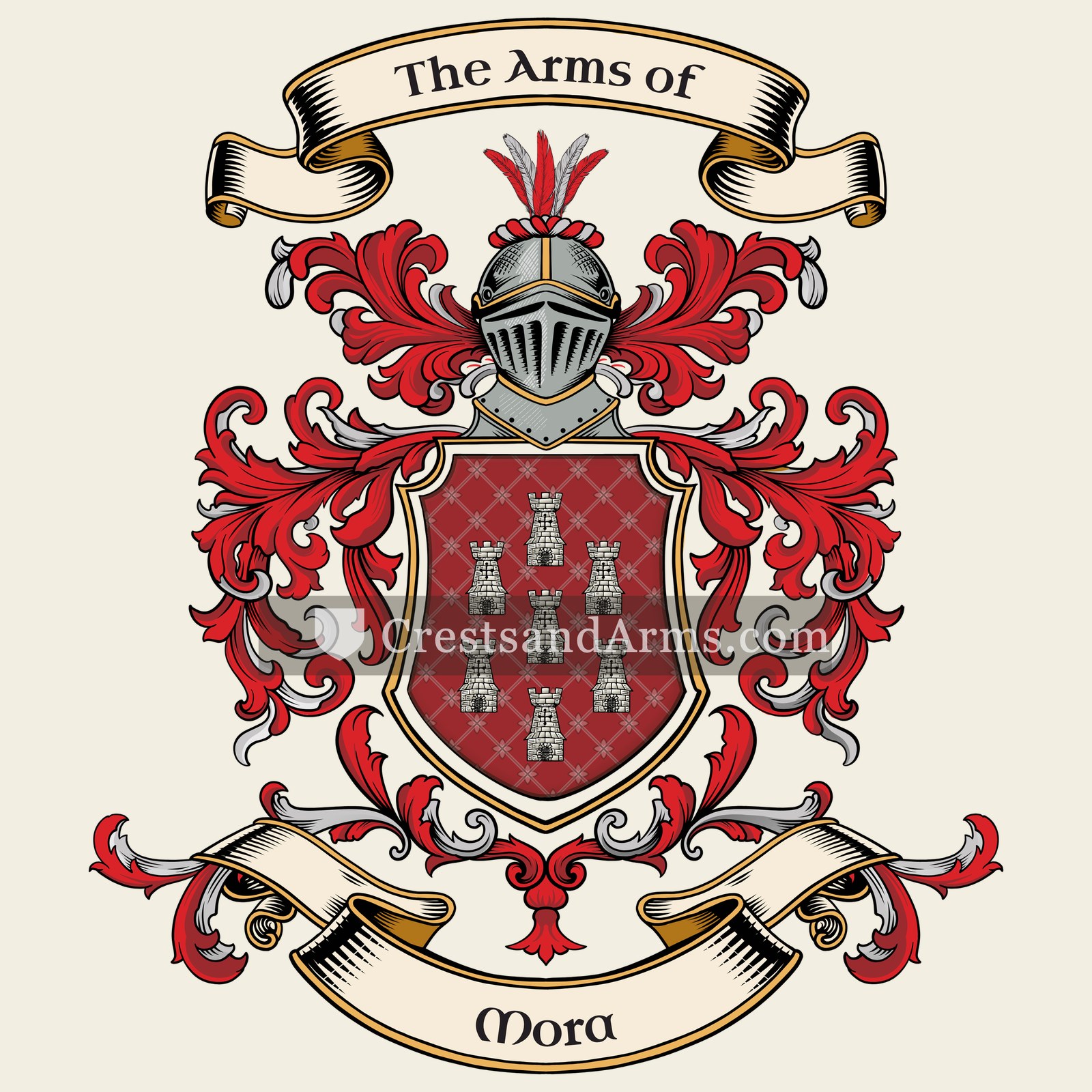
 towerGrandeur and solidity, and a stronghold defended
 towerGrandeur and solidity, and a stronghold defended


 bendDefence, and the scarf of a commander
 eagleNobility, strength and a keen mind
 lionCourage, strength and royalty


 treeLife, endurance and deep roots
 fleur de lisPurity, light, and the sixth son