Map of Spain showing where the Moran arms are recorded
The Moran arms were recorded in Asturies, c. 1722.
This is where the arms were entered in the register. Families often moved to other parts of the country, so the same name can turn up in more than one region.
The body that granted and recorded arms in Spain in this period.
Philip V of Spain
Sovereign of the period
Philip V of Spain
1714–1724
Reigning in Spain when the Moran arms are first recorded.
How Arms Worked in Spain
In Spain, a coat of arms was considered a form of property that belonged to the entire family line. These arms were passed down from a father to all his children equally. Younger branches of the family usually kept the original design without needing to add any special marks to distinguish their specific line.
Granting authority
The Cronista Rey de Armas was the official body that regulated and granted coats of arms throughout Spain.
How they got arms
Families often obtained their arms through royal grants or by proving their noble status to the official heraldic authority.
Where arms were recorded
Coats of arms were officially recorded in the registers of the Cronista Rey de Armas starting in 1496.
The family's standing
Recorded among the armigerous families of Spain.
Origin & History of the Moran Family in Spain
The family name Moran has deep roots in the rugged landscape of northern Spain. By the early 18th century, records confirm that members of the family were well established in the region of Asturias. This area was historically significant because it served as a stronghold for Christian kingdoms during the Middle Ages. Families living in Asturias during this period often worked as farmers or local landowners in the mountain valleys. The name itself is thought to be topographic, likely describing people who lived near a moor or a dark, rocky hill. As the family grew, they became part of the local social fabric, participating in the parish life and agricultural traditions that defined Asturian society in 1722 and the years that followed.
Coat of Arms & Family Crest Details
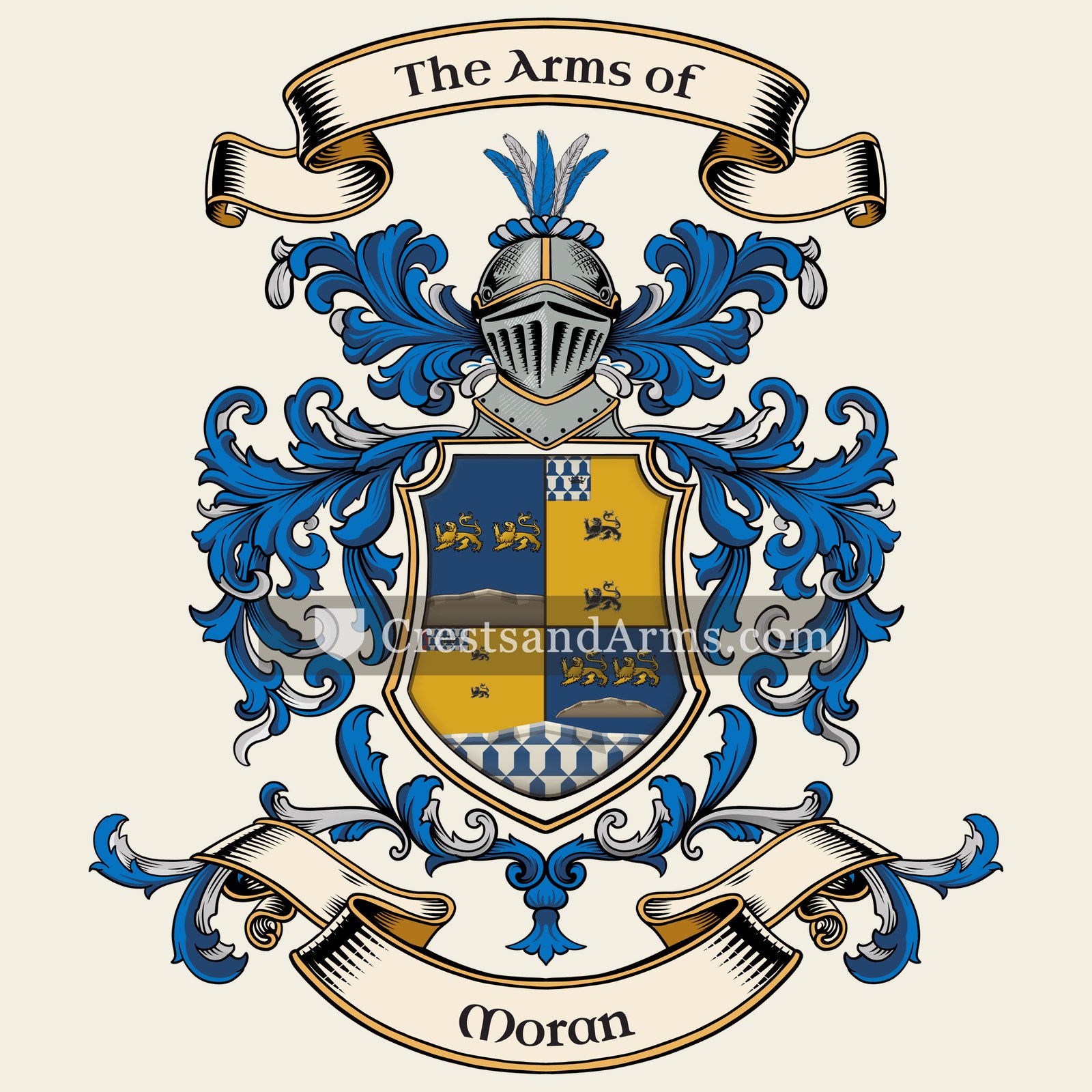
Symbols on this shield
mountThe ground held, and steadfastness upon it
cantonA mark of honour granted by the sovereign
lionCourage, strength and royalty
crownSovereignty, authority and just reward
Colours
Blue (Azure)Means: Loyalty and truth
Gold (Or)Means: Generosity
Red (Gules)Means: Military strength
Black (Sable)Means: Constancy
Historical info
Source
Sir Bernard Burke, The General Armory of England, Scotland, Ireland and Wales, London: Harrison & Sons, 1884
Blazon (the actual original written record)
“Quarterly, 1st and 4th, az. on a mount ppr. two lions combatant or, supporting a flag staff also ppr. therefrom a flag ar., for Moran; 2nd and 3rd, or, two lions pass. in pale sa. on a canton gu. an ancient Irish crown of the first, for O'Rourke”
LeitrimLeitrim, c. 1645
Digital archive packCoat of arms PNG, gold border print PDF, vector SVG and the certificate of authenticity. Sent to your email in minutes.
Map of Ireland showing where the Moran arms are recorded
The Moran arms were recorded in Leitrim, c. 1645.
Leitrim was poor, narrow Irish country of lake and mountain. Its landed families were few, but those who held ground held it for a very long time.
This is where the arms were entered in the register. Families often moved to other parts of the country, so the same name can turn up in more than one region.
The body that granted and recorded arms in Ireland in this period.
Charles I of England
Sovereign of the period
Charles I of England
1625–1649
Reigning in Spain when the Moran arms are first recorded.
How Arms Worked in Ireland
The Ulster King of Arms granted coats of arms to individuals who proved their social standing and good character. These symbols were typically inherited by all legitimate descendants of the original holder. If a family branch wanted a unique look, they could apply for a specific change to their design through the office to ensure their identity remained distinct.
Granting authority
The Ulster King of Arms acted as the official body that regulated and issued all coats of arms throughout Ireland.
How they got arms
Families obtained their arms through formal grants issued by the office after proving their eligibility and paying the required fees.
Where arms were recorded
All official grants were recorded in the registers held by the Ulster King of Arms starting from the year 1552.
The family's standing
Recorded among the armigerous families of Leitrim.
Origin & History of the Moran Family in Ireland
The surname Moran has deep roots in the Irish landscape, particularly within the province of Connacht. The name is an anglicized version of the Gaelic Ó Móráin, which translates to descendant of Mórán, a personal name derived from the word for great or large. By the mid-seventeenth century, historical records confirm that the family held a significant presence in County Leitrim. During this era, the Moran family was closely associated with the local Gaelic social structure, often serving as hereditary stewards or keepers of lands for regional chieftains. As the political landscape of Ireland shifted under the influence of the seventeenth-century plantations, many families like the Morans faced the challenge of maintaining their ancestral ties to the soil while navigating a changing legal and social system. Their persistence in Leitrim by 1645 highlights a long-standing connection to the region that predates the major upheavals of the Cromwellian era.
Related Branches & Arms
Root word
Moro
Derived from the Latin word maurus meaning dark or moorish.
This name
MoranA topographic name for someone who lived near a moor or a dark-skinned person.
also spelled
Morran
Morane
Morann
Morren
Morin
Related arms
Morinvariant spelling
Fitz-Geraldrecorded with Moran, same area
O'Connor Failgherecorded with Moran, same area
Documented Sources
J. B. Rietstap, Armorial Général, Gouda: G. B. van Goor Zonen, 1884–87
Archivo Histórico Diocesano de Oviedo, Libros Sacramentales de la Parroquia de San Juan de Amandi
Archivo General de Simancas, Catastro de Ensenada
Moll, Francesc de Borja, Els llinatges catalans: Catalunya, País Valencià, Illes Balears, 1959
Faure, Roberto, Diccionario de apellidos españoles, 2001
Digital archive packCoat of arms PNG, gold border print PDF, vector SVG and the certificate of authenticity. Sent to your email in minutes.


 arms pheon arrowheadReadiness for battle, and the broad arrow of the sovereign
 arms pheon arrowheadReadiness for battle, and the broad arrow of the sovereign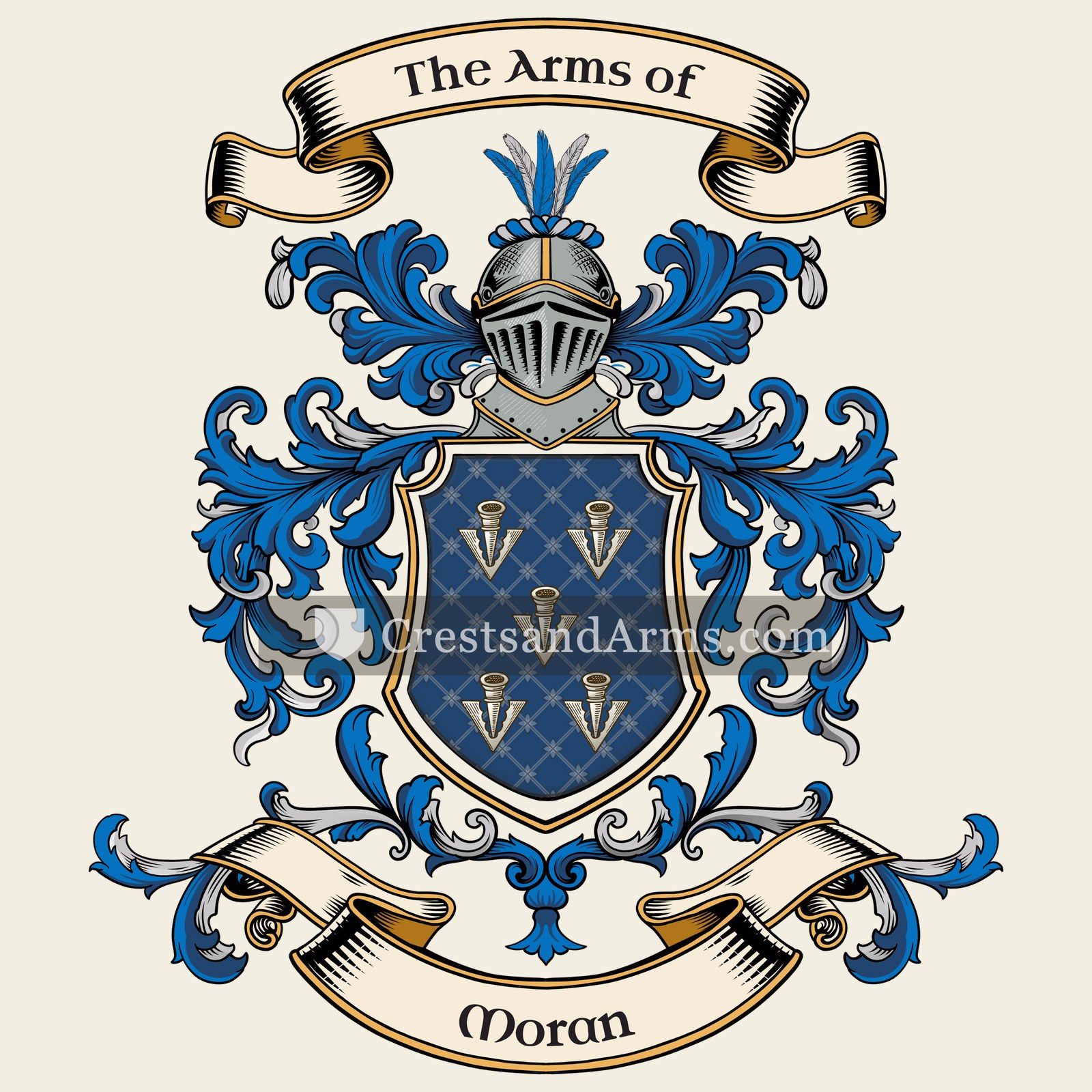


 mountThe ground held, and steadfastness upon it
 cantonA mark of honour granted by the sovereign
 lionCourage, strength and royalty
 crownSovereignty, authority and just reward