Map of Spain showing where the Morani arms are recorded
The Morani arms were recorded in Asturies, c. 1722.
This is where the arms were entered in the register. Families often moved to other parts of the country, so the same name can turn up in more than one region.
The body that granted and recorded arms in Spain in this period.
Philip V of Spain
Sovereign of the period
Philip V of Spain
1714–1724
Reigning in Spain when the Morani arms are first recorded.
How Arms Worked in Spain
In Spain, a coat of arms was considered a form of property that belonged to the entire family line. These arms were passed down from a father to all his children equally. Younger branches of the family usually kept the original design without needing to add any special marks to distinguish their specific line.
Granting authority
The Cronista Rey de Armas was the official body that regulated and granted coats of arms throughout Spain.
How they got arms
Families often obtained their arms through royal grants or by proving their noble status to the official heraldic authority.
Where arms were recorded
Coats of arms were officially recorded in the registers of the Cronista Rey de Armas starting in 1496.
The family's standing
Recorded among the armigerous families of Spain.
Origin & History of the Morani Family in Spain
The Morani family name carries a deep connection to the rugged landscape of northern Spain. Historical records confirm that members of the family were established in the region of Asturias by the year 1722. During this period, Asturias was a mountainous area known for its strong local traditions and its role in the history of the Spanish kingdoms. Families living in these northern territories often worked in agriculture or local administration, helping to build the small communities that defined the rural economy of the eighteenth century. The presence of the Morani name in this specific region suggests that the family was part of the steady social development occurring in the Spanish highlands during the early modern era. By maintaining a presence in Asturias, the family contributed to the regional identity that has shaped the culture of northern Spain for generations.
Meaning of the Morani family crest colors & symbols
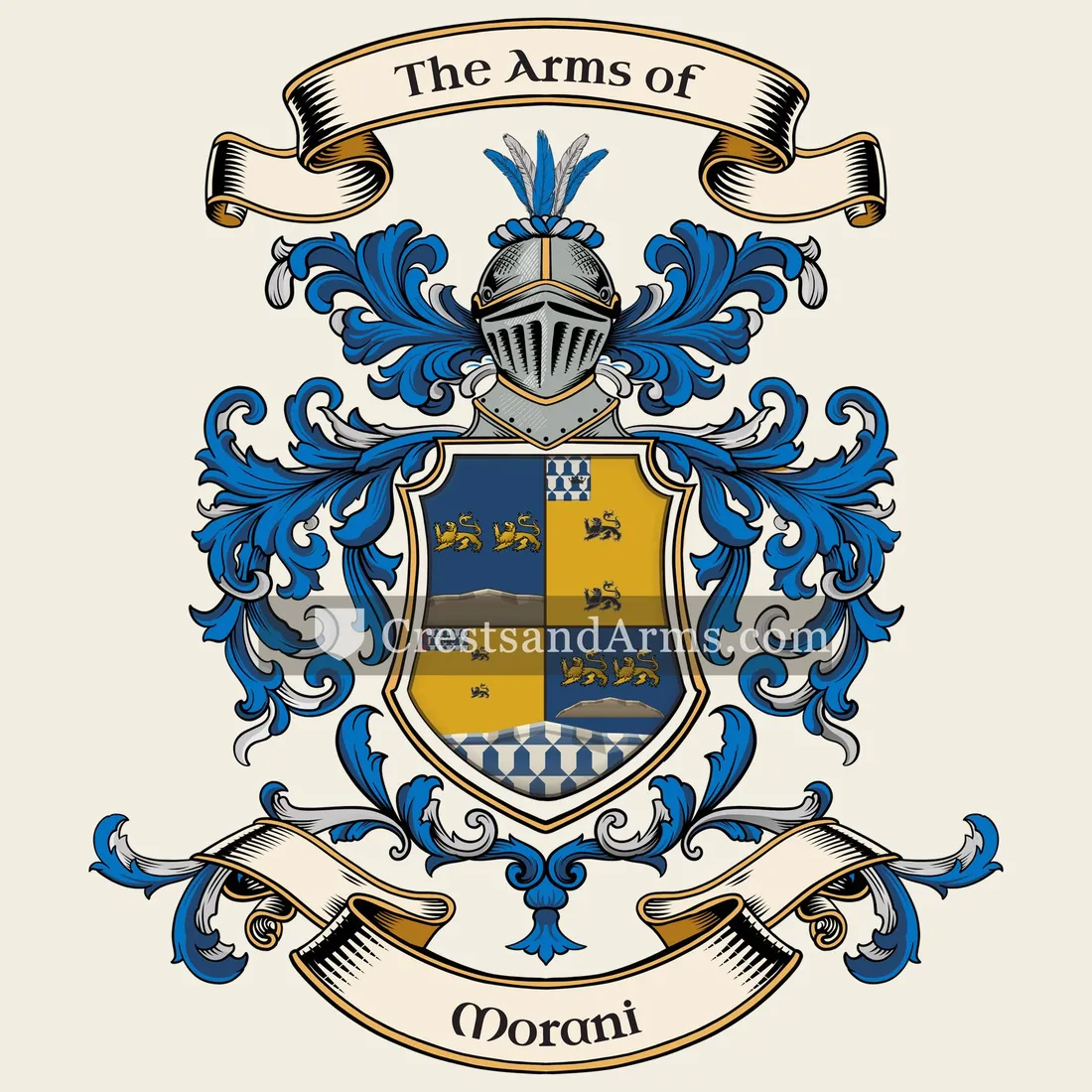
Symbols on this shield
mountThe ground held, and steadfastness upon it
cantonA mark of honour granted by the sovereign
lionCourage, strength and royalty
crownSovereignty, authority and just reward
Colours
Blue (Azure)Means: Loyalty and truth
Gold (Or)Means: Generosity
Red (Gules)Means: Military strength
Black (Sable)Means: Constancy
Historical info
Source
Sir Bernard Burke, The General Armory of England, Scotland, Ireland and Wales, London: Harrison & Sons, 1884
Blazon (the actual original written record)
“Quarterly, 1st and 4th, az. on a mount ppr. two lions combatant or, supporting a flag staff also ppr. therefrom a flag ar., for Moran; 2nd and 3rd, or, two lions pass. in pale sa. on a canton gu. an ancient Irish crown of the first, for O'Rourke”
LeitrimLeitrim, c. 1645
Digital archive packCoat of arms PNG, gold border print PDF, vector SVG and the certificate of authenticity. Sent to your email in minutes.
Map of Ireland showing where the Morani arms are recorded
The Morani arms were recorded in Leitrim, c. 1645.
Leitrim was poor, narrow Irish country of lake and mountain. Its landed families were few, but those who held ground held it for a very long time.
This is where the arms were entered in the register. Families often moved to other parts of the country, so the same name can turn up in more than one region.
The body that granted and recorded arms in Ireland in this period.
Charles I of England
Sovereign of the period
Charles I of England
1625–1649
Reigning in Spain when the Morani arms are first recorded.
How Arms Worked in Ireland
The Ulster King of Arms granted coats of arms to individuals who proved their social standing and good character. These symbols were typically inherited by all legitimate descendants of the original holder. If a family branch wanted a unique look, they could apply for a specific change to their design through the office to ensure their identity remained distinct.
Granting authority
The Ulster King of Arms acted as the official body that regulated and issued all coats of arms throughout Ireland.
How they got arms
Families obtained their arms through formal grants issued by the office after proving their eligibility and paying the required fees.
Where arms were recorded
All official grants were recorded in the registers held by the Ulster King of Arms starting from the year 1552.
The family's standing
Recorded among the armigerous families of Leitrim.
Origin & History of the Morani Family in Ireland
The family name Morani has deep roots in the Irish landscape, with historical evidence placing members of the family in County Leitrim as early as 1645. During this period, Ireland was undergoing significant political and social upheaval, which often forced families to relocate or adapt to changing land ownership laws. The name likely evolved from older Gaelic naming traditions, reflecting the linguistic shifts that occurred as local families interacted with broader administrative changes in the seventeenth century. By establishing themselves in Leitrim, the Morani family became part of the complex social fabric of the west of Ireland, a region defined by its resilient rural communities and strong cultural heritage. Their presence in the mid-1600s suggests they were well-integrated into the local economy and community life during a time when the region was transitioning through intense historical challenges.
Morani Meaning & Related Branches
Root word
Maurus
Derived from the Latin term for a dark-skinned person or Moor.
This name
MoraniA habitational or descriptive surname referring to someone from the Moorish lands or of dark complexion.
also spelled
Morran
Morane
Morann
Morren
Morin
Documented Sources
J. B. Rietstap, Armorial Général, Gouda: G. B. van Goor Zonen, 1884–87
Archivo Histórico Diocesano de Oviedo, Libros Sacramentales de la Parroquia de San Juan de Amandi, 1722
Caveda y Nava, José, Historia de Oviedo, 1844
Fernández Buelta, José María, Asturias en la historia, 1952
Digital archive packCoat of arms PNG, gold border print PDF, vector SVG and the certificate of authenticity. Sent to your email in minutes.


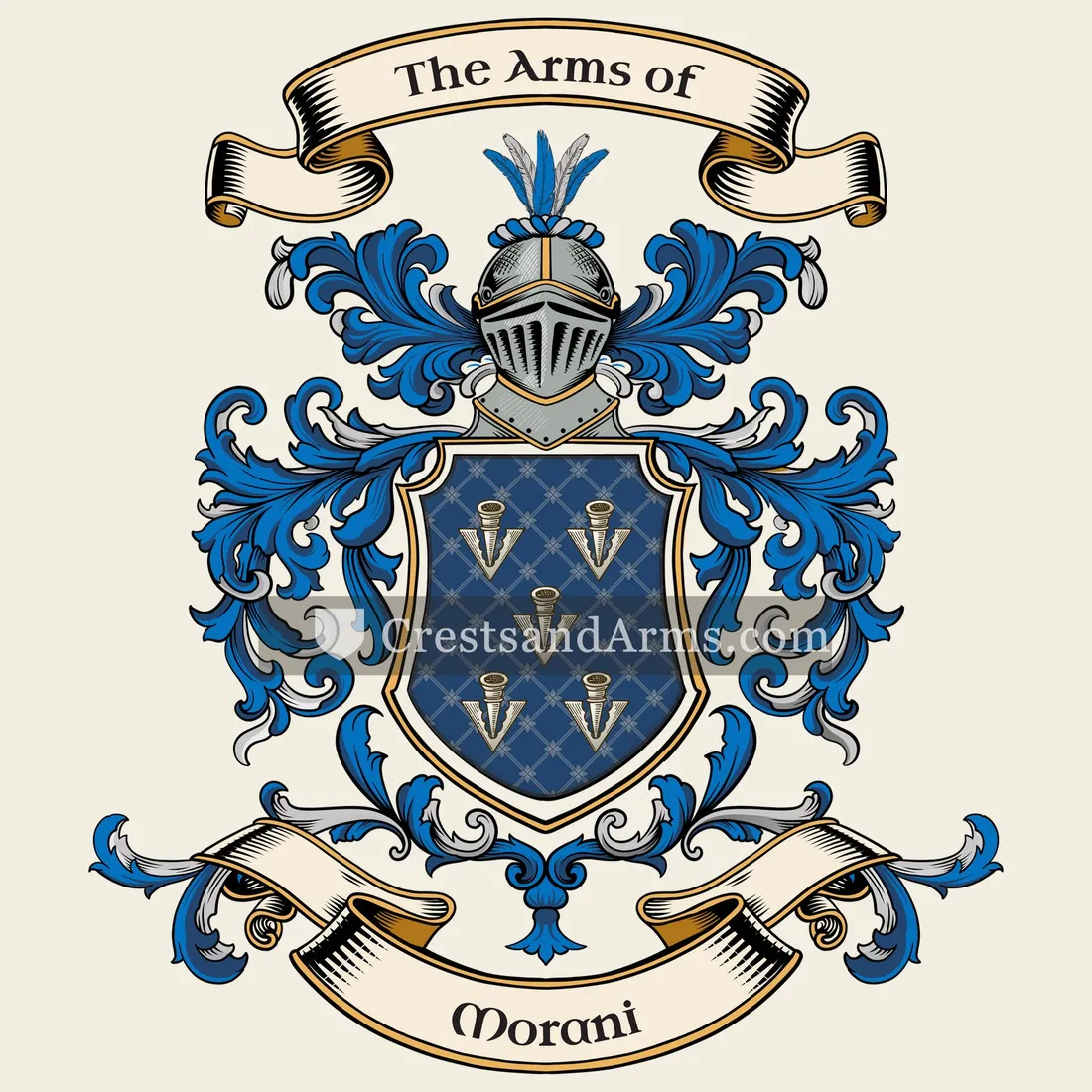
 arms pheon arrowheadReadiness for battle, and the broad arrow of the sovereign
 arms pheon arrowheadReadiness for battle, and the broad arrow of the sovereign


 mountThe ground held, and steadfastness upon it
 cantonA mark of honour granted by the sovereign
 lionCourage, strength and royalty
 crownSovereignty, authority and just reward