Map of Spain showing where the Morano arms are recorded
The Morano arms were recorded in Asturies, c. 1722.
This is where the arms were entered in the register. Families often moved to other parts of the country, so the same name can turn up in more than one region.
The body that granted and recorded arms in Spain in this period.
Philip V of Spain
Sovereign of the period
Philip V of Spain
1714–1724
Reigning in Spain when the Morano arms are first recorded.
How Arms Worked in Spain
In Spain, a coat of arms was considered a form of property that belonged to the entire family line. These arms were passed down from a father to all his children equally. Younger branches of the family usually kept the original design without needing to add any special marks to distinguish their specific line.
Granting authority
The Cronista Rey de Armas was the official body that regulated and granted coats of arms throughout Spain.
How they got arms
Families often obtained their arms through royal grants or by proving their noble status to the official heraldic authority.
Where arms were recorded
Coats of arms were officially recorded in the registers of the Cronista Rey de Armas starting in 1496.
The family's standing
Recorded among the armigerous families of Spain.
Origin & History of the Morano Family in Spain
The surname Morano traces its roots to the rugged landscapes of northern Spain, where it became firmly established in the region of Asturias by the early 18th century. Etymologically, the name is often linked to the Spanish word "moro," which historically referred to people of darker complexion or those with ancestral ties to the Mediterranean. By 1722, records confirm that families bearing this name were active members of the Asturian community, likely engaged in the agricultural or artisanal trades common to the mountainous terrain of the Cantabrian coast. During this era, the social structure of Asturias was deeply tied to local parish records and land ownership, which helped families like the Moranos maintain a distinct identity. As the family grew, they contributed to the unique cultural fabric of the region, blending local traditions with the broader historical shifts occurring across the Spanish peninsula during the Bourbon transition.
Meaning of the Morano family crest colors & symbols
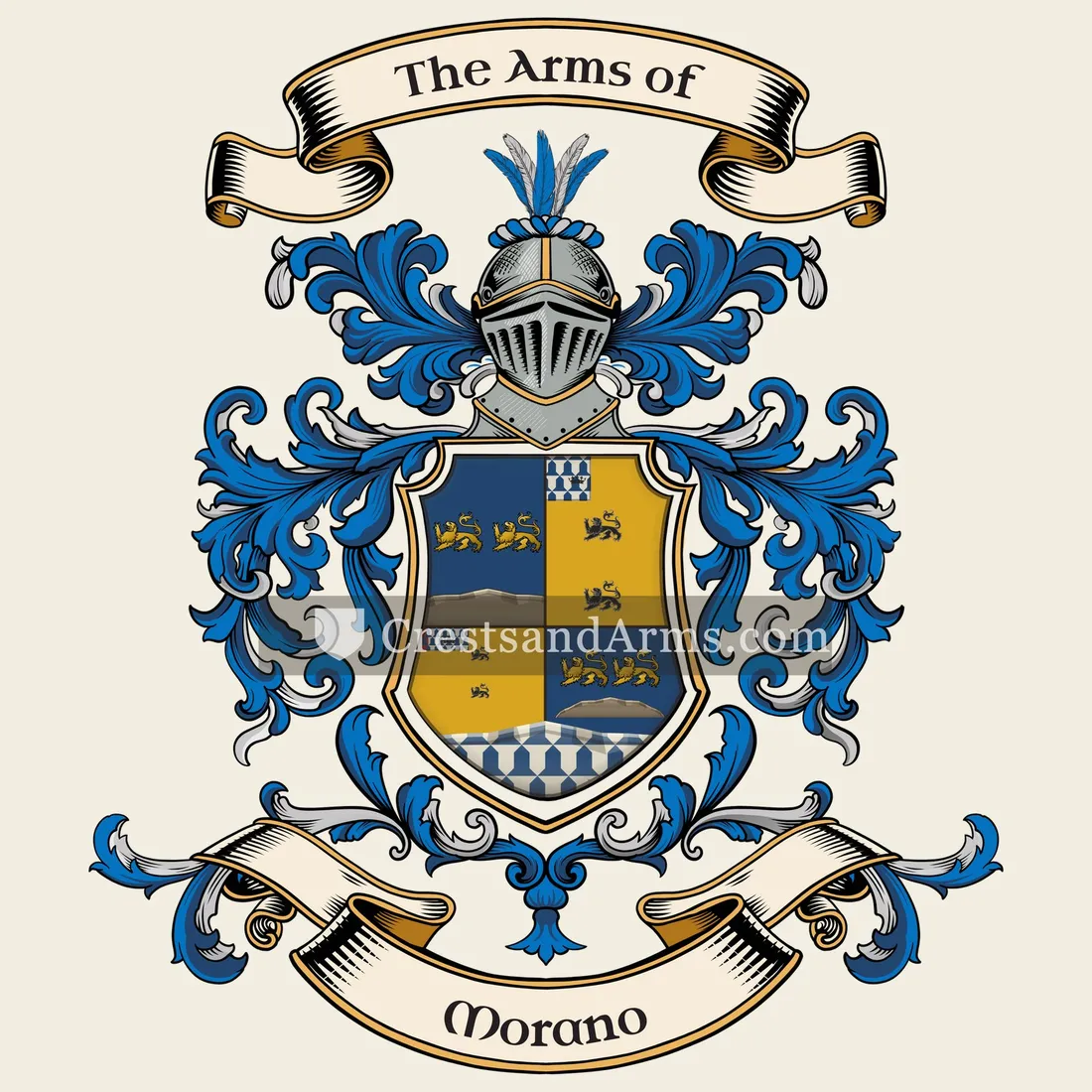
Symbols on this shield
mountThe ground held, and steadfastness upon it
cantonA mark of honour granted by the sovereign
lionCourage, strength and royalty
crownSovereignty, authority and just reward
Colours
Blue (Azure)Means: Loyalty and truth
Gold (Or)Means: Generosity
Red (Gules)Means: Military strength
Black (Sable)Means: Constancy
Historical info
Source
Sir Bernard Burke, The General Armory of England, Scotland, Ireland and Wales, London: Harrison & Sons, 1884
Blazon (the actual original written record)
“Quarterly, 1st and 4th, az. on a mount ppr. two lions combatant or, supporting a flag staff also ppr. therefrom a flag ar., for Moran; 2nd and 3rd, or, two lions pass. in pale sa. on a canton gu. an ancient Irish crown of the first, for O'Rourke”
LeitrimLeitrim, c. 1645
Digital archive packCoat of arms PNG, gold border print PDF, vector SVG and the certificate of authenticity. Sent to your email in minutes.
Map of Ireland showing where the Morano arms are recorded
The Morano arms were recorded in Leitrim, c. 1645.
Leitrim was poor, narrow Irish country of lake and mountain. Its landed families were few, but those who held ground held it for a very long time.
This is where the arms were entered in the register. Families often moved to other parts of the country, so the same name can turn up in more than one region.
The body that granted and recorded arms in Ireland in this period.
Charles I of England
Sovereign of the period
Charles I of England
1625–1649
Reigning in Spain when the Morano arms are first recorded.
How Arms Worked in Ireland
The Ulster King of Arms granted coats of arms to individuals who proved their social standing and good character. These symbols were typically inherited by all legitimate descendants of the original holder. If a family branch wanted a unique look, they could apply for a specific change to their design through the office to ensure their identity remained distinct.
Granting authority
The Ulster King of Arms acted as the official body that regulated and issued all coats of arms throughout Ireland.
How they got arms
Families obtained their arms through formal grants issued by the office after proving their eligibility and paying the required fees.
Where arms were recorded
All official grants were recorded in the registers held by the Ulster King of Arms starting from the year 1552.
The family's standing
Recorded among the armigerous families of Leitrim.
Origin & History of the Morano Family in Ireland
The Morano name in Ireland is deeply connected to the rugged landscapes of County Leitrim, where records confirm the family was established by at least 1645. While the name is often associated with Mediterranean origins, its presence in northwestern Ireland suggests a long history of integration within local Gaelic society. During the mid-seventeenth century, families like the Moranos lived through a period of intense political upheaval as land ownership and social structures shifted across the province of Connacht. By settling in the rural heartlands of Leitrim, these early ancestors became part of the local fabric, likely working as farmers or tradespeople who navigated the challenges of life under the changing rule of the era. Their persistence in this specific region indicates that the family successfully adapted to the local environment and remained a consistent part of the community for generations.
Morano Meaning & Related Branches
Root word
Maurus
Latin term referring to a person from Mauretania or dark-skinned.
This name
MoranoA topographic name for someone living near a moor or a dark-complexioned individual.
also spelled
Morran
Morane
Morann
Morren
Morin
Documented Sources
J. B. Rietstap, Armorial Général, Gouda: G. B. van Goor Zonen, 1884–87
Archivo Histórico Diocesano de Oviedo, Libros Sacramentales de la Parroquia de San Juan de Amandi, 1722
Canella Secades, Fermín, Asturias, 1895
Moll, Francesc de Borja, Els llinatges catalans, 1959
Digital archive packCoat of arms PNG, gold border print PDF, vector SVG and the certificate of authenticity. Sent to your email in minutes.


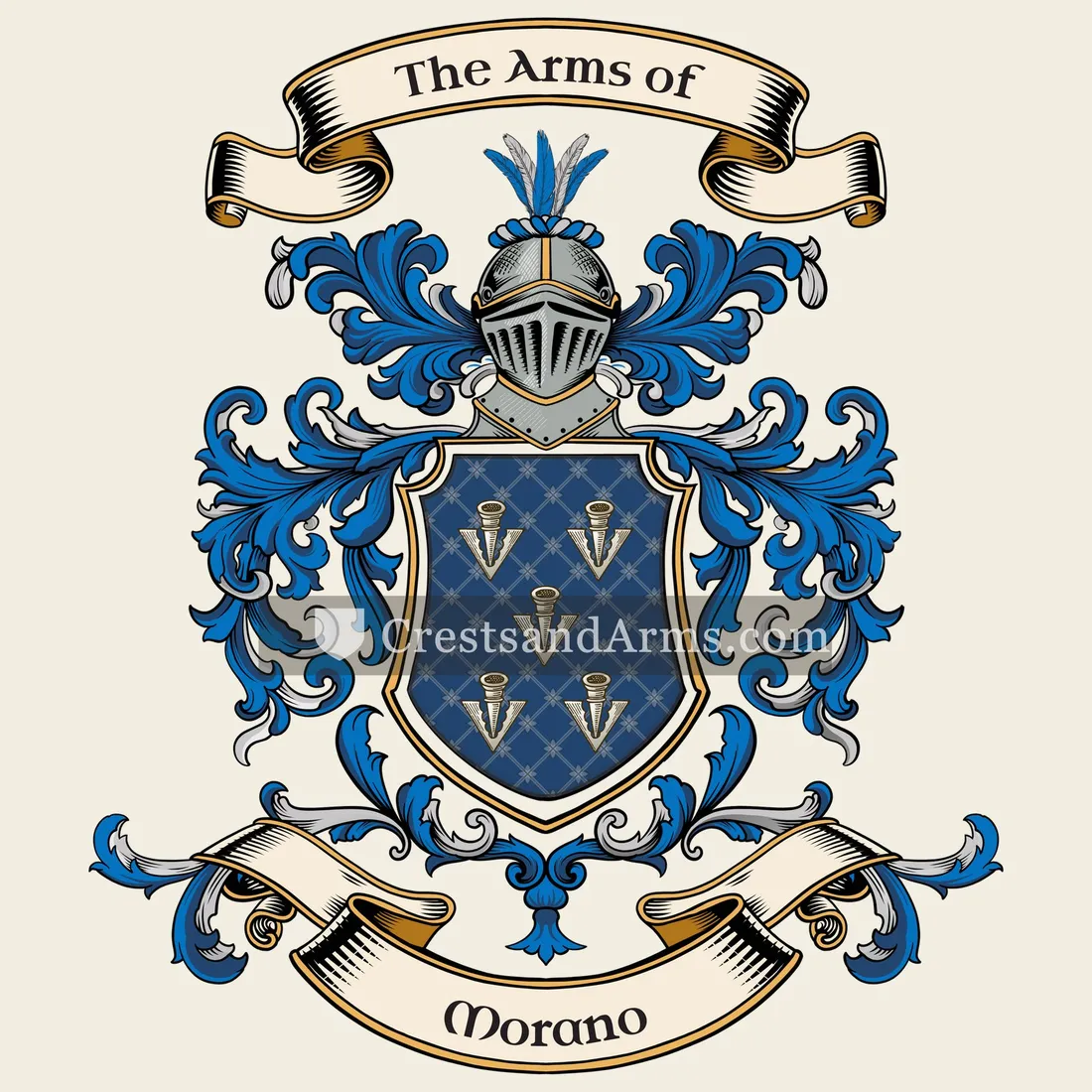
 arms pheon arrowheadReadiness for battle, and the broad arrow of the sovereign
 arms pheon arrowheadReadiness for battle, and the broad arrow of the sovereign


 mountThe ground held, and steadfastness upon it
 cantonA mark of honour granted by the sovereign
 lionCourage, strength and royalty
 crownSovereignty, authority and just reward